
Industries · Battery production & manufacturing
Grade every weld, not just the sample.
Battery modules are built by joining tens to hundreds of cells, and every joint is a potential failure point. A cold joint runs high-resistance and self-heats under load; an over-energised weld can damage the cell. The machine log knows the setpoint, not the outcome.
Recommended setup
Process Monitoring Kit
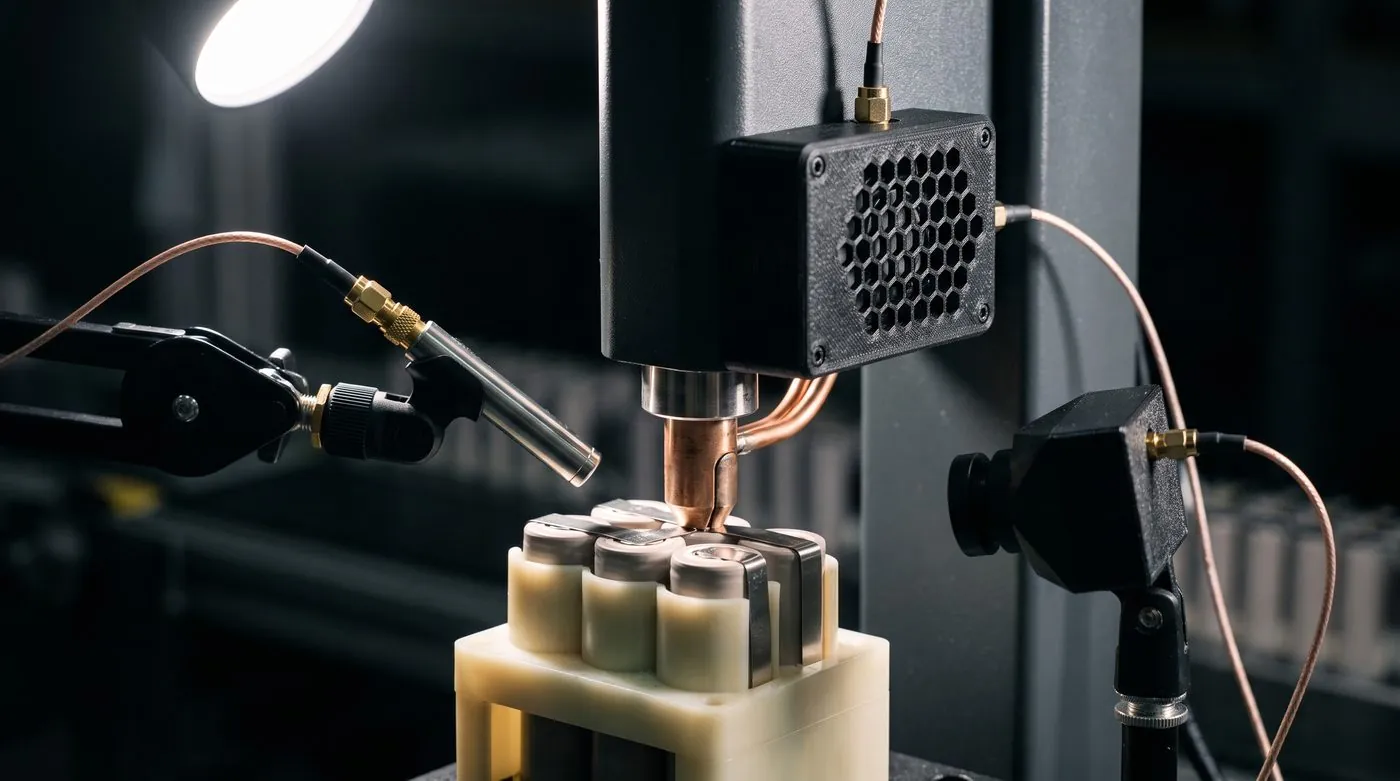
Acoustic Node and Vision Node above the welding station, optionally with a Vibration Node.
What we detect
- Cold welds and expulsion in resistance spot welding
- Deviations in laser weld seams in cell production
- Process deviations from electrode wear, oxidation or the cell-to-busbar gap
How we measure
- Acoustic signature from a measurement microphone (Acoustic Node)
- Vision and thermal imaging of the joint from the Edge AI Hub
- Weld current and voltage from the welding controller, on request
What you get
- One verdict per weld, keyed to the module barcode
- Operator dashboard at the machine; Grafana, OpenSearch and Kafka integration on request
- Entries for the digital battery passport, being developed in DIGIBATT360
Our measurement setup for battery welds
Ultrasonic sensor and data acquisition (DAQ) in one setup, the same we use for battery production. The video shows it from every side.
Digital battery passport: from 18 February 2027, LMT batteries, industrial batteries above 2 kWh and EV batteries placed on the EU market must carry a digital battery passport. In the DIGIBATT360 project we work with VARTA, Fraunhofer IIS, Circulor and VRI on how manufacturing quality evidence gets into it.
Next step
Have your welding line measured?
We record on your machine and tell you in writing whether the signal separates good and bad welds.