Products · Sensor guide

Pick the senses. Build your own AI.

NeuroControls builds the sensing platform: industrial sensors, an edge AI computer and a data logger that records every stream on one shared clock. You choose the sensors your task needs, collect clean, synchronised data and train the application you want.

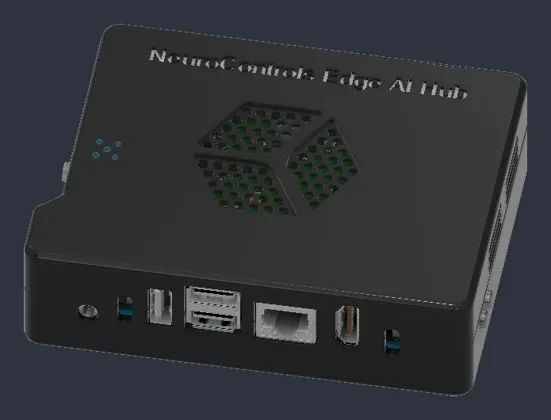
NeuroControls Edge AI Hub, CAD rendering
Edge AI Hub with Qualcomm Dragonwing™ QCS6490. CAD rendering.

How it works

One platform underneath many applications

A chipmaker designs one processor, and thousands of companies build their own products on top of it. We follow the same idea for sensing. The platform below stays the same. Your application on top is your own: a quality check, a maintenance alert, a robot, a research study.

  1. 5

    Your application

    Anomaly detection, fault classification, inspection, tracking or research: trained on your data, owned by you.

  2. 4

    Data quality and analysis software

    Data-quality assessment for every modality. Advanced analysis for vibration and sound, from audible to ultrasonic.

  3. 3

    Synchronised data logging

    Every sensor stream goes into one time-aligned recording, in an open, self-describing format with timing metadata for each sensor.

  4. 2

    Edge AI computer

    Qualcomm Dragonwing™ QCS6490 processor, up to 12 TOPS. Feature extraction on the device; on-device AI models coming soon.

  5. 1

    Sensors

    Cameras, event camera, thermal, depth, microphones, ultrasonic, vibration and motion sensors. Use one, or combine several.

Each node checks its own sensors at the edge: weak signals, drift and dropouts are flagged before they spoil a dataset.

Sensor explorer

What each sensor sees, and where it fits

Filter by what you want to capture. Each card names the sensor, its key specifications, how it connects, and the jobs it is best at.

VisionBuilt to order

IMX900 global-shutter camera

Sharp 3.2 MP images of moving parts, without motion skew.

Resolution
2064 × 1552 px (3.2 MP) datasheet
Shutter
Global datasheet
Pixel size
2.25 µm datasheet
Max frame rate (sensor)
up to 120 fps (8-bit) datasheet
Variants
Colour or monochrome datasheet

Connects Built into the Triple Eye camera head on the hub; also as a Vision Node option

Inline inspectionFast-moving partsWelding process view

Keep in mind Needs light; high data volume at full rate.
VisionBuilt to order

AR0234 global-shutter camera

Full-HD-class colour or mono video for general machine vision.

Resolution
1920 × 1200 px (2.3 MP) datasheet
Shutter
Global datasheet
Pixel size
3.0 µm datasheet
Max frame rate (sensor)
120 fps datasheet

Connects Vision Node option, plugs into the Edge AI Hub

InspectionProcess monitoringLab observation

Keep in mind Needs light; no depth or temperature.

VisionAvailable

OV9281 mono global-shutter camera

Compact 1 MP monochrome camera for tracking, measurement and IR-lit scenes.

Resolution
1280 × 800 px (1 MP) datasheet
Shutter
Global datasheet
Pixel size
3 µm datasheet
Max frame rate (sensor)
120 fps datasheet
Colour
Monochrome datasheet

Connects Edge AI Vision Node, plugs into the Edge AI Hub

TrackingMeasurementNight or IR-lit scenes

Keep in mind No colour information.

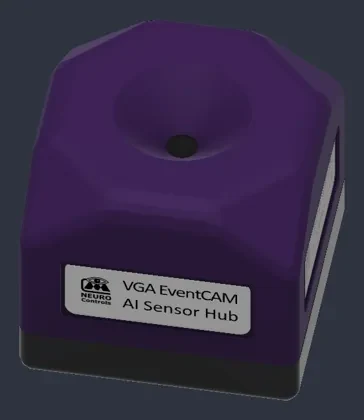
VGA event camera, CAD rendering
Event visionBuilt to order

VGA event camera

Every pixel reports only changes in brightness, with microsecond timing. Blur-free motion at very low data rates in calm scenes.

Resolution
640 × 480 (VGA) datasheet
Max event throughput
450 Mev/s datasheet
Latency
typically < 1 ms datasheet
Dynamic range
~90 dB to ~110 dB datasheet
Built-in IMU
6-axis, synchronised datasheet
Lens
M12 (S-mount) datasheet

Connects Edge AI Event Node, USB-C to the Edge AI Hub

High-speed motionVibration seen by cameraRoboticsGlare and mixed lighting

Keep in mind No ordinary picture of a static scene; needs event-based processing.

Radiometric thermal camera, 160 × 120, CAD rendering
ThermalAvailable

Radiometric thermal camera, 160 × 120

Measures surface temperature for every pixel. Works in total darkness.

Resolution
160 × 120 px datasheet
Spectral range
Long-wave IR, 8–14 µm datasheet
Thermal sensitivity
< 50 mK datasheet
Radiometric
Yes, per-pixel temperature datasheet
Measurement range
−10 to +400 °C (low gain) datasheet
Field of view
57° horizontal datasheet
Frame rate
8.7 Hz datasheet

Connects Built into the Multi-Camera Hub and the Triple Eye head

Hot bearings and motorsElectrical hot spotsBattery and electronicsAnimal welfare

Keep in mind Low resolution; no view through glass; shiny metal needs emissivity correction.

DepthAvailable

VL53L9CX direct time-of-flight depth sensor

A depth map: distance for every zone, from its own infrared light. Works in the dark and shows no faces.

Depth resolution
up to 54 × 42 (≈2,300) datasheet
Range
< 5 cm to 9 m datasheet
Frame rate
up to 100 Hz datasheet
Field of view
54° × 42° (71° diag.) datasheet
Emitter
940 nm VCSEL (invisible) datasheet

Connects Edge AI Depth Node, plugs into the Edge AI Hub

Volume and fill levelRobots and AGVsPresence and occupancyObject positioning

Keep in mind Coarser than a camera; strong sunlight and very dark or shiny surfaces reduce range.

Sound
SoundAvailable

Calibrated measurement microphone

Individually calibrated microphone for repeatable sound recordings across sites.

Type
1/2-inch condenser, omnidirectional datasheet
Calibration
Individual per-unit file datasheet
Sampling
44.1 to 192 kHz datasheet
On the hub
48 kHz, time-aligned with video system

Connects USB-C to the Edge AI Hub

Machine sound signaturesEnd-of-line acoustic testsProcess noise

Keep in mind Picks up surrounding noise; placement matters.

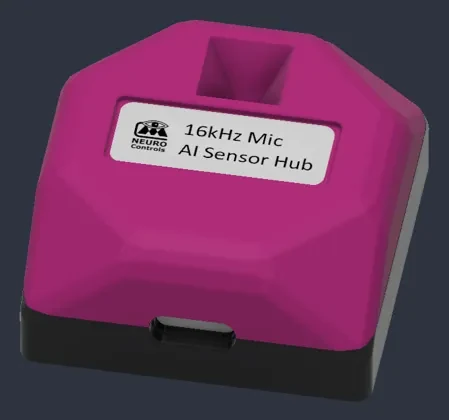
16 kHz MEMS microphone node, CAD rendering
SoundAvailable

16 kHz MEMS microphone node

Compact microphone node for everyday machine and room sound.

Element
Digital MEMS, omnidirectional datasheet
Sampling rate
16 kHz datasheet
Usable bandwidth
up to 8 kHz (half the sampling rate) datasheet
Acoustic overload point
135 dB SPL datasheet

Connects USB-C to the Edge AI Hub

General sound eventsLow-cost multi-point coverage

Keep in mind Not a calibrated measurement microphone; no ultrasonic range.

UltrasoundAvailable

Ultrasonic measurement microphone

Hears far above the human range, where leaks, friction, arcing and welding processes leave clear traces, away from most audible factory noise.

Capsule
1/4-inch, prepolarised datasheet
Capsule frequency range
up to 100 kHz datasheet
Measurement band
2 to 100 kHz system
Signal conditioning
NeuroControls data acquisition system

Connects NeuroControls Acoustic AI and Edge AI Acoustic Node (standalone logger; as a hub node built to order)

Laser welding QALeak detectionFriction and bearing wearElectrical arcing

Keep in mind Short, directional range; aim at the source.

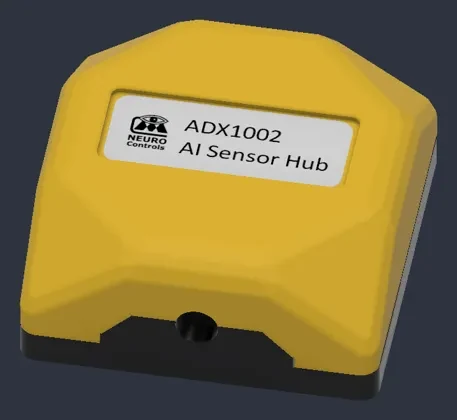
ADXL1002 vibration sensor, CAD rendering
VibrationAvailable

ADXL1002 vibration sensor

Structure-borne vibration straight from the machine housing: the classic input for condition monitoring.

Measurement range
±50 g datasheet
Frequency range (−3 dB)
DC to 11 kHz datasheet
Resonant frequency
21 kHz datasheet
Noise density
25 µg/√Hz datasheet
Axes
Single-axis datasheet
Digitisation
18-bit, 200 kSPS system

Connects Edge AI Vibration Node; network into the hub's recording

Pumps, motors, fansGearboxes and spindlesSpot-welding qualityRail and transport

Keep in mind Needs rigid mounting close to the measuring point, e.g. near the bearing.

Motion (IMU)Built to order

LSM6DSOX motion sensor

Acceleration and rotation in all six axes: tilt, shocks, movement and orientation.

Axes
6 (3 accel + 3 gyro) datasheet
Accel range
±2 to ±16 g datasheet
Gyro range
±125 to ±2000 °/s datasheet
On-chip
Machine-learning core datasheet

Connects Edge AI Wireless Node (IMU), Wi-Fi into the hub's recording

Mobile machinesHandling and transport shocksOrientation of tools

Keep in mind Low bandwidth; not a replacement for a vibration sensor.

Environment & gas
Environment & gasOn request

Environmental sensors

Temperature, humidity, pressure and air quality alongside your process data.

Connects Configured per project

Indoor climateProcess airLab conditions
Environment & gas
Environment & gasOn request

Gas sensors

Detection of selected gases, integrated into the same synchronised recording.

Connects Configured per project

Battery roomsProcess gasesRoom air quality

Keep in mind Not a certified gas warning device.

Sensor specifications are taken from the sensor datasheets. Figures marked “system” are measured on NeuroControls hardware. Images are CAD renderings.

Side by side

How the modalities compare

A quick guide to the strengths of each way of sensing. These are general properties of each modality, not test results.

Swipe sideways to see all columns →

ModalityCapturesIn darknessUpdate rateData ratePersonal dataWatch out for
VisionShape, colour, textureNeeds lightUp to 120 fpsHighCan show peopleLighting changes, motion blur on rolling shutters
Event visionChanges in brightnessDown to low lightMicrosecond timingLow in calm scenesLow identifiabilityNo still image; new processing methods
ThermalSurface temperatureYes8.7 HzLowLow identifiabilityShiny metal reflects heat; no view through glass
DepthDistance per zoneYesUp to 100 HzLowLow identifiabilitySunlight, very dark or mirror-like surfaces
SoundAirborne soundYesContinuousMediumCan capture speechBackground noise
UltrasoundUltrasound up to 100 kHzYesContinuousMedium to highReduced; band starts at 2 kHzDirectional; place close to the source
VibrationStructure-borne vibrationYesContinuousMedium to highNoneNeeds firm mounting
Motion (IMU)Motion, tilt, shockYesContinuousLowNoneLow bandwidth
Environment & gasClimate, air, gasesYesSlowVery lowNoneResponse time of the sensing element

Use-case matrix

Which sensors fit which job

Our recommendations. core sensor for this job · adds useful context. Most strong systems combine two or three modalities.

Swipe sideways to see all sensors →

Use caseVisionEvent visionThermalDepthSoundUltrasoundVibrationMotion (IMU)Environment & gas
Pumps, motors, fans and gearboxes
CNC spindles and tool wear
Laser welding quality
Resistance spot welding quality
Compressed-air and gas leaks
Electrical cabinets: hot spots and partial discharge
Inline visual inspection
High-speed motion analysis
Robots, AGVs and mobile machines
Logistics: pallets and volumes
Presence and occupancy monitoring
Rail wagons, transport and structures
Battery and electronics thermal monitoring
Life-science labs: behaviour and welfare
Indoor climate and process air

Combinations

Modalities that work better together

One sensor answers one question. Combined on one clock, they explain each other: a vibration peak lines up with a hot bearing in the thermal image and a change in sound, in the same second.

Rotating machinery

VibrationUltrasoundThermal

Vibration finds the fault, ultrasound catches it early, thermal confirms the heat.

Welding quality

UltrasoundVisionThermal

The process sound, the seam image and its heat, on one timeline.

Inspection with measurement

VisionDepthThermal

What it looks like, where it is, how hot it is: the Triple Eye in one head.

Fast motion

Event visionMotion (IMU)

Microsecond visual changes paired with the motion of the machine itself.

Presence monitoring

DepthThermal

Presence and distance without identifiable images. Not a safety-rated protective function.

Building blocks

Qualcomm Dragonwing™ QCS6490 hub, CAD rendering
VisionThermalSound
Available

Qualcomm Dragonwing™ QCS6490 hub

The heart of every kit. It connects the sensors and records every stream on one clock. Feature extraction on the device; on-device AI models coming soon.

Processor
Qualcomm Dragonwing™ QCS6490 processor, up to 12 TOPS datasheet
Recording
3 cameras at 100 fps + thermal + 48 kHz audio in one time-aligned file system
Ports
USB, Ethernet, HDMI system
VisionDepthThermal
Built to order

Triple Eye

Camera, depth and thermal stacked in one head and aligned in time. See a part, measure its distance and its temperature together. Also available with an event camera in place of the image camera.

Image
3.2 MP global shutter, or VGA event camera datasheet
Depth
54 × 42 zones system
Thermal
160 × 120 radiometric datasheet
Edge AI Vibration Node, CAD rendering
Vibration
Available

Edge AI Vibration Node

A vibration channel that joins the hub's recording over the network, for machines where structure-borne signals tell the story.

Sensor
±50 g, DC to 11 kHz datasheet
Digitisation
18-bit, 200 kSPS system
UltrasoundSound
Available

NeuroControls Acoustic AI

Acoustic and ultrasonic monitoring on an edge AI unit. Capture band 2 to 100 kHz; production-proven 2 to 20 kHz on a laser-welding line.

Band
2 to 100 kHz; production-proven 2 to 20 kHz system
Use
Inline acoustic quality assurance system

Kits

Every kit is quoted to your configuration. Compare all kits →

Available · Multi-Camera HubBuilt to order · Triple Eye Hub

Starter Kit

Contents Edge AI Hub

The entry point. Add nodes later.

Request a quote
Built to order

Machine Health Kit

Contents Hub + Vibration Node + Acoustic Node

Condition monitoring with vibration, ultrasound and thermal in one system.

Request a quote
Built to order

Process Monitoring Kit

Contents Hub + Acoustic Node + Vision Node (+ Vibration Node)

Inline quality monitoring for welding, built on the measurement chain of our e-LAS+ and e-WAS projects.

Request a quote
Built to order

High-Speed Vision Kit

Contents Hub + Vision Node + Event Node

Global-shutter frames and event-based vision in one system.

Request a quote
Built to order

Multi-Modal Sensing Kit

Contents Hub + Vision, Vibration, Acoustic, Depth and Event Nodes

The full platform: depth, vision, thermal, sound and ultrasound, vibration and events in one system.

Request a quote

Software

From raw streams to training-ready data

Available

Synchronised data logging

Records every connected sensor into one time-aligned dataset, ready for labelling and model training in the tools you already use.

Available

NeuroControls data-quality assessment

Checks every modality before you train: gaps, dropouts, clipping, drift and timing alignment between streams.

Available

Advanced vibration and sound analysis

In-depth analysis for vibration and for sound from audible to ultrasonic. Analysis for further modalities is being added.

Available

Custom model training

Our engineers train anomaly-detection and fault-classification models on your data.

Coming soon

Self-service training framework

Train and update models yourself on the same platform.

Coming soon

On-device AI models

Models running on the hub. Today the device extracts features; models are trained by our engineers.

Next step

Tell us what you want to measure

We help you choose the sensors, set up the kit and collect your first dataset. Every kit is quoted to your configuration.