
Short answer
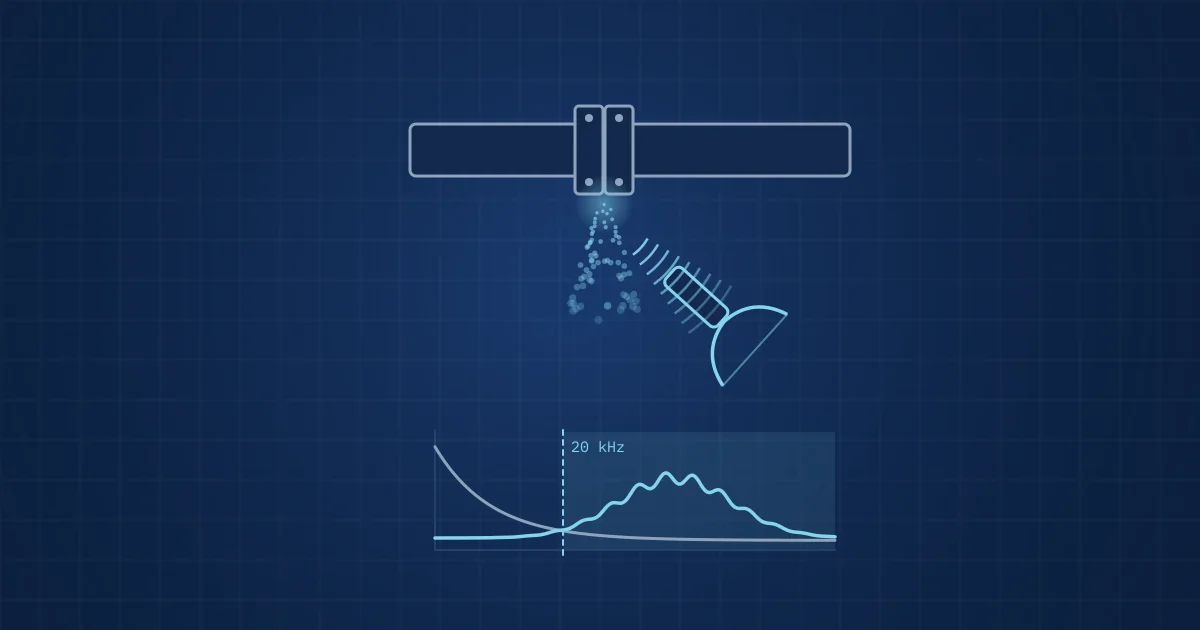
Airborne ultrasound leak detection works because gas escaping through a small opening becomes turbulent and emits broadband sound well above 20 kHz, the upper limit of human hearing. Friction in under-lubricated contacts does the same. Ultrasound is short-wavelength and attenuates quickly in air, so a sensor pointed at the source hears it clearly above the low-frequency noise of a factory and can locate it.
Key takeaways
- Compressed-air leaks can waste 20 to 30 percent of a compressor's output, according to the US Department of Energy, and in its worked example the ten largest leaks deliver almost 70 percent of the savings.
- At 40 kHz the wavelength in air is under 9 mm, which makes ultrasound directional and easy to localise but also quick to fade with distance.
- ISO 29821:2026, which replaced the 2018 edition in April 2026, gives requirements and guidelines for ultrasound condition monitoring, covering airborne and structure-borne ultrasound, severity assessment criteria and reporting.
- Handheld surveys find leaks; continuous ultrasonic monitoring is better suited to friction and process changes that come and go.
Airborne ultrasound leak detection is one of the few condition monitoring techniques that pays for itself in an afternoon. A technician walks the compressed-air network with a handheld detector, hears a hiss nobody else can hear, tags the fitting and moves on. The same physics also reveals friction in bearings, valves and slides, which makes ultrasound a useful companion to vibration analysis.
This article explains why leaks and friction are audible in the ultrasonic band, how to run a survey that produces a repair list rather than a heap of tags, what the relevant standards cover, and when a permanently installed sensor is the better tool.
What airborne ultrasound is
Ultrasound is sound above roughly 20 kHz, beyond the range of human hearing. Airborne ultrasound travels through air to a microphone or ultrasonic transducer. Structure-borne ultrasound travels through solid material to a contact sensor. Both are used in condition monitoring, and ISO 29821:2026, Condition monitoring and diagnostics of machine systems - Ultrasound - General requirements, guidelines, procedures and validation, covers both. Published in April 2026 as the second edition, it replaced ISO 29821:2018. It gives guidelines for establishing severity assessment criteria for anomalies, specifies methods and requirements for ultrasonic inspection, testing, measurement and monitoring of machines, including safety recommendations and sources of error, and provides information on data interpretation, assessment criteria and reporting.
Two properties make the ultrasonic band useful in a factory. First, most machine noise is concentrated at lower frequencies, so a high-pass view of the world is quieter. Second, the short wavelength makes ultrasound directional. At 40 kHz the wavelength in air is about 8.6 mm; at 20 kHz it is about 17 mm. A sensor with a modest aperture already has a narrow acceptance angle, and the source can be found by pointing.
The price is attenuation. Atmospheric absorption rises steeply with frequency, which is why ultrasound fades within metres while low-frequency rumble carries across the hall. ISO 9613-1 gives the method for calculating atmospheric absorption, with formulae that extend to ultrasonic frequencies, as a function of temperature, humidity and pressure.
Why leaks are loud in the ultrasonic band
When gas escapes through a small opening at a high pressure ratio, the jet becomes turbulent. Turbulent mixing produces broadband noise, and for small openings much of the energy lies at high frequencies. Scheuer and DeCorby showed in a 2023 Sensors paper on air-coupled ultrasonic leak detection that high-pressure gas leaks contain frequency content extending far into the megahertz range, well beyond what conventional detectors use.
In practice, handheld instruments work in a band somewhat above 20 kHz and convert the received signal down into the audible range by heterodyning, a frequency-shifting technique borrowed from radio. The technician hears a hiss in headphones and sees a level on a display. The instrument is effectively a narrow-band, directional listening device.
What leaks cost
The US Department of Energy's compressed air tip sheet Minimize Compressed Air Leaks states that leaks often waste as much as 20 to 30 percent of a compressor's output and suggests that a leak level of 5 to 10 percent of total system flow is a typical cost-effective target for industrial facilities. It recommends ultrasonic acoustic detectors because they recognise the high-frequency hissing associated with air leaks.
The same document works through an example plant with 160 leaks of three sizes. At its assumptions of 7,000 operating hours a year, USD 0.05 per kWh and 18 kW per 100 cfm, the 10 largest leaks account for nearly 70 percent of the savings. The lesson transfers directly to European plants with higher energy prices: survey thoroughly, but repair in order of size.
For a structured assessment of the whole system, from compressor to point of use, ISO 11011:2013 defines how to carry out and report a compressed-air energy efficiency assessment covering supply, transmission and demand. Since August 2026 ISO lists it as to be revised, with a successor under development.
A leak survey procedure that produces repairs
- Choose the time. Survey during production for realistic pressures, and again at a quiet time such as a weekend to hear leaks masked by machine noise.
- Map the network. Work from the compressor room outwards: headers, drops, filter-regulator-lubricator units, hoses, quick couplings and machine connections.
- Scan, then pinpoint. Scan with the open sensor to find the area, then switch to a focusing probe or tube to pin the leak to one fitting.
- Check for reflections. Ultrasound reflects off hard surfaces. Confirm the source by approaching from a second direction.
- Grade each leak. Record the level, distance and pressure, and estimate the flow class with the instrument's method or a simple size scale.
- Tag and photograph. Attach a numbered tag and log the location so maintenance can find it.
- Repair largest first. Sort the list by estimated flow, not by convenience.
- Verify and repeat. Re-check repaired points and repeat the survey at a fixed interval, because leaks return.
The DOE tip sheet lists the usual suspects: couplings, hoses, tubes, fittings, pipe joints and quick disconnects, plus filter-regulator-lubricator units, condensate traps, valves, flanges, packings, thread sealants and point-of-use devices.
Friction and lubrication: ultrasound on rotating parts
Friction between surfaces in relative motion produces high-frequency sound for the same reason a leak does: many small, fast events add up to broadband noise. In a rolling element bearing, a healthy lubricant film keeps the level low. When the film thins, metal-to-metal contact raises the ultrasonic level. Over-greasing can also raise it, through churning and heat.
That gives two practical uses:
- Condition-based lubrication. A technician listens while greasing and stops when the level drops to its baseline, instead of injecting a fixed volume on a schedule.
- Early bearing distress. A rising ultrasonic level on a bearing that still looks normal in velocity trends is often the first sign of lubrication trouble. Impacts from spalls then show up in envelope spectra, as explained in our guide to bearing fault frequencies.
Valves and steam traps are a third application. A valve that should be closed but passes flow makes a turbulent sound, and a trap that blows through sounds different from one that cycles.
| Application | Source of ultrasound | What changes when there is a problem | Typical approach |
|---|---|---|---|
| Compressed-air and gas leaks | Turbulent jet at the opening | New, localised broadband source | Periodic handheld survey |
| Bearing lubrication | Friction in the contact | Level rises above baseline | Route-based or continuous trend |
| Valves and steam traps | Flow through a seat or orifice | Sound when there should be silence, or a changed pattern | Contact or airborne check |
| Slides and guides | Sliding friction | Level and pattern change with wear or contamination | Continuous monitoring during motion |
Handheld survey or fixed sensor?
A handheld detector is the right tool for leaks. Leaks are static, a survey covers a whole network, and the person carrying the instrument provides the localisation.
Fixed sensors earn their place where the problem is intermittent, tied to a process step, or on equipment nobody can reach while it runs. Friction on a slide that appears only on the return stroke, a valve that leaks only at one point in the cycle, or a bearing in a guarded enclosure are better watched continuously. A fixed sensor also creates a trend, which a survey cannot. As we argue in why single-sensor monitoring misses faults, ultrasound is most convincing when it confirms or contradicts what vibration and temperature say, for example a warm bearing in a thermal image.
How NeuroControls approaches this
Our Acoustic Node uses a Microtech Gefell MK 301 E measurement capsule, specified in its datasheet from 5 Hz to 100 kHz. The node's capture band runs from 2 to 100 kHz, so it records the lower ultrasonic range alongside audible sound. To be precise about maturity: the band from 2 to 20 kHz is the one proven in production so far, and ultrasonic applications above it are project work. Our article on acoustic vs vibration monitoring explains when a microphone is the right sensor in the first place.
The Acoustic Node is available as a standalone logger and built to order as a node on the Edge AI Hub, where it can be combined with vibration in the Machine Health Kit. Each node reports its signal health and dropouts with the data, as described on our cognitive sensors page. The condition monitoring solution shows how acoustic, ultrasonic and vibration data are used in condition monitoring.
Frequently asked questions
How does ultrasonic leak detection work?
Gas escaping through a small opening forms a turbulent jet that emits broadband sound, much of it above 20 kHz. An ultrasonic detector listens in that band, where background machine noise is lower, and converts the signal into an audible hiss and a level reading. Because ultrasound is directional and fades quickly, the operator can locate the leak by pointing the sensor.
How much energy do compressed air leaks waste?
The US Department of Energy states that leaks often waste 20 to 30 percent of a compressor's output, and that 5 to 10 percent of total system flow is a typical cost-effective target for industrial facilities. In its worked example, the 10 largest leaks delivered nearly 70 percent of the savings, so repairing the largest leaks first gives the best return.
Which standard covers ultrasound condition monitoring?
ISO 29821:2026, Condition monitoring and diagnostics of machine systems - Ultrasound - General requirements, guidelines, procedures and validation, which replaced the 2018 edition in April 2026. It covers airborne and structure-borne ultrasound, guidelines for severity assessment criteria, inspection methods and requirements, safety, sources of error, data interpretation and reporting. For compressed-air system assessments, ISO 11011:2013 defines the energy efficiency assessment method; ISO has marked it for revision.
Can ultrasound detect bearing lubrication problems?
Yes, in many cases. Friction in a poorly lubricated rolling contact raises the ultrasonic level above the bearing's baseline, often before vibration velocity changes. Technicians use this to grease on condition, stopping when the level returns to baseline. Over-greasing can also raise the level. Trends against a baseline are more reliable than single readings.
Why can't I hear a compressed air leak in a busy factory?
Much of the leak's sound energy lies above the range of human hearing, and the audible part is masked by louder low-frequency machine noise. An ultrasonic detector listens in a higher band where factory noise is weaker, and shifts that signal down so a technician can hear it in headphones. Surveying during quiet periods also helps.
Sources and further reading
- ISO 29821:2026 Condition monitoring and diagnostics of machine systems - Ultrasound - General requirements, guidelines, procedures and validation
- US Department of Energy: Minimize Compressed Air Leaks, Compressed Air Tip Sheet #3
- ISO 11011:2013 Compressed air - Energy efficiency - Assessment
- ISO 9613-1:1993 Acoustics - Attenuation of sound during propagation outdoors - Part 1
- Scheuer and DeCorby: All-Optical, Air-Coupled Ultrasonic Detection of Low-Pressure Gas Leaks and Observation of Jet Tones in the MHz Range, Sensors 2023
- Microtech Gefell MK 301 E measuring microphone cartridge datasheet (AcSoft)