
Short answer
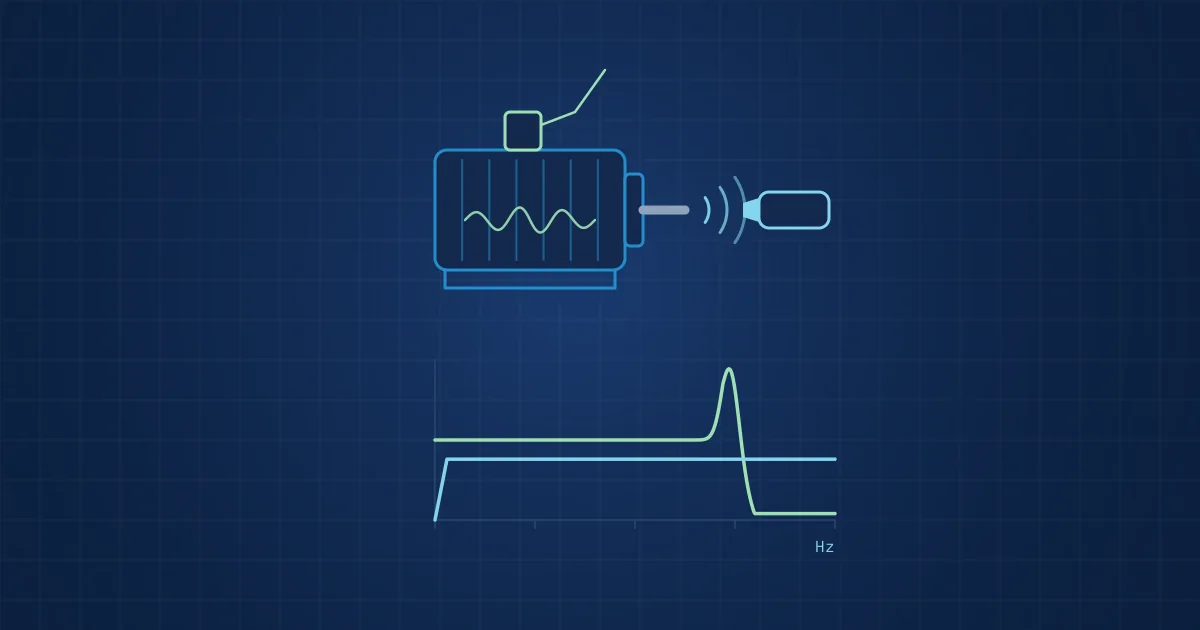
Acoustic vs vibration monitoring comes down to coupling and bandwidth. An accelerometer bolted to a housing measures structure-borne vibration at one point and resists ambient noise. A measurement microphone needs no contact, covers a much wider frequency band and hears whole processes. Choose the microphone for non-contact, high-frequency or process sounds; choose the accelerometer for localised, low-frequency faults in noisy halls.
Key takeaways
- A MEMS accelerometer such as the ADXL1002 is linear from DC to about 11 kHz, while a quarter-inch measurement capsule such as the MK 301 E is specified from 5 Hz to 100 kHz.
- Microphones win when contact is impossible, when the signal of interest lies above an accelerometer's band, or when the process itself is the source.
- Accelerometers win when you must attribute a signal to one bearing, when the hall is loud, or when results must be compared against vibration severity guidelines.
- Published tests show acoustic anomaly detection degrading clearly as background noise rises, so the acoustic environment has to be part of the design.
The question of acoustic vs vibration monitoring usually arrives framed as a contest. In practice the two sensors measure related but different things. An accelerometer reports how one point of a structure moves. A microphone reports pressure fluctuations in the air, which mix contributions from every surface and process within earshot.
That difference is a weakness or a strength depending on the job. Below we compare the two on the properties that decide real projects, then list the cases where we would pick the microphone without hesitation. If you need a refresher on spectra first, read our vibration analysis basics.
Two sensors, two physical quantities
Structure-borne sound travels through solid material. It is what an accelerometer picks up when mounted on a bearing housing, gearbox or weld head. The path from source to sensor is short and mostly mechanical, so the signal is strong and fairly specific to the component underneath.
Airborne sound is the part of that energy radiated into the air, plus whatever the process emits directly: turbulent flow, arcing, cutting, impacts. A microphone receives it after spreading and reflection in the room. The signal is weaker, broader in origin and dependent on the acoustic environment, but it needs no contact at all.
Both are vibration in the physical sense. The engineering difference lies in coupling, bandwidth and what else ends up in the recording.
Acoustic vs vibration monitoring compared
| Property | Accelerometer (structure-borne) | Measurement microphone (airborne) |
|---|---|---|
| Contact | Mounted on the structure; stud, adhesive or magnet | None; can sit centimetres to metres away |
| Usable band (example parts) | ADXL1002: DC to 11 kHz (3 dB), resonance near 21 kHz | MK 301 E: 5 Hz to 100 kHz (plus or minus 2 dB) |
| Localisation | Good: dominated by the component under the sensor | Weaker: hears everything in range, needs directivity or modelling |
| Sensitivity to ambient noise | Low | High; background noise is the main design constraint |
| Moving, rotating or hot parts | Difficult or impossible to mount | Straightforward |
| Link to severity standards | Direct: ISO 20816-type evaluation uses vibration | Indirect; no comparable general severity scale |
| Typical strengths | Unbalance, misalignment, bearings, looseness | Process sounds, leaks, friction, high-frequency events |
The bandwidth figures come from the manufacturers' published specifications for the ADI ADXL1002 and the Microtech Gefell MK 301 E measuring capsule, which is a prepolarised quarter-inch cartridge with a maximum sound pressure level of 158 dB. Piezoelectric accelerometers reach higher than MEMS parts, but mounting quality then limits the usable band as much as the sensor does.
When a microphone beats an accelerometer
There is nothing to bolt the sensor to
Rotating tools, moving carriages, hot surfaces, thin-walled parts and products passing on a conveyor all resist contact sensors. A microphone placed nearby records the process without touching it. This is the main reason acoustic monitoring is used in production processes rather than only on machines.
The signal lives above the accelerometer's band
Friction, early impacts, turbulent flow and many welding phenomena carry energy well into the tens of kilohertz. A MEMS accelerometer such as the ADXL1002 rolls off above about 11 kHz. A measurement capsule with a flat response to 100 kHz, digitised at well over twice the highest frequency of interest, captures that range directly. We cover the ultrasonic end of this in our post on airborne ultrasound for leaks and friction.
The process is the source, not a component
In a weld, a cut or a press stroke, the information is in the event itself, and a microphone can hear that event without touching the tool or the part. Our own work points the same way. In the e-WAS feasibility study (2021, with VRI, LarsLabs and PORON), a sensor integrated in the weld head recorded the vibro-acoustic response at 64 kSPS, and the damping after a successful weld was clearly measurable and scaled with weld current. That sensor sat in the weld head, so it measured structure-borne sound rather than airborne sound; what it shows is that the process carries the information, whichever path you listen on. The airborne case comes from the e-LAS+ project with Fraunhofer IDMT, a multimodal inline inspection of laser weld seams in battery cell production, where an Acoustic Node and a camera sit above the cell fixture of the welding station. Our post on laser welding defects and inspection methods covers that application.
You want one sensor to listen to several sources
One microphone can cover several valves, a group of pumps or a fan bank. The MIMII dataset, published by Purohit and colleagues as a sound dataset for malfunctioning industrial machine investigation, recorded valves, pumps, fans and slide rails with an eight-microphone array at 16 kHz and 16 bits. Anomalies included contamination, leakage, rotating unbalance and rail damage, all captured without contact.
When the accelerometer is the better choice
The same MIMII paper shows the cost of listening through air. Its baseline detector was evaluated with factory noise mixed in at 6 dB, 0 dB and minus 6 dB signal-to-noise ratio. Average AUC for pumps fell from 0.81 to 0.68 and for valves from 0.67 to 0.53 across that range, according to the full paper. Background noise is not a detail in acoustic monitoring. It is the design problem.
Accelerometers are the better choice when:
- You need to name the component. A sensor on the drive-end bearing housing mainly hears the drive-end bearing. Calculated bearing fault frequencies then point to a specific race.
- The hall is loud and changes. Neighbouring machines, forklifts and compressed-air blow-off raise the acoustic floor. A well-mounted accelerometer is largely immune.
- The fault is low frequency. Unbalance and misalignment sit at one or two times running speed, often below 100 Hz, where structure-borne measurement is reliable and airborne radiation from small machines is weak.
- Results must map to a standard. Severity guidance such as ISO 20816 is written for vibration measurements, not sound pressure.
It also helps to keep comparisons fair. Hemmer and Waag compared heterodyned acoustic emission with conventional vibration on a top-drive bearing in their PHM Society paper and found acoustic emission RMS tracked bearing condition more consistently and was less sensitive to speed, in a comparison of one previously used, replaced bearing with one new bearing. Acoustic emission is measured with contact sensors at high frequencies, so it is a third category, not airborne sound. The lesson is that bandwidth often matters more than the label on the sensor.
A selection checklist
Answer these before choosing a sensor:
- Can a sensor be mounted rigidly on the component of interest, and will it stay there?
- What is the highest frequency the fault or process is likely to produce?
- How loud and how variable is the background noise at the measurement point?
- Must the result be attributed to one component, or is a process-level verdict enough?
- Is there an applicable severity standard your maintenance team already uses?
- Will one sensor need to cover several machines or process stations?
- How will you detect a sensor that has come loose or been covered?
If most answers point both ways, that is a hint to use both, which is the argument behind comparing what each sensing modality sees and misses.
How NeuroControls approaches this
We build one node per function. The Vibration Node uses an ADXL1002 with an 18-bit converter at 200 kSPS. The Acoustic Node uses a Microtech Gefell MK 301 E measurement capsule with a 2 to 100 kHz capture band; the band from 2 to 20 kHz is the one proven in production so far. The Acoustic Node is available as a standalone logger and is built to order as a hub node.
The Machine Health Kit puts both nodes on one Edge AI Hub, where every stream is time-stamped on the hub and each sensor reports its own signal health. Models trained by our engineers on customer data can then use whichever channel carries the fault. For welding and process applications, the Process Monitoring Kit shows how the e-WAS and e-LAS+ work fed into our measurement chain, and the condition monitoring solution page covers rotating machinery.
Frequently asked questions
Can a microphone replace an accelerometer for condition monitoring?
Sometimes, but not in general. A microphone works well for non-contact measurement, process sounds and high-frequency phenomena, and one microphone can cover several sources. It is weaker at attributing a fault to one component and more sensitive to background noise. For bearing-level diagnosis in a noisy hall, a mounted accelerometer remains the more reliable choice.
What frequency range does an industrial accelerometer cover compared with a microphone?
It depends on the parts. The ADXL1002 MEMS accelerometer is linear from DC to about 11 kHz at the 3 dB point, with a resonance near 21 kHz. The Microtech Gefell MK 301 E quarter-inch measurement capsule is specified from 5 Hz to 100 kHz within plus or minus 2 dB. Piezoelectric accelerometers can reach higher, but mounting then limits the usable band.
How much does background noise affect acoustic machine monitoring?
A great deal. In the MIMII dataset study, average detection performance for pumps fell from an AUC of 0.81 at 6 dB signal-to-noise ratio to 0.68 at minus 6 dB, and for valves from 0.67 to 0.53. Microphone placement, directivity, filtering and models trained with realistic background noise are essential for acoustic monitoring in production halls.
Is acoustic emission the same as airborne acoustic monitoring?
No. Acoustic emission usually refers to high-frequency stress waves picked up by contact sensors on the structure, often far above the audible range. Airborne acoustic monitoring uses microphones that measure pressure in air without contact. Both extend beyond what a typical accelerometer covers, but they differ in coupling, noise sensitivity and how the sensor is installed.
When should I use both a microphone and an accelerometer?
Use both when a fault produces energy in different bands or paths, when you need a process-level and a component-level view, or when one sensor alone gives too many ambiguous alarms. A combined system can, for example, confirm a bearing fault seen in vibration with high-frequency content heard by the microphone, or separate machine faults from process changes.
Sources and further reading
- Analog Devices ADXL1002 product page
- Microtech Gefell MK 301 E measuring microphone cartridge datasheet (AcSoft)
- Purohit et al.: MIMII Dataset: Sound Dataset for Malfunctioning Industrial Machine Investigation and Inspection
- Hemmer and Waag: A Comparison of Acoustic Emission and Vibration Measurements for Condition Monitoring of an Offshore Drilling Machine, PHM Society 2017
- ISO 20816-1:2016 Mechanical vibration - Measurement and evaluation of machine vibration - Part 1