
Short answer
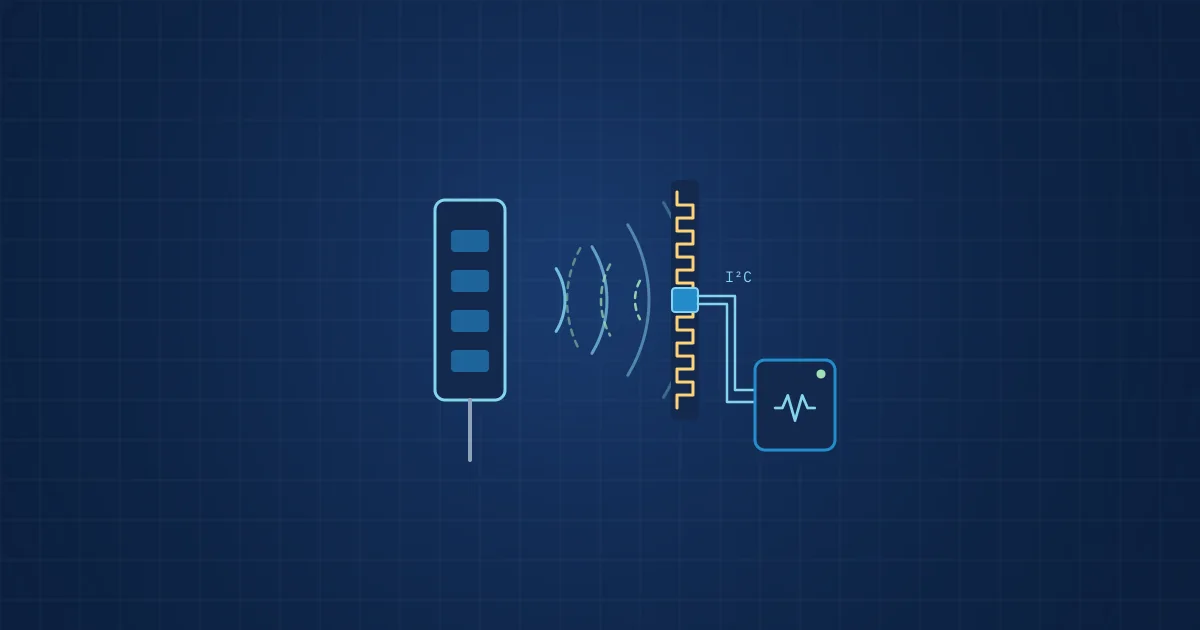
Passive RFID read-out lets a sensor deliver results without a radio or a battery. The sensor writes a few bytes into a dual-interface RFID tag over a wired bus such as I²C. When a reader passes, its field powers the tag, which replies by backscatter or load modulation. The reader supplies the communication energy, so the sensor spends almost nothing on transmitting data.
Key takeaways
- A passive RFID tag has no transmitter of its own: it draws power from the reader's field and answers by changing how its antenna reflects or loads that field.
- Dual-interface tag chips expose the same memory to a radio interface and to a wired I²C bus, which is what turns an identification tag into a sensor mailbox.
- UHF RFID under the GS1 EPC Gen2 standard reaches metres, and Sweden began installing readers for wagon identification at detection sites from 2011; HF and NFC tags reach centimetres but can also harvest power for the host.
- Passive read-out suits results that can wait for the next reader, such as slowly developing faults, not alarms that need immediate action.
- Payload design, tag placement on metal and data integrity matter more than raw read range.
Passive RFID sensor read-out solves a specific problem: how to get a result off a device that cannot afford to run a radio. On harvested power, a single active radio packet can cost more energy than many measurement cycles. If the sensor only needs to report a few bytes now and then, it can hand the communication cost to someone else.
That someone else is an RFID reader. This article explains how passive tags communicate, how dual-interface chips let a sensor use them as a mailbox, how UHF and NFC compare, and what to watch for in a real design.
How passive RFID communicates without a battery
A passive RFID tag is an antenna and a chip with no power source of its own. All of its operating energy comes from the reader.
The GS1 EPC Gen2 UHF RFID standard, currently version 3.0.1 ratified in February 2026, describes the mechanism precisely. The reader (the "interrogator") transmits a continuous-wave RF signal. The tag rectifies part of it to power its chip. To reply, it changes the reflection coefficient of its antenna, so the reader sees its own carrier modulated by the tag's data. This is called backscatter. The protocol is interrogator-talks-first and half-duplex: a tag only answers when a reader asks.
Gen2 operates between 860 MHz and 930 MHz, and it harmonises with ISO/IEC 18000-63, which covers 860 MHz to 960 MHz. The exact band a reader uses depends on local radio regulations.
High-frequency tags at 13.56 MHz, including NFC tags under ISO/IEC 15693, work differently. Reader and tag couple magnetically through their antennas like a loose transformer, and the tag replies by switching a load on and off. The range is shorter, but the coupling can deliver more power to the tag.
Dual-interface tags: an RFID chip as a sensor mailbox
An ordinary RFID tag stores an identifier and some user memory written during commissioning. A dual-interface tag adds a wired port, usually I²C, so a microcontroller on the same board can read and write that memory directly.
The sensor and the reader never talk to each other. They share a mailbox:
- The sensor wakes on harvested energy, measures and evaluates.
- It writes a short result record into the tag's user memory over I²C.
- It goes back to sleep.
- Hours or days later, a reader passes, powers the tag through its antenna and reads the memory.
Two commercial examples show the range of options:
- The Impinj Monza X-8K is a UHF Gen2 chip with 8,192 bits of user memory accessible through both the RF interface and a standard I²C bus. Impinj highlights that the memory can be accessed even when the host device is powered off, and the chip offers a wake-up trigger and two antenna ports for far-field and near-field use.
- The ST25DV04K from STMicroelectronics is an NFC Forum Type 5 tag based on ISO/IEC 15693, with 4 Kbit of EEPROM, a 1 MHz I²C interface, a 256-byte mailbox for fast transfer and an analogue output that can power external components when the field allows. ST lists this particular part as not recommended for new designs, but the dual-interface concept is widespread in its successors.
The energy cost to the sensor is one short I²C write. Everything after that is paid for by the reader.
UHF versus NFC versus an active radio
| Option | Typical range | Energy cost to the sensor per report | Infrastructure | Best fit |
|---|---|---|---|---|
| Passive UHF (EPC Gen2) | Metres in free space, less on metal | One local memory write | Fixed or handheld UHF readers | Assets that pass a known point: wagons, containers, pallets |
| Passive HF or NFC (ISO/IEC 15693) | Centimetres | One local memory write; the field can even power the host | Handheld readers, phones, close-range gates | Inspection rounds, commissioning, data hand-over at a station |
| Active radio (BLE, LoRa and similar) | Tens of metres to kilometres | A full transmission from the sensor's own budget | Gateways or network coverage | Results that need to arrive immediately |
The ranges in the table are indicative. Read range depends on reader power, antenna design, tag orientation and, above all, what the tag is mounted on.
What passive read-out cannot do
The limitation is latency. A passive tag only reports when a reader is close enough. If the nearest reader is 200 km away, so is your next data point.
That is acceptable for faults that develop over days or weeks, such as a wheel flat that slowly grows or a bearing that starts to degrade. It is not acceptable for a hot axle box that needs a train stopped within minutes. Passive read-out is a maintenance channel, not a safety alarm. Our article on wheel flats on freight wagons explains why the two kinds of monitoring complement each other.
The second limitation is payload. Tags hold kilobits, not megabytes. You will not get raw vibration recordings out this way. The sensor must decide locally and send conclusions.
Rail: readers are already at the trackside
Rail is a natural fit because the infrastructure partly exists. According to the supplier TagMaster, the Swedish Transport Administration, Trafikverket, began rolling out long-range UHF RFID readers at detection sites from the end of 2011, as part of a nationwide system for tracking freight wagons. The readers comply with EPC Gen2 (ISO 18000-6C), the supplier says it cooperates with Trafikverket and GS1, and axle counters are connected directly to the readers so that wagons without tags are also detected. Using an ISO standard is intended to give cross-border interoperability across Europe.
Where such readers already identify wagons, adding condition data is mostly a question of what is written into the tag's memory and how the back office interprets it.
Ideas from research: sensing through identification
Using RFID infrastructure for sensing is not new. In 2005, Philipose, Smith and colleagues described the wireless identification and sensing platform (WISP) in IEEE Pervasive Computing. Their working prototype was a one-bit tilt sensor: a mercury switch connected one of two tag chips to the antenna, depending on tilt, so the reader saw either one ID or the other. Standard tags at the time were readable at up to eight metres, and the modified tag remained readable, at a degraded rate, to about three metres.
Later work moved computation onto the tag. The NFC-WISP presented at UbiComp 2015 used a TI MSP430 microcontroller to sample temperature and 3D acceleration every three seconds and report whether an object was static or moving. The lesson from both: the reader does the heavy lifting, and the sensor's job is to put something meaningful into a small memory.
Design checklist for a passive RFID sensor link
- Define the payload first. Decide what a maintenance planner needs: sensor identity, time or position reference, fault type, severity grade, and a measure of confidence or signal quality. Fit it into a fixed record of a few tens of bytes.
- Plan the memory. Decide whether you overwrite the latest result or keep a short ring buffer, and check the write endurance of the tag memory in the datasheet against your write rate over the product's lifetime.
- Design the antenna for metal. Tags on bogies, axle boxes or machine frames need antennas designed for metal mounting. Test read rates at the real mounting position and at the real passing speed.
- Check the read window. At line speed, a tag is in the reader's field only briefly. Make sure the record can be read within that window, with retries.
- Protect integrity. A record that anyone with a reader could alter is not evidence. Plan checksums at minimum, and signatures if results feed into maintenance decisions.
- Expose sensor health. Include a flag that tells the reader whether the sensor's own signal was valid, so a loose mount is not read as a healthy wheel.
- Plan the back office. Readers deliver records; something has to match them to assets, trend them and raise work orders.
How NeuroControls approaches this
Passive read-out is part of the VCD4.3, our energy-autonomous freight-wagon sensor. It is powered by the vibration it monitors, grades wheel flats and bearing faults on board and is read out over passive RFID, so the sensor never runs a radio. It has been demonstrated on a rail-wheel fault rig, is built to order and was developed as the demonstrator we led in the EdgeAI project. The power side of the design is covered in our article on energy harvesting sensors.
The principle that each device has one clear job and a defined interface also runs through our wired systems, as described in the hub-and-node architecture. For details on the special sensor, see our special sensors page; for rail applications, our rail industry page; and for how the pieces fit together, our system architecture.
Frequently asked questions
How does a passive RFID tag work without a battery?
A passive tag takes all its energy from the reader's radio field. At UHF, the reader sends a continuous carrier, the tag rectifies part of it to power its chip and replies by changing how strongly its antenna reflects the carrier, which is called backscatter. At HF and NFC, reader and tag couple magnetically and the tag replies by switching a load. In both cases the tag transmits nothing of its own.
What is a dual-interface RFID tag?
A dual-interface tag chip has two ways into the same memory: the RFID air interface and a wired bus, usually I²C. A microcontroller on the same board can write data into the tag's memory, and a reader can later read it wirelessly. Examples include UHF chips such as the Impinj Monza X-8K and NFC chips such as the ST25DV family.
What is the read range of passive UHF RFID compared with NFC?
Passive UHF RFID under the EPC Gen2 standard typically reaches several metres in free space, although metal mounting, antenna design and reader power reduce this. NFC and other HF tags work at a few centimetres because they rely on magnetic coupling. UHF suits fixed readers at a passing point; NFC suits handheld read-out during inspection.
Can RFID sensors replace wireless condition monitoring systems?
Only for some tasks. Passive RFID read-out is ideal when results can wait until the asset passes a reader, as with slowly developing wheel or bearing faults on rail vehicles. It cannot deliver immediate alarms, and tags hold only kilobits, so raw data stays on the sensor. Where results must arrive immediately or continuously, an active radio or a wired link is needed.
Is passive RFID used in railways today?
Yes, mainly for vehicle identification. According to the reader supplier, Trafikverket in Sweden began rolling out long-range UHF RFID readers that comply with EPC Gen2 at detection sites from 2011 to track freight wagons. Where such readers exist, condition data written into tag memory can be collected through the same infrastructure, with the main work in data formats and back-office systems.
Sources and further reading
- GS1 EPC Radio-Frequency Identity Protocols Generation-2 UHF RFID Standard
- Impinj Monza X series tag chips
- STMicroelectronics ST25DV04K dynamic NFC/RFID tag
- Railway Technology: TagMaster UHF RFID readers for Trafikverket, Sweden
- Philipose et al., Battery-free wireless identification and sensing, IEEE Pervasive Computing (2005)
- Zhao, Smith and Sample, NFC-WISP: an open source software defined near field RFID sensing platform, UbiComp 2015