
Short answer
Energy harvesting sensors power themselves from their surroundings, most often from the vibration of the machine or vehicle they monitor. A piezoelectric or electromagnetic transducer converts motion into microwatts to milliwatts, a power management chip stores it, and the sensor measures and computes in short bursts. It works when the measurement, the processing and the data link all fit inside that small, variable energy budget.
Key takeaways
- Vibration harvesters are usually resonant devices, so their output drops sharply when the excitation frequency moves away from the tuned frequency.
- Sensor-sized harvesters in the literature range from about 16 µW for a small piezoelectric micro-beam design to several milliwatts for tuned track-vibration devices under laboratory excitation; watt-level figures come from much larger electromagnetic devices.
- Dedicated harvesting power management chips run on under a microampere of quiescent current, which is what makes microwatt budgets workable at all.
- The radio link, not the sensor or the processor, is usually the first thing that breaks an energy budget, which is why autonomous sensors evaluate data locally and send only results.
- Freight wagons are a natural target because they generally have no on-board power supply but carry plenty of vibration.
Energy harvesting sensors promise condition monitoring without batteries to replace and cables to pull. For a machine hall, that is a convenience. For a freight wagon, which has no on-board power supply, it is often the only practical way to put electronics on the running gear at all.
The promise comes with hard limits. A harvester produces microwatts to a few milliwatts, and only while the source is vibrating at the right frequency. This article explains what the physics allows, which components turn raw harvester output into usable power, and how to design an energy budget that actually closes.
What an energy harvesting sensor is
An energy harvesting sensor is a measurement device that draws its operating energy from its environment instead of a mains supply or a primary battery. The source can be light, heat gradients, radio fields or motion. For condition monitoring on rotating machines and rail vehicles, motion is the obvious choice, because the thing you want to measure is also the thing that supplies the power.
Every such sensor has four blocks:
- A transducer that converts vibration into electrical energy.
- A power management circuit that rectifies, regulates and stores that energy.
- A sensing and processing chain that runs in short bursts when enough energy is stored.
- A way to get results off the device, which is usually the most expensive part in energy terms.
The design problem is to make the average consumption of blocks 3 and 4 smaller than the average output of blocks 1 and 2, across all the operating conditions you care about.
How much power vibration energy harvesting delivers
The honest answer is "less than you hope, and it depends heavily on frequency".
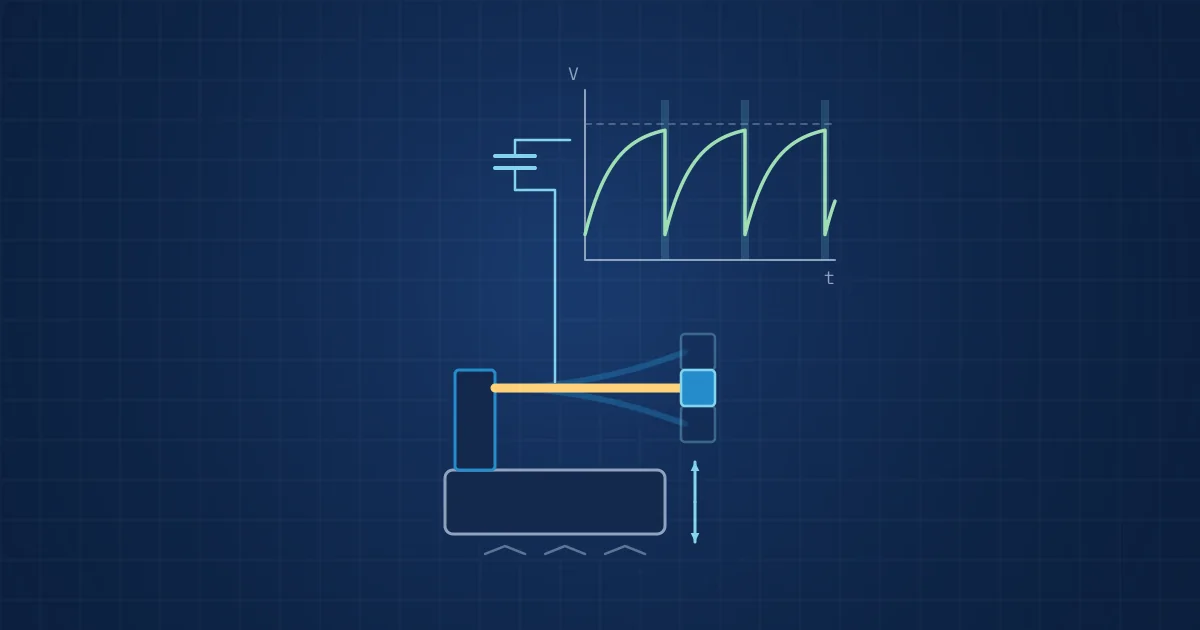
Most vibration harvesters are spring-mass resonators. A proof mass on a cantilever or spring moves relative to the housing, and a piezoelectric layer or a magnet and coil converts that motion into charge. Power is highest when the excitation frequency matches the resonance and falls away quickly on either side.
Roundy and colleagues, writing in IEEE Pervasive Computing in 2005, put numbers on this. A 1 cm³ piezoelectric design could generate around 375 µW from a vibration source of 2.5 m/s² at 120 Hz. With a 120 Hz resonance and a damping ratio of 0.025, the useful bandwidth was only about 6 Hz. Power scaled close to linearly with proof mass, which means that small harvesters pay twice: less mass and usually less piezo material.
Rail track vibration is a better source than a quiet building, but it brings its own problems. Shan, Kuang and Zhu (2022) built a compact piezo-stack harvester for track vibration in the 16 Hz to 21 Hz range. An inertial mass strikes the stack, which up-converts the low input frequency to the stack's higher resonance. In the laboratory, at 0.7 g rms, it delivered a maximum average power of 6.72 mW and a 1 mW bandwidth of 15 Hz. The literature review in their introduction shows how wide the field is: simply supported piezo beams around 380 µW, a nonlinear micro-beam at 16 µW rms, and electromagnetic designs from about 119 mW peak up to a ball-screw rotary harvester at 1.12 W average in field tests. The large electromagnetic figures come from devices that are far bigger than a sensor.
A review of vibration energy harvesting in rail transportation published in iScience in 2022 groups harvesters into electromagnetic, piezoelectric, triboelectric and hydraulic types, and names the open challenges plainly: system stability, durability and economy.
Transducer options compared
| Transducer | How it converts motion | Strengths for sensors | Typical weaknesses |
|---|---|---|---|
| Piezoelectric beam or stack | Strain in a piezo material produces charge | Compact, high open-circuit voltage, no moving contacts | Narrow resonance, high source impedance, fatigue of the piezo layer |
| Electromagnetic (magnet and coil) | Relative motion induces voltage in a coil | Higher power in larger devices, robust | Bulk and mass, low output voltage at low frequency |
| Triboelectric | Contact and separation of dissimilar surfaces | Works at low frequency, cheap materials | Durability and output stability still open |
| Hydraulic | Fluid flow drives a generator | High power from large displacements | Only viable for large track-side or suspension systems |
For a condition monitoring sensor bolted to a bearing housing or axle box, the practical choice today is piezoelectric, with electromagnetic as an option where space allows.
Turning harvester output into usable power
A raw piezoelectric harvester gives you an alternating voltage with high source impedance, sometimes tens of volts open-circuit, sometimes almost nothing. Electronics need a stable rail. The power management chip bridges that gap, and its own consumption must be tiny, because it runs all the time.
Two widely used parts show the two main approaches:
- The Analog Devices LTC3588-1 combines a full-wave bridge rectifier with a buck converter. It accepts 2.7 V to 20 V, draws 950 nA with the output in regulation and no load, offers selectable outputs of 1.8 V, 2.5 V, 3.3 V or 3.6 V, and can supply up to 100 mA in bursts. It suits piezoelectric sources with high voltage and high impedance.
- The Texas Instruments BQ25570 is a boost charger with a nano-power buck converter. It cold-starts from 600 mV, keeps harvesting down to about 100 mV, draws 488 nA in full operation and offers programmable maximum power point tracking. It suits low-voltage sources such as thermoelectric generators and small solar cells, and piezo sources after rectification.
Storage sits between the converter and the load. Ceramic and electrolytic capacitors charge quickly and tolerate many cycles but hold little energy. Supercapacitors hold much more, but a large one takes a long time to charge from a weak source, so the sensor stays dark for a long time after a cold start. Rechargeable cells hold the most, at the cost of temperature limits and ageing. The right choice depends on whether you need the sensor awake within seconds of motion starting or need it to bridge long stops.
Designing an energy budget that closes
The most common failure in harvesting projects is a budget built on the best-case operating point. Here is a procedure that avoids it:
- Measure the real vibration. Record acceleration spectra at the mounting point across the full operating range: speeds, loads, empty and loaded, summer and winter. Laboratory sine excitation is not a substitute.
- Pick the worst operating case you still need to monitor. If a wagon must be monitored at 30 km/h, size for 30 km/h, not 80.
- Estimate harvested power at that case, including converter efficiency and the quiescent current of the power management chip.
- List every energy cost per measurement cycle: sensor warm-up, sampling, computation, storage writes and data transfer. Measure them on the bench with a source meter rather than taking datasheet typicals.
- Derive the achievable duty cycle. Average harvested power divided by energy per cycle gives the maximum cycle rate.
- Check the cold start. How long after motion begins does the sensor produce its first result? Is that acceptable?
- Add margin for ageing and mounting. Piezo output falls if the mount loosens or the material fatigues.
An illustrative calculation, with assumed figures rather than measured ones: if a harvester delivers 200 µW on average at the worst operating case and one complete measurement and classification costs 2 mJ, the sensor can complete one cycle every 10 seconds. If the same cycle also includes a radio transmission that costs ten times more, the rate drops to one cycle every 110 seconds.
That second step shows why architecture matters more than component choice.
Why autonomous sensors compute locally and talk little
In most low-power designs, transmitting data costs far more energy than measuring or computing it. A sensor that streams raw vibration to a gateway will never run on harvested power. A sensor that samples a short window, extracts a few features, grades the condition and stores a handful of bytes can.
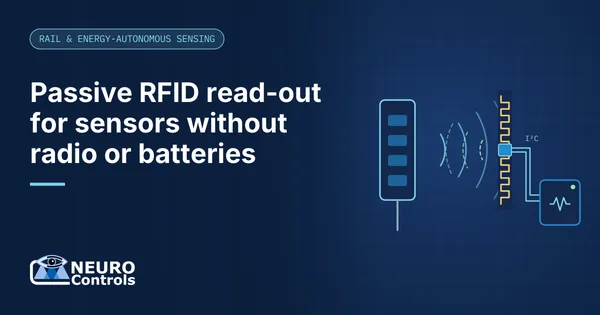
This pushes the intelligence onto the sensor. Instead of a fast Fourier transform on long buffers, designers use compact time-domain features such as peak-to-peak amplitude, crest factor, kurtosis and the envelope of impacts, which we explain in our guide to vibration analysis basics. The same principle applies to the link: rather than an active radio, the sensor can write its result into memory that a passing reader collects without the sensor spending its own energy, as described in our article on passive RFID read-out.
It also changes what counts as a good model. On a harvesting node, a classifier that needs half the operations at slightly lower accuracy may be the better engineering choice, because it can run more often.
Where energy harvesting fits, and where it does not
Energy harvesting makes sense where three conditions meet:
- No practical wired power. Freight wagons are the textbook case. The German ESZüG project, funded by the Federal Ministry of Education and Research from 2013 to 2016, started from exactly that point: because freight trains have no on-board power supply, energy-autonomous sensor systems had to be developed. The checks it names as background are the regular inspection of brakes, wheel bearings and wagon mileage.
- Reliable vibration while monitoring is needed. A sensor powered by vibration only works while the asset moves. That suits running gear, conveyors and fans, and does not suit standby equipment.
- Low data needs. If the decision can be made locally and the result is a few bytes, harvesting is realistic. If you need continuous high-rate recording for model development, wire it.
For laboratory rigs, production lines and machine halls with power available, wired sensors remain the better tool. They can record at full bandwidth, keep raw data for training and validation, and support the multimodal setups described in what multimodal sensing is.
How NeuroControls approaches this
We use both approaches, deliberately. Our hub-based systems run on mains power and record raw vibration, sound, images and thermal data, because that is how you build and validate models. Our special sensor programme covers the opposite case.
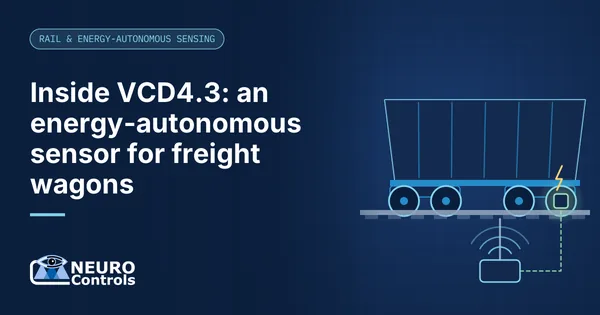
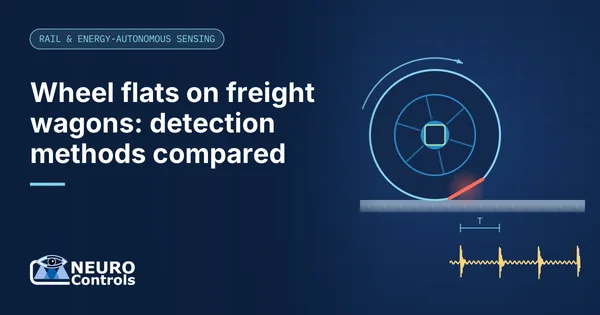
The VCD4.3 is an energy-autonomous freight-wagon sensor that is powered by the vibration it monitors, is read out over passive RFID and grades wheel flats and bearing faults on board. It has been demonstrated on a rail-wheel fault rig and is built to order. We developed it as the demonstrator we led in EdgeAI (Edge AI Technologies for Optimised Performance Embedded Processing), a Horizon Europe project funded through the Key Digital Technologies Joint Undertaking, which ran from December 2022 to June 2026 and coordinated by SINTEF. More on the project sits on our research demonstrators page, and the wider rail context on our rail industry page. Our article on wheel flats on freight wagons looks at one of the two faults the VCD4.3 grades.
Frequently asked questions
How much power can a vibration energy harvester produce?
It depends strongly on size, vibration level and frequency. A classic 1 cm³ piezoelectric design was modelled to produce around 375 µW from 2.5 m/s² at 120 Hz. A compact piezo-stack harvester for rail track vibration reached 6.72 mW average at 0.7 g rms in the laboratory. Small beams often deliver tens to hundreds of microwatts, so sensor designs must work within that range.
Can a condition monitoring sensor run without a battery?
Yes, if the energy budget closes. The sensor must harvest more energy on average than it spends on sensing, computation and data transfer, across the operating conditions you need to monitor. That usually means short measurement bursts, local evaluation, small result payloads and a power management chip with sub-microampere quiescent current. Raw data streaming is not feasible on harvested power.
Which is better for sensors, piezoelectric or electromagnetic harvesting?
For small sensors mounted on bearing housings or axle boxes, piezoelectric harvesters are usually the better fit. They are compact, have no sliding contacts and give high voltages that are easy to rectify. Electromagnetic harvesters can produce more power but need more space and mass. Both are typically resonant, so tuning to the real vibration spectrum matters more than the transducer type.
Why do energy harvesting sensors avoid radios?
Because in most low-power designs the radio transmission costs far more energy than the measurement or the computation. A sensor that streams data continuously cannot run on microwatts. Autonomous sensors therefore evaluate data locally and send only results, or write them into memory that a passive reader collects, so the sensor spends almost none of its own energy on communication.
Why are freight wagons a good application for energy harvesting?
Most freight wagons have no on-board power supply, so wired sensors on the running gear are impractical and batteries need replacing across large fleets. At the same time, wagons in service vibrate constantly. That combination makes vibration-powered sensors attractive for monitoring wheels, bearings and brakes, as German research projects such as ESZüG recognised over a decade ago.
Sources and further reading
- Roundy et al., Improving power output for vibration-based energy scavengers, IEEE Pervasive Computing (2005)
- Shan, Kuang and Zhu, Design, modelling and testing of a compact piezoelectric transducer for railway track vibration energy harvesting, Sensors and Actuators A 347 (2022), doi:10.1016/j.sna.2022.113980
- A review of vibration energy harvesting in rail transportation field, iScience (2022)
- Analog Devices LTC3588-1 nanopower energy harvesting power supply
- Texas Instruments BQ25570 energy harvester power management IC
- TRIMIS: ESZüG, energy self-sufficient sensor systems for monitoring freight cars