
Short answer
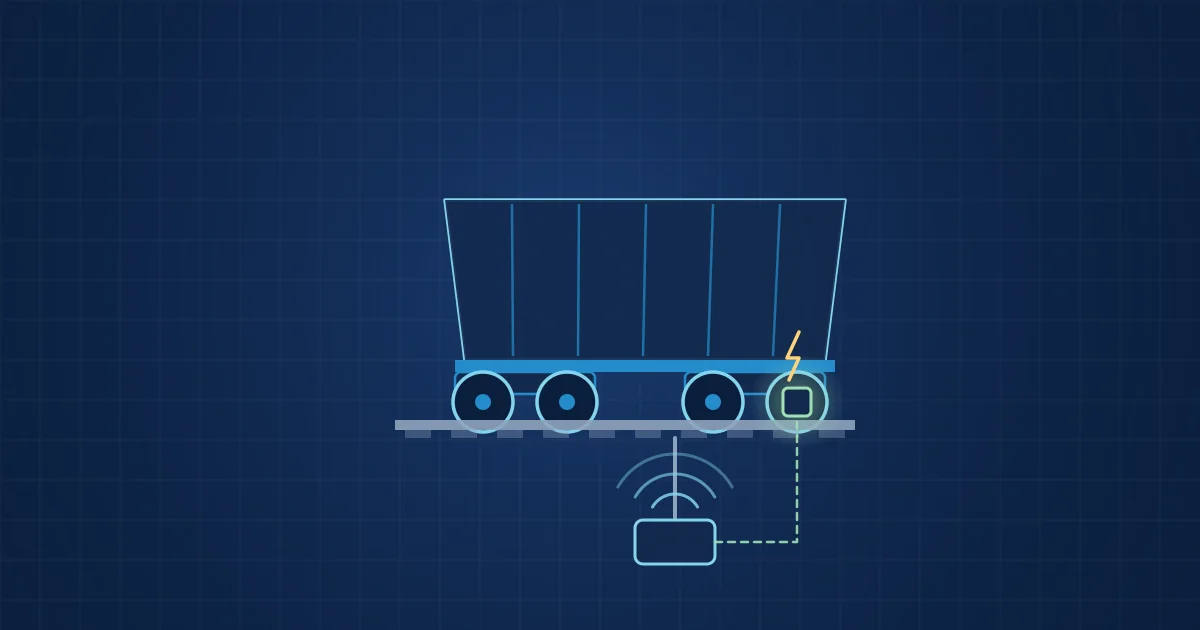
VCD4.3 is an energy-autonomous sensor for freight wagons developed in the EU EdgeAI project. A piezoelectric harvester bolted to the bearing housing turns wheel impacts into power, a low-power microcontroller grades wheel flats and bearing faults with time-domain features in under 10 µJ per inference, and the result is written into a dual-interface RFID tag that trackside readers collect. No battery, no radio, no raw data leaves the wagon.
Key takeaways
- We replaced the usual FFT pipeline because a spectrum cannot tell five small flats from one large flat, and because the FFT costs too much energy for an intermittent harvester.
- The classifier uses peak-to-peak amplitude, crest factor, kurtosis, envelope characteristics and inter-pulse timing, with fewer than 2,000 operations per inference.
- A rigidly bolted piezoelectric cantilever harvests from the impacts themselves; at 40 km/h with a moderate flat, average harvested power is about 200 µW, enough for one classification every 10 to 20 seconds.
- Results go into a dual-interface RFID tag over I²C for about 5 µJ, compared with 10 to 100 mJ for a BLE or LoRa packet.
- The classifier and harvesting chain are validated on field data and a bench rig; trackside integration, antenna geometry for European bogies and the cryptographic layer are still open.
The VCD4.3 is our answer to a narrow question: can an energy-autonomous sensor for freight wagons grade wheel and bearing faults on board, with no battery to replace and no radio to power? It was the demonstrator we led in the European EdgeAI project, as our first EdgeAI blog article describes, and we described its design in detail on the EdgeAI project blog in May 2026.
This article walks through the main design decisions, with the numbers behind them, and is honest about what still needs work.
The problem: no power, no network, a harsh place
A freight wagon is a hostile place for electronics. There is generally no on-board power supply, the bogie sees heavy shocks, wagons spend long periods standing and fleets are large. A sensor that needs a battery change every few years becomes a maintenance task of its own. A sensor that needs cellular coverage stops working in tunnels, sidings and cross-border runs.
So the requirements for the VCD4.3 were strict from the start:
- harvest its own energy from the running gear;
- evaluate the signal on the wagon and grade severity, not only detect;
- hand results off without spending its own energy on a radio;
- keep raw data on the wagon and send only classification results.
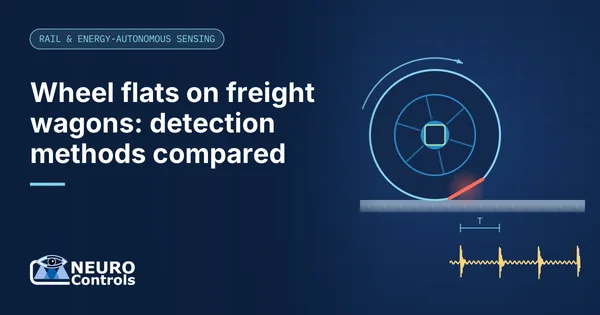
The background on wheel flats and why severity matters is in our comparison of wheel flat detection methods.
Why we dropped the FFT
Conventional vibration monitoring samples at 10 kHz to 25 kHz and uses a fast Fourier transform (FFT) to find bearing defect frequencies. That works on wired systems. On the VCD4.3 it failed on two counts.
It cannot grade severity. Five small flat spots on a wheel produce the same defect frequency as one large flat spot. The spectrum tells you something periodic is happening at wheel rate; it does not tell you how hard the impacts are or how many there are per revolution.
It costs too much energy. A radix-2 1024-point FFT needs about 5,000 butterfly operations, roughly 20,000 real multiplications. On an STM32L4-class microcontroller one FFT cycle costs about 15 µJ to 20 µJ, and the full pipeline approaches 50 µJ per inference. At a 5 Hz evaluation rate that is 250 µJ per second. By our estimate, a CR2032 coin cell (nominally about 225 mAh at 3 V, roughly 2.4 kJ) would sustain that for only about 112 days, and an intermittent harvester cannot sustain it at all.
What we use instead
The VCD4.3 classifier works in the time domain. It uses:
- peak-to-peak amplitude;
- crest factor, the ratio of peak to rms value;
- kurtosis, which rises sharply when a signal contains short impacts;
- characteristics of the rms envelope;
- the timing between impact pulses.
These features describe the impacts directly: how hard, how sharp, how many and how regular. The classifier needs fewer than 2,000 operations per inference and no large buffer. On the same dataset it uses more than 50 % fewer instructions than an FFT-based classifier of similar accuracy. With clock gating at the lowest stable frequency, energy per inference is below 10 µJ.
If you want the general method behind this choice, our guide to feature engineering for industrial signals covers how time-domain statistics compare with spectral features.
Powered by the fault it detects
The harvester is a sealed piezoelectric cantilever (Mide Volture series) bolted rigidly to the bearing housing. There is deliberately no damping between them. The goal is to capture the impact spikes, not to isolate the sensor from them.
That design has an interesting consequence. A wheel flat produces an impact once per revolution. At 35 km/h to 50 km/h on an 810 mm wheel, that is 3.8 Hz to 5.5 Hz. Each impact can drive the open-circuit voltage above 50 V, with energy per pulse in the order of tens of microjoules. The fault the sensor is looking for is also a source of its energy.
An LTC3588-1 power management chip rectifies the output, regulates it to 3.3 V and charges a capacitor bank. According to the Analog Devices product page, its input operating range is 2.7 V to 20 V, with a protective input shunt from 20 V, so what matters is the energy per pulse, not the open-circuit peak. At 40 km/h with a moderate flat, the average harvested power is about 200 µW. Even after MCU wake-up overhead, leakage and the RFID tag write, that sustains one classification every 10 to 20 seconds, which is ample for faults that develop over days.
Capacitors, not a supercapacitor
We chose electrolytic capacitors over a supercapacitor for two reasons:
- Cold start. A supercapacitor takes 30 to 45 minutes to cold-start from this source. The capacitor bank reaches operating voltage within seconds, so the sensor is useful soon after the wagon starts moving.
- Hazardous cargo. The energy stored in a supercapacitor could exceed ATEX ignition thresholds in hazardous cargo environments. A smaller stored energy reduces that risk and simplifies certification for hazardous environments, although it does not replace an assessment.
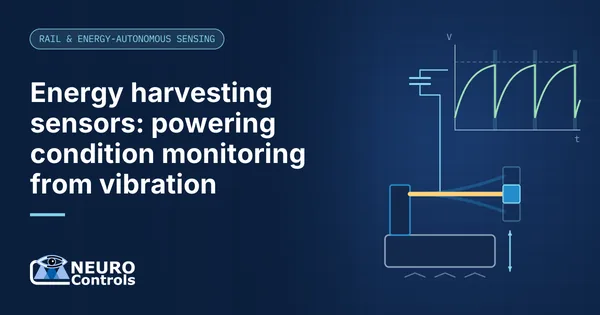
The general trade-offs between storage options are covered in our article on energy harvesting sensors.
No radio: results go to passive RFID
A BLE or LoRa transmission costs 10 mJ to 100 mJ per packet. On a 200 µW budget, a single message would consume between about 50 seconds and eight minutes of harvesting. The VCD4.3 avoids the radio entirely.
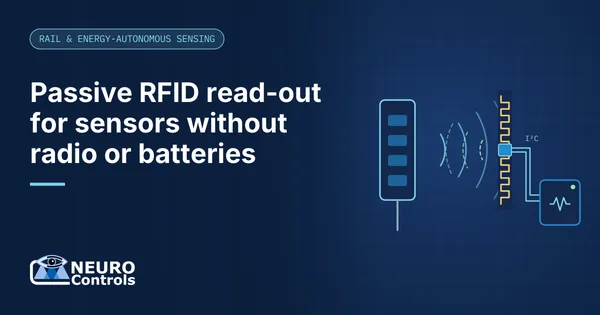
Instead, the sensor writes a 23-byte payload over I²C into a dual-interface tag on a passive UHF RFID link. The payload contains the sensor ID, a GPS stamp, the fault type and the severity level. The write costs about 5 µJ. Trackside readers interrogate the tag passively at checkpoints, at a read range of tens of centimetres to about one metre, as described in the EdgeAI project article on the VCD4.3.
Trackside RFID readers already exist for wagon identification, so collecting condition data becomes largely a configuration task. Only classification results leave the wagon; there is no dependence on cellular or satellite links. Our article on passive RFID read-out explains the tag technology in more depth.
The energy budget at a glance
| Step | Approximate energy | Comment |
|---|---|---|
| FFT-based pipeline (rejected) | About 50 µJ per inference | 1024-point FFT on an STM32L4-class MCU |
| VCD4.3 time-domain classifier | Below 10 µJ per inference | Under 2,000 operations, clock-gated |
| Write result to RFID tag | About 5 µJ | 23 bytes over I²C |
| BLE or LoRa packet (rejected) | 10 mJ to 100 mJ | Per packet, before retries |
| Energy per harvested impact | Tens of µJ | Open-circuit voltage can exceed 50 V |
The table makes the design logic visible. Computation and hand-off together cost about as much as one or two harvested impacts provide. A single radio packet would cost as much as a thousand or more inferences.
What has been validated, and what is still open
The classifier was trained on field recordings from 15 wagons under five speed conditions, which produced more than 12,600 classified datasets. Energy harvesting was validated on a bench rig. Live trackside integration testing is still to be done.
Three engineering items remain open:
- Temperature sensor fusion to support detection of rolling element faults in bearings.
- RFID antenna geometry for European freight bogies, where metal surroundings and mounting positions vary.
- The cryptographic layer: secure boot, TPM attestation and tamper-evident signatures on results. This waits for hardware integration.
We consider the remaining items engineering tasks with clear specifications and known solutions, but they are not finished, and we do not claim otherwise.
On fleet economics, our figures are estimates: the design has no consumables and could serve for the service life of the wagon, potentially 24 years, and a fleet simulation over 51 years indicated payback within the financing period at a target unit cost below EUR 25. These are simulation results, not field data.
The EdgeAI project
The VCD4.3 was developed within EdgeAI, "Edge AI Technologies for Optimised Performance Embedded Processing". According to CORDIS, the project ran from 1 December 2022 to 30 June 2026 under Horizon Europe's Key Digital Technologies programme, coordinated by SINTEF in Norway, with a total cost of about EUR 33.3 million and an EU contribution of about EUR 10.2 million. It was a research and innovation action of the Key Digital Technologies Joint Undertaking, now the Chips Joint Undertaking, under grant agreement No 101097300.
EdgeAI brought together partners from across Europe to develop components, processing architectures, software and middleware for edge AI, and to demonstrate them in several vertical use cases. The VCD4.3 was one of those demonstrators. I presented mobile agent condition monitoring at the European Conference on EDGE AI Technologies and Applications (EEAI 2025) in Naples, which we wrote up in our conference notes.
How NeuroControls approaches this
The energy-autonomous vibration sensor, developed as demonstrator VCD4.3 in the EU EdgeAI project, is now one of our special sensors and is built to order. It is powered by the vibration it monitors, read out over passive RFID, and grades wheel flats and bearing faults on board. Tell us which faults you want to catch on your vehicles; the open items listed above are still being worked on. Details are on our special sensors page, and the project context on our research demonstrators page.
What carries over to our other products is the discipline: decide at the sensor, send results rather than raw data, and design the sensor to report its own health. For the wider rail context, see our rail industry page.
Frequently asked questions
What is the VCD4.3 sensor?
The VCD4.3 is an energy-autonomous condition monitoring sensor for freight wagons, developed by NeuroControls as a demonstrator in the EU EdgeAI project. It harvests energy from wheel impacts with a piezoelectric cantilever, grades wheel flats and bearing faults on board with a low-power time-domain classifier, and writes results into an RFID tag that trackside readers collect. It needs no battery and no radio.
Why does the VCD4.3 not use an FFT?
For two reasons. A spectrum cannot grade severity: five small flats give the same defect frequency as one large flat. And the FFT is expensive: a 1024-point FFT pipeline on an STM32L4-class microcontroller costs about 50 µJ per inference. The VCD4.3 uses time-domain features such as crest factor and kurtosis and stays below 10 µJ per inference.
How much power does the VCD4.3 harvest?
At 40 km/h with a moderate wheel flat, the piezoelectric harvester delivers about 200 µW on average, enough for one classification every 10 to 20 seconds. Each wheel impact can push the open-circuit voltage above 50 V, with energy per pulse in the tens of microjoules. An LTC3588-1 chip regulates the output to 3.3 V and charges an electrolytic capacitor bank.
How is data read from the VCD4.3?
The sensor writes a 23-byte record containing sensor ID, GPS stamp, fault type and severity level into a dual-interface UHF RFID tag over I²C, at an energy cost of about 5 µJ. Trackside RFID readers, which already exist for wagon identification, read the tag passively at checkpoints. The read range is tens of centimetres to about one metre.
What is the status of the VCD4.3?
It was developed as demonstrator VCD4.3 in the EU EdgeAI project and is now built to order as our energy-autonomous vibration sensor. The classifier was trained on field recordings from 15 wagons at five speed conditions, and energy harvesting was validated on a bench rig. Trackside integration testing, RFID antenna geometry for European freight bogies, temperature fusion for rolling element faults and the cryptographic layer are still open.
Sources and further reading
- EdgeAI project blog: Powered by the fault it detects, inside the VCD4.3 energy-autonomous sensor (May 2026)
- CORDIS: EdgeAI, Edge AI Technologies for Optimised Performance Embedded Processing (grant 101097300)
- Analog Devices LTC3588-1 nanopower energy harvesting power supply
- EdgeAI project blog: No battery, no problem, how edge AI is making freight rail condition monitoring finally viable (May 2026)
- European Conference on EDGE AI Technologies and Applications (EEAI 2025): conference programme