

Short answer
Wheel flats on freight wagons are detected either at the track or on the vehicle. Wayside systems, mostly wheel impact load detectors using strain gauges or accelerometers in the rail, measure each wheel's impact force as it passes a site. On-board systems measure axle box acceleration continuously and see the impact on every revolution. Wayside covers whole fleets cheaply; on-board sees faults earlier and grades severity better.
Key takeaways
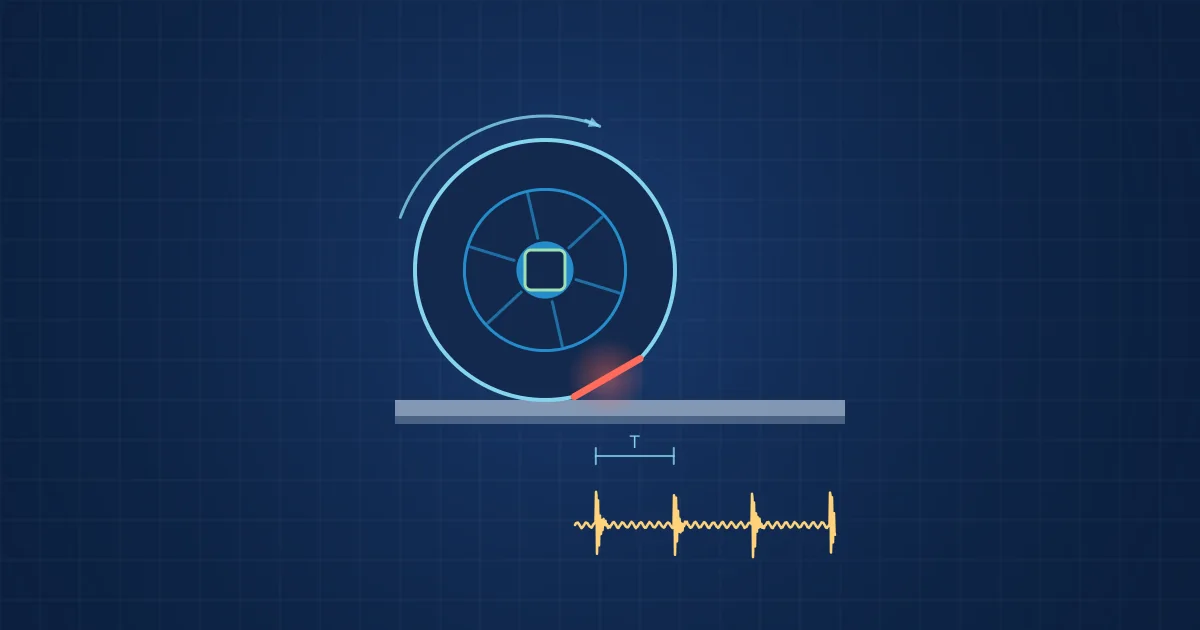
- A wheel flat is a flattened spot on the tread, usually caused by the wheel sliding under braking, and it produces an impact once per wheel revolution.
- Wheel impact load detectors are the established wayside method; in Sweden a peak load above 350 kN triggers a stop for inspection or a speed restriction until the damaged vehicle is removed.
- Most wayside systems only see the part of the tread that touches the rail inside the instrumented section, so arrays are built to span at least one wheel circumference.
- On-board axle box signals are strongly periodic, which makes flats easier to separate from crossings and rail joints, but the sensor needs power on a vehicle that usually has none.
- Flat length alone is a weak severity measure: a Swedish case study found no evident correlation between flat length, train speed and peak load.
Wheel flat detection is one of the oldest problems in rail condition monitoring, and still one of the most expensive. A flat hammers the rail on every revolution, damages bearings and track, and turns a routine freight run into a stopped train when a detector alarms.
This article compares the main methods: wayside load detectors, acoustic and image-based systems, and on-board sensing on the axle box. It focuses on freight wagons, where the lack of on-board power changes the trade-offs.
What a wheel flat is and why it matters
A wheel flat is a locally flattened section of the wheel tread. The usual cause is a wheel that stops rotating while the wagon still moves: a brake that does not release, poor adhesion under braking, or a locked axle. The steel slides on the rail, wears flat and is often heat-affected at the surface.
Once the wheel turns again, the flat produces a short, high impact force every time it reaches the rail. Fu and colleagues (2023) summarise the consequence in their review: repeated high wheel-rail contact forces accelerate wear and can lead to failure of wheels, bearings and track components if the flat is not caught early.
The impact is periodic with wheel rotation. An illustrative calculation: a wheel with a diameter of 0.9 m has a circumference of about 2.83 m. At 60 km/h (16.7 m/s) it turns about 5.9 times per second, so a flat produces an impact roughly every 170 ms. That periodicity is the most useful property for detection, as long as your sensor sees more than one revolution.
How railways act on wheel flats today
Operators act on two kinds of evidence: measured impact loads and visual inspection of the tread.
A 2024 report from Chalmers University of Technology and Swedish operators, assessing wheel impact load detectors, describes the Swedish rules. If a detector measures a peak load above an alarm limit of 350 kN, the train must stop for a visual inspection. If the inspection finds tread damage longer than 60 mm, the vehicle must be taken out of the train, independent of speed and axle load. A companion conference paper by Mattsson et al. (2024) describes the consequence of the 350 kN alarm as a speed reduction until the vehicle with the wheel damage has been decoupled from the train.
In continental European wagon inspection practice, limits depend on wheel diameter. The Swiss inspection catalogue (BAV Fehlerkatalog, version 18.0, January 2026), for example, sets wagons aside for flats over 60 mm on wheels above 840 mm, over 40 mm on wheels of 630 to 840 mm and over 35 mm on wheels below 630 mm, with lower bands that call for examination before onward travel, restrictions such as an isolated brake, or reporting.
The Chalmers report shows why the Swedish rules are under review:
- In a case study it found no evident correlation between wheel flat length, train speed and peak load.
- Measured loads varied widely between detectors, and the authors note that the accuracy of the measured dynamic loads is unknown.
- Dynamic loads from one detector type varied with the season, particularly for empty vehicles, which raises the risk of false alarms.
- Inspections of vehicles or tracks, such as those after alarms, caused about 1000 hours of delay in 2023, up from about 300 hours in 2013.
For anyone designing detection, the lesson is that "flat detected" is not the hard part. Grading how harmful a given flat is, at a given speed and load, is.
Wayside wheel flat detection methods
Wayside systems sit in or beside the track and measure every wheel that passes. Fu et al. group them into three families.
Stress-based: wheel impact load detectors
This is the most widely used family. Strain gauges, accelerometers or fibre Bragg gratings (FBG) on the rail measure the dynamic force or rail response as each wheel passes.
- Strain gauges are cheap and have high resolution, but they are non-linear, need regular calibration and are sensitive to train speed, weight and electromagnetic interference.
- Rail-mounted accelerometers work over a wider speed range. In one study cited in the review, trams with flats produced an envelope peak above 35 m/s² that healthy trams did not.
- FBG arrays are immune to electromagnetic interference and can be multiplexed on one fibre, but most interrogators measure below 1 kHz and must separate strain from temperature.
The main limitation is coverage. A conventional system only sees the part of the tread that contacts the rail inside the instrumented section. The review notes that this can leave more than 70 % of the tread area undetected, which is why arrays are built to be at least one wheel circumference long.
Sound-based: microphones and acoustic emission
A flat changes the rolling noise. Wayside microphones spaced at one wheel circumference, or acoustic emission sensors clamped to the rail, pick this up. One acoustic emission system reached accuracy of up to 90 % in field tests. Ambient noise is the main obstacle, and the review concludes that sound is not a popular solution for wayside flat detection.
Image-based: cameras, thermal imaging and lasers
Cameras photograph the tread; laser and optical sensors measure rail deflection or tread profile. Image methods have one clear advantage: flat size can be measured directly rather than inferred from a force waveform. In one study using thermal images with histogram-of-oriented-gradients features and a support vector machine, 98 % of defective wheels were detected with no false alarms on the test data. The drawbacks are cost, dirt and dependence on the image processing.
On-board detection on the axle box
On-board systems put the sensor on the wagon, usually an accelerometer on the axle box or bearing adapter. The flat then appears as an impact on every revolution, for as long as the wheel turns.
That periodicity is the big advantage. Fu et al. note that on-board flat signals have strong periodicity and better robustness, while a wayside system sees each wheel only once and therefore needs more sophisticated signal processing.
Zhou, Vuitton, Tian and Hecht (2024) at TU Berlin show how to exploit it. They resample axle box acceleration into the angular domain and average over many revolutions. Impacts that repeat at the same wheel angle add up; short irregular impulses from crossings and rail joints average out. Plotted in polar coordinates, the flat stands out clearly. They validated the method with a multibody simulation and a field experiment, and used the simulation to study different flat sizes and multiple flats.
The obstacle on freight wagons is power. Bernal Arango, Spiryagin and Cole (2021) at CQUniversity tackled this for heavy-haul wagons by mapping their detection method onto an analogue circuit, cutting the power and hardware needed by the sensor node. Their argument for on-board sensing is simple: wayside monitoring cannot raise an alarm between sites.
Interest is moving into the industry too. Network Rail reported in October 2024 on intelligent wagons fitted with sensors that flag, among other things, overheating brakes and locked axles, both of which are root causes of flats.
Wheel flat detection methods compared
| Method | Where | What it measures | Strengths | Limits |
|---|---|---|---|---|
| Strain-gauge load detector | Track | Dynamic rail force per wheel | Established, fleet-wide, regulatory basis | Partial tread coverage, calibration, detector-to-detector scatter |
| Rail accelerometer or FBG array | Track | Rail vibration or strain | Wider speed range (accelerometers), EMI immunity (FBG) | Size inferred via models, FBG sampling limits |
| Microphone or acoustic emission | Track | Rolling noise or rail-borne stress waves | Non-contact (microphones), simple installation | Ambient noise, less established |
| Camera, thermal or laser | Track | Tread image or deflection | Measures flat size directly | Cost, contamination, image processing dependence |
| Axle box accelerometer | Vehicle | Impact on every revolution | Early, continuous, robust periodicity, good for grading | Needs power and data path on unpowered wagons |
The two approaches complement each other. Wayside detectors give a fleet-wide safety net at fixed points. On-board sensing gives early warning and trend information for each wheelset, which is what maintenance planning needs.
From detection to severity grading
Given the Swedish findings, a binary "flat or no flat" output is not enough. A useful on-board system should grade severity in a way that tracks the harm a flat does, not only its length.
In practice that means combining several signal properties:
- Impact amplitude and crest factor, normalised for speed.
- Kurtosis and impact shape, which separate sharp flats from rough treads.
- Repetition pattern, which separates one flat from several and from track features.
- Trend over days, which shows whether a flat is growing or wearing round.
Speed matters throughout. Impact forces rise with speed, so a grade without a speed reference is hard to compare. This is also where modelling choices matter; our article on anomaly detection, classification and severity grading explains the step from "something is wrong" to "how bad is it". Because flats also stress bearings, the defect frequencies in bearing fault frequencies explained belong in the same feature set.
How NeuroControls approaches this
Our answer to the power problem on freight wagons is the VCD4.3, an energy-autonomous sensor that is powered by the vibration it monitors, is read out over passive RFID and grades wheel flats and bearing faults on board. It is built to order and was developed as the demonstrator we led in the EdgeAI project. The design principles behind it are covered in our article on energy harvesting sensors.
It complements wayside detectors rather than replacing them: the trackside site remains the safety net, and the on-board grade adds early, per-wheel information. More detail sits on our special sensors page and our rail industry page.
Frequently asked questions
What causes wheel flats on freight wagons?
Wheel flats form when a wheel stops rotating while the wagon is still moving, so the tread slides along the rail and wears flat. Typical causes are brakes that fail to release, low adhesion during braking on wet or contaminated rails, and locked axles. The sliding also heats the tread surface, which can change the steel's structure and make the damaged area more prone to cracking.
How does a wheel impact load detector work?
A wheel impact load detector measures the dynamic vertical force each wheel applies to the rail as a train passes a fixed site. Strain gauges or accelerometers mounted on the rail over a measurement section, usually at least one wheel circumference long, capture the force waveform. When the peak load exceeds an alarm limit, such as 350 kN in Sweden, the train is stopped for inspection or slowed until the damaged vehicle is removed.
Is on-board or wayside wheel flat detection better?
Neither replaces the other. Wayside detectors cover entire fleets at fixed points and form the regulatory basis for stopping trains. On-board axle box sensors see a flat on every revolution, detect it earlier and support severity grading and trending per wheelset. The main obstacle for on-board sensing on freight wagons is power, because most wagons have no on-board electrical supply.
How long can a wheel flat be before the wagon is removed?
Limits differ between countries and rule sets. Under the Swedish rules described in a 2024 Chalmers report, a vehicle with tread damage longer than 60 mm must be taken out of the train independent of speed and axle load. In continental European inspection practice the limit depends on wheel diameter: the Swiss inspection catalogue sets wagons aside for flats over 60 mm on wheels above 840 mm, over 40 mm on 630 to 840 mm wheels and over 35 mm on smaller wheels. The Chalmers report found no evident correlation between flat length and peak load in a case study, so length alone is a weak severity measure.
Can machine learning detect wheel flats?
Yes, and published studies already use it, for example support vector machines on thermal images of wheels. Reviews expect machine learning to become more important for wayside detection as datasets grow. The main limitation is data balance: damaged wheels are rare compared with healthy ones, so models need careful validation on realistic data rather than on small balanced test sets.
Sources and further reading
- Fu et al., Recent advances in wayside railway wheel flat detection techniques: a review, Sensors 23(8) 3916 (2023), doi:10.3390/s23083916
- Nielsen et al., Towards improved regulations and procedures for damaged wheels: assessment of wheel impact load detectors, Chalmers (2024)
- Mattsson et al., On wayside detector measurement of wheel-rail impact loads induced by wheel flats: data analysis, alarm levels and regulations, Sixth International Conference on Railway Technology, Prague (2024)
- Bundesamt für Verkehr (BAV): Fehlerkatalog zur Kontrolle von Zügen, Reisezug-, Güter- und Gefahrgutwagen, Anlage 1, version 18.0 (2026)
- Zhou, Vuitton, Tian and Hecht, Wheel flat detection by angular domain synchronous averaging and axle box acceleration, Measurement 230 (2024), doi:10.1016/j.measurement.2024.114508
- Bernal Arango, Spiryagin and Cole, On-board wheel flat detection for heavy haul wagons using ultra-low power sensor nodes, CORE 2021
- Network Rail, Intelligent wagons: using tech to make freight more efficient (2024)