
Short answer
DIGIBATT360 is a German research project, running from February 2026 to January 2029, that extends the EU digital battery passport with a federated data space and AI-based analytics. Led by VARTA Storage with Fraunhofer IIS, Circulor, VRI and NeuroControls, it aims to make lifecycle data for LMT and industrial batteries available across companies, to support state-of-health forecasts, second-life decisions and recycling.
Key takeaways
- DIGIBATT360, "Digital Circular Economy for Batteries", runs from 1 February 2026 to 31 January 2029 and is funded by the German Federal Ministry of Research, Technology and Space under the GreenTech innovation competition.
- According to the Fraunhofer IIS project page, the consortium combines field and BMS data from VARTA Storage, module manufacturing and quality assurance from VRI, supply chain traceability from Circulor, cognitive sensing and returned-goods analysis from NeuroControls, and a federated data space from Fraunhofer IIS.
- A decentralised data space lets partners exchange battery information without storing it centrally, which fits the Battery Regulation's principle that passport data is stored by the responsible operator.
- Within its sensing role, NeuroControls is developing an inline edge node designed to grade every weld of a battery module; the verdict is designed to go into the module's battery passport.
The EU battery passport becomes mandatory on 18 February 2027 for LMT batteries, industrial batteries above 2 kWh and electric vehicle batteries. Most of the industry's attention has gone into getting the mandatory fields filled in on time. DIGIBATT360 asks the next question: once passports exist, how do the companies around a battery actually share and use the data, without handing it all to one central platform?
We are one of the five partners. This post explains what the project is, who contributes what, and where our part, cognitive sensing including per-weld grading at the module, fits into a battery passport data space.
What DIGIBATT360 is
DIGIBATT360 stands for "Digital Circular Economy for Batteries". According to the project page of Fraunhofer IIS, published by its Supply Chain Services division, the project runs from 1 February 2026 to 31 January 2029 and is funded by the German Federal Ministry of Research, Technology and Space (BMFTR). The Solarserver report on the project launch in July 2026 adds that it is funded within the GreenTech innovation competition.
The project's aim, in the words of the Fraunhofer IIS page, is to increase the availability of data in the digital battery passport and the systems around it, and to extend the passport with a federated data space and AI-based analytics. The analytics are meant to support assessments of remaining life, second-life potential and the choice between so-called R-strategies: reuse, repair, remanufacturing and recycling. The focus is on batteries for light means of transport (LMT) and industrial applications; the page names operators of home, commercial and grid storage among the groups for whom the approach is particularly relevant.
The division of work is set out in the FAQ of the Fraunhofer IIS project page: VARTA Storage leads the consortium and supplies operational, field and BMS data, VRI is responsible for module manufacturing and quality assurance, NeuroControls contributes cognitive sensing and returned-goods analysis, Circulor adds traceability data from the supply chain, and Fraunhofer IIS develops the federated data space and the methods for data analysis and AI modelling.
Why a data space, not a central database
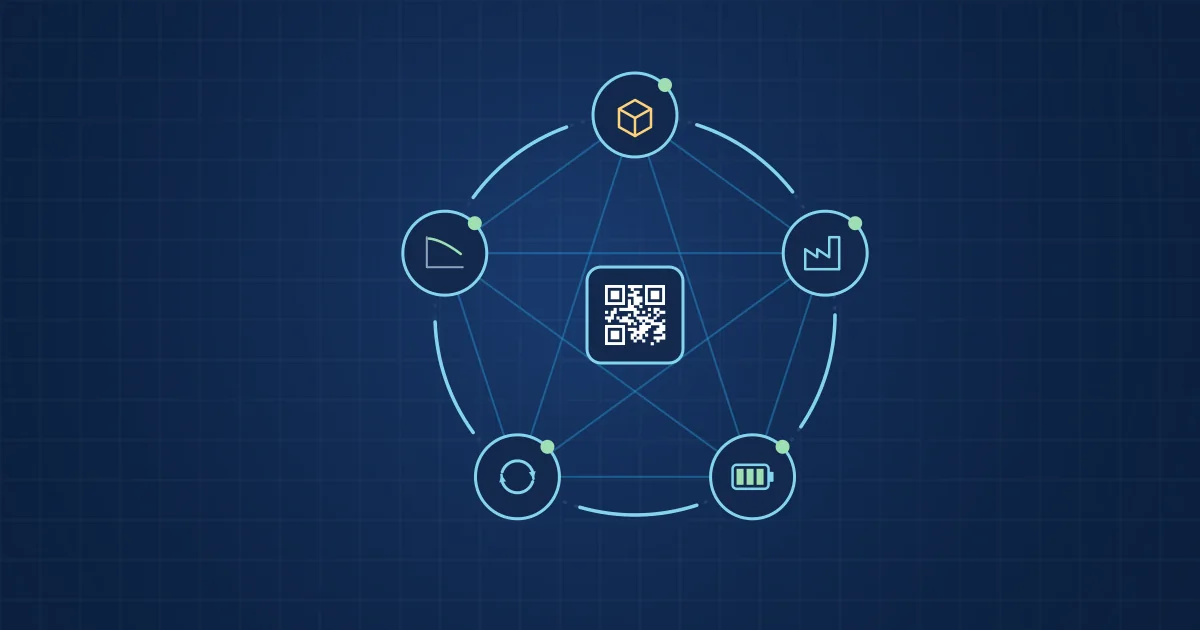
A data space is an arrangement in which several organisations exchange data under agreed rules, while each keeps control over its own data. The Solarserver report describes DIGIBATT360's approach as a decentralised data space through which battery information can be exchanged between the actors involved, without central storage. Fraunhofer IIS describes it as federated, with sovereign data use.
This is not only a technical preference. Article 78 of Regulation (EU) 2023/1542 requires that passport data be stored by the economic operator responsible for the passport, or by operators authorised to act on its behalf, and forbids those service providers from selling or re-using the data beyond the service. Article 77(5) asks for an open, interoperable data exchange network without vendor lock-in. A federated design fits those rules naturally.
There is also a commercial reason. Field data from a storage system, quality data from a module line and supply chain data from a raw material tracker belong to different companies, each with good reasons not to pool everything. A data space lets them share what a specific decision needs, such as whether a module is fit for a second life, without giving up the rest. The broader question of who owns machine data is discussed in industrial AI and the EU Data Act.
Which data flows where
The value of the project comes from combining data that normally sits in separate silos across the battery's life.
| Life phase | Data | Source in the consortium |
|---|---|---|
| Raw materials and supply chain | Provenance and traceability of materials | Circulor |
| Module production | Manufacturing and quality assurance data | VRI, with inline sensing from NeuroControls |
| First use | Operating data, field data, BMS data | VARTA Storage |
| Return and assessment | Condition of returned modules | VARTA Storage, NeuroControls |
| Analysis and decisions | State of health, remaining useful life, R-grading | Fraunhofer IIS |
The Fraunhofer IIS page lists state of health, remaining useful life prognosis and automated R-grading as research topics. Solarserver describes the same goal as AI-supported condition forecasts that help assess batteries and decide on their further use, with the aim of extending service life through reuse, repair, remanufacturing and recycling.
Much of this connects to the passport's individual battery data. Annex XIII of the Battery Regulation already requires state of health information, the battery's status (original, repurposed, re-used, remanufactured or waste) and data resulting from use. DIGIBATT360 explores what becomes possible when that data is linked with production and supply chain records rather than kept in isolation.
Second life makes this linkage concrete. Under Article 77(7), a battery that has been prepared for re-use, repurposed or remanufactured gets a new passport, linked to the passport or passports of the original batteries, and responsibility moves to the operator who places it on the market again. That operator has to decide, module by module, what is worth reusing. The better the history it can see, from production quality to field operation, the better that decision becomes.
Where per-weld grading fits
Our published role in the project is cognitive sensing and returned-goods analysis. Within it, we develop the measurement system: an inline edge node, currently in development, designed to grade every weld of a battery module, with the verdict designed to go into the module's battery passport. It builds on our earlier research on laser and spot welding inspection, including the e-LAS+ and e-WAS projects.
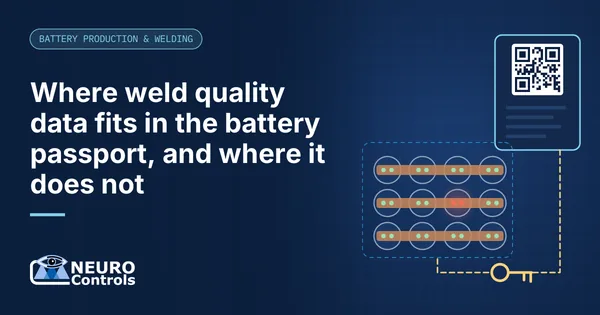
To be precise about the regulatory status: weld quality is not a mandatory field of the EU battery passport. As discussed in where weld quality data fits in the battery passport, Annex XIII records product properties and usage, not how each joint was made. DIGIBATT360 is a research setting in which we can test what per-weld data contributes when it is available alongside field data, for example when a returned module is assessed for second life.
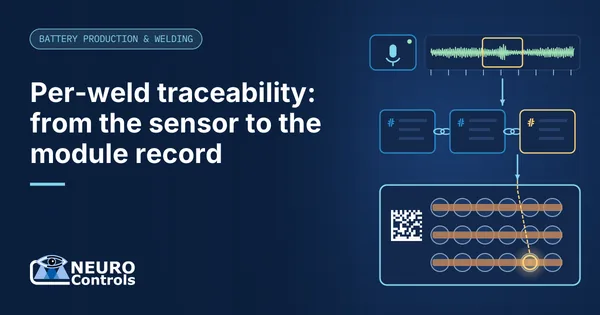
The technical chain behind that, from sensor sample to module record, is described in per-weld traceability: from the sensor to the module record.
Our second role, returned-goods analysis, looks at modules coming back from the field. Here the question is reversed: given a module of known history, what does its condition tell us, and which records would have helped predict it?
Questions the project has to answer
Three years is enough time to build working prototypes, but some of the questions are hard and will shape the result:
- Access rights. The passport distinguishes public data, data for persons with a legitimate interest and data for authorities. Article 77(9) leaves the details of legitimate interest to Commission implementing acts. Those acts were due by 18 August 2026 but had not been adopted by that date; the Commission's timeline of May 2026 places them in the fourth quarter of 2026. A data space has to map these tiers to real permissions.
- Semantics. Data from a BMS, a weld inspection station and a supply chain platform uses different vocabularies. Fraunhofer IIS's use of Semantic Web technologies addresses exactly this. The Battery Pass consortium's open data model, expressed in RDF and based on DIN DKE SPEC 99100, shows how passport attributes themselves can be described in a machine-readable vocabulary.
- Trust in the data. A state-of-health forecast is only as good as the data it is built on. Integrity and provenance of each record, including sensor records, matter as much as the model.
- Interoperability beyond batteries. Article 78 requires the battery passport to be interoperable with other digital product passports under EU eco-design law. The wider context is covered in the digital product passport under ESPR.
Where NeuroControls fits
We bring cognitive sensing to the project: sensors that flag their signal health and dropouts with the data, and recording that keeps a versioned manifest, per-segment SHA-256 hashes and an append-only journal. Both matter when sensor data becomes part of a record that other companies rely on.
More on the principle is on our cognitive sensors page. DIGIBATT360 and our other funded projects are listed on the research projects page, and applications in cell and module production are on the battery production page.
Frequently asked questions
What is DIGIBATT360?
DIGIBATT360, "Digital Circular Economy for Batteries", is a German research project running from February 2026 to January 2029. It extends the EU digital battery passport with a federated data space and AI-based analytics for LMT and industrial batteries. The consortium is led by VARTA Storage, with Fraunhofer IIS, Circulor, VRI and NeuroControls as partners.
Who funds DIGIBATT360?
The project is funded by the German Federal Ministry of Research, Technology and Space (BMFTR), according to the Fraunhofer IIS project page. The Solarserver report on the project launch in July 2026 states that it is funded within the GreenTech innovation competition. The project runs from 1 February 2026 to 31 January 2029.
What is a battery passport data space?
A battery passport data space is a decentralised arrangement in which the companies involved in a battery's life exchange passport-related data under agreed rules, without storing everything in one central database. Each company keeps control of its own data. This matches the Battery Regulation's principle that passport data is stored by the responsible economic operator or its authorised service provider.
What does NeuroControls contribute to DIGIBATT360?
NeuroControls contributes cognitive sensing and returned-goods analysis. Within that role it is developing an inline edge node designed to grade every weld of a battery module, with the verdict designed to go into the module's battery passport. This builds on its earlier laser and spot welding inspection research in the e-LAS+ and e-WAS projects.
Is weld data part of the EU battery passport?
Not as a mandatory field. Annex XIII of Regulation (EU) 2023/1542 lists product, composition, performance and usage data, but no manufacturing process data. DIGIBATT360 is a research project that explores what per-weld data adds when it is available alongside field and second-life data, for example when assessing returned modules.
Sources and further reading
- Fraunhofer IIS (Supply Chain Services): DIGIBATT360, Digital Circular Economy for Batteries
- Solarserver: Digitaler Batteriepass, VARTA Storage startet Projekt DIGIBATT360 (9 July 2026)
- Regulation (EU) 2023/1542 concerning batteries and waste batteries (EUR-Lex)
- Battery Pass Data Model (GitHub)
- European Commission, DG GROW: The Digital Product Passport, implications and practical guidance for the battery industry (27 May 2026)