
Short answer
Weld quality data is not a mandatory part of the EU battery passport. Annex XIII of Regulation (EU) 2023/1542 lists product, composition, performance and usage data, but no manufacturing process data. Weld records fit best as internal traceability data keyed to the passport's unique identifier, or as voluntary, access-restricted additions, where they support failure analysis, warranty claims and remanufacturing decisions.
Key takeaways
- Annex XIII of the EU Battery Regulation contains no field for weld quality, joint resistance per connection or any other manufacturing process parameter.
- Welding affects passport values only indirectly, for example through internal cell and pack resistance and through negative events recorded during use.
- Contact resistance alone is a weak proxy for weld quality: in one study of spot-welded tabs on 18650 cells, resistance barely differed between welds of very different shear strength, although other work finds resistance useful as a screen.
- The most robust place for per-weld data is an internal record indexed by the passport's unique identifier, with integrity protection comparable to what Article 78 asks of the passport itself.
Engineers who run welding cells in battery module plants often ask the same question once the passport project reaches their desk: do we need to put our weld quality data into the battery passport? The short answer is no. The longer answer is that weld data still belongs in the passport's orbit, just not inside the mandatory record.
This post separates what Regulation (EU) 2023/1542 requires from what is useful, and suggests where per-weld data should live so that it is available when someone needs it.
What the battery passport actually requires
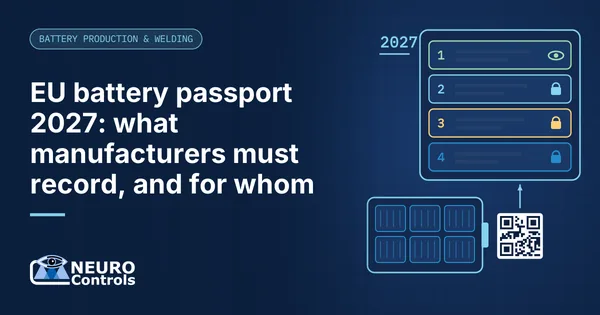
The passport content is defined in Annex XIII, which I walked through in detail in the EU battery passport 2027 guide. It has four parts: public information on the battery model, model information for persons with a legitimate interest, test reports for authorities only, and data on the individual battery for persons with a legitimate interest.
Read the list with a welding engineer's eyes and you find nothing about joints. Part 1 asks for capacity, voltages, power capability, expected lifetime, round trip efficiency and "internal battery cell and pack resistance". Part 2 asks for detailed composition, spare parts and dismantling information, including "amount of cells used and layout". Part 4 asks for performance and durability values, state of health, the battery's status and data resulting from use.
The only manufacturing facts in the passport are where and when the battery was made (via Annex VI Part A) and who made it. Weld seam geometry, spot weld energy, inspection results and rework history are not mentioned anywhere.
Where welding still touches passport fields
Welding has an indirect effect on several passport values. The table maps the relevant Annex XIII items to the joint quality questions behind them.
| Annex XIII item | Access tier | Link to welding | Is weld data required? |
|---|---|---|---|
| Internal battery cell and pack resistance (1(o)) | Public, model level | Every cell connection adds contact resistance to the pack | No, only the model value |
| Original power capability and limits (1(i)) | Public, model level | High-resistance joints heat up and can limit power | No |
| Amount of cells used and layout (2(c)) | Legitimate interest | Describes the topology the welds create | No |
| Performance and durability values at placing on the market (4(a)) | Legitimate interest, per battery | End-of-line values reflect, among other things, joint quality | No, only the resulting values |
| Negative events such as accidents (4(d)) | Legitimate interest, per battery | A failed joint in the field could trigger an event | No, only the event |
The pattern is consistent. The passport records outcomes at battery level. It does not record the causes at joint level.
Why resistance values do not stand in for weld quality
It is tempting to argue that the pack resistance in the passport already "covers" weld quality. The research on tab joints does not support that.
In a parametric study of spot welding 18650 cells to nickel-plated steel connectors, Masomtob and colleagues measured both electrical resistance and shear strength of the welded contacts. Because the resistance differences between their weld contacts were minimal, they used mechanical strength as the deciding criterion for weld quality.
The picture is not uniform. Kaufmann et al. found resistance differences of less than 13 % across their green-laser copper-to-aluminium parameter sets, yet still report a correlation between electrical resistance and tensile strength, and suggest that a non-destructive resistance measurement may allow joint strength to be predicted. Resistance can therefore help as a screen, but with such a small spread it needs a precise measurement, and it is a single value per joint, not a direct look at fusion or porosity.
A weak weld can still pass a coarse resistance check and still be the joint that cracks after thermal cycling and vibration. Mechanical integrity, fusion depth and porosity are what decide how long the joint lasts, and none of them show up in a pack resistance value. I covered the defect side in laser welding of battery cells: typical defects and inline inspection methods and the spot welding side in resistance spot welding of battery tabs.
Three places weld quality data can live
If weld data is not mandatory but is useful, where should it go? There are three realistic options. They are not exclusive.
Option 1: internal record keyed to the passport identifier
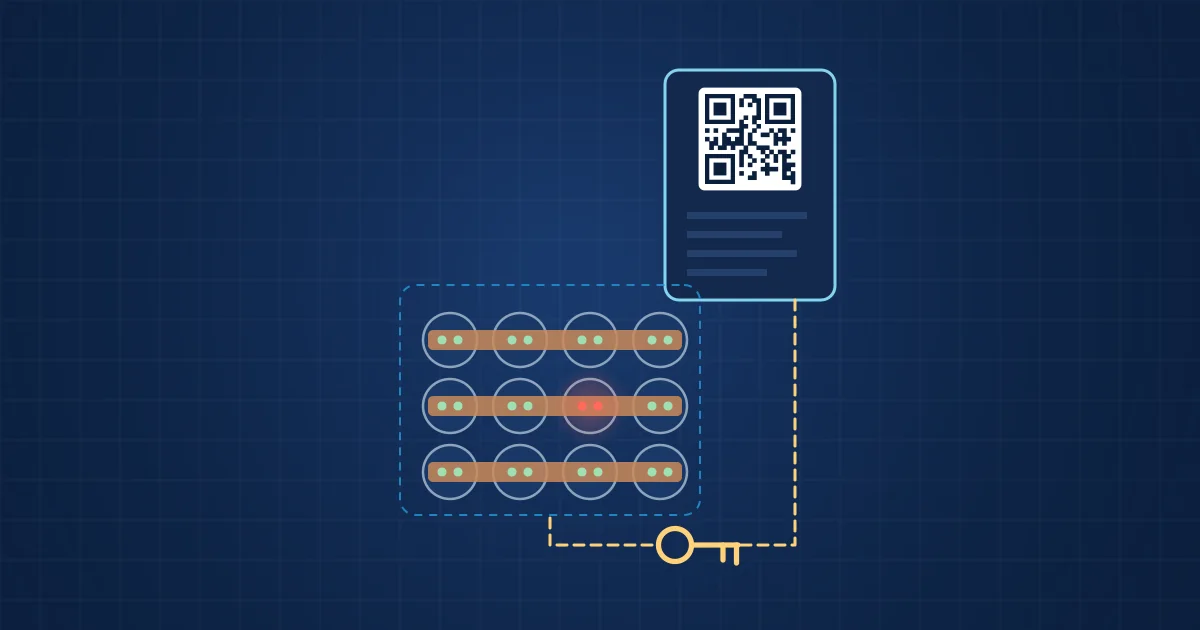
The passport's unique identifier, which Article 77(3) requires to comply with ISO/IEC 15459 parts 1 to 6 or equivalent standards, is a natural primary key. If every module record in the plant uses it, a weld inspection result can be found years later from nothing more than the QR code on a returned battery.
This option needs no change to the passport and no decision about who outside the company may see the data. It is the right default for most manufacturers.
Option 2: voluntary additions to the passport
According to the VDE announcement of DIN DKE SPEC 99100, the specification covers both the data attributes the regulation requires and voluntary additions. A manufacturer could in principle publish a summary weld quality attribute, for example "all cell connections inspected inline, no rework", as a voluntary statement.
Be careful with this. Anything in the passport must be accurate and kept up to date under Article 77(4), and a voluntary claim becomes a claim you must be able to defend. A summary statement is usually wiser than raw per-weld data.
Option 3: restricted data for remanufacturers and recyclers
Remanufacturers and second-life operators care about which modules can be reused. Per-weld quality could help them decide, for instance, which modules had rework. The regulation's legitimate-interest mechanism is designed for this kind of audience, but who counts as a person with a legitimate interest, and how far they may download and re-use the data, is left to Commission implementing acts. Article 77(9) set 18 August 2026 as the deadline for adopting them; the deadline passed without the act being adopted, and the Commission's timeline of May 2026 places it in the fourth quarter of 2026.
Even once those rules exist, they govern the mandatory passport content. Sharing per-weld data with downstream partners is a bilateral, contract-based matter, not a passport function.
| Option | Who can see it | Effort | Main risk |
|---|---|---|---|
| Internal record keyed to passport ID | Your company | Low to medium | Records not linked to the identifier |
| Voluntary passport attribute | Public or restricted, as you define | Medium | Claims you must keep defensible |
| Shared with remanufacturers by contract | Named partners | Medium to high | Commercial sensitivity, data format agreements |
What a useful per-weld record contains
A weld record that will still be useful in five years needs more than a pass or fail flag. Here is a minimal checklist:
- the module or pack identifier, identical to the passport's unique identifier or reliably mapped to it
- the joint position within the module (cell number, tab, busbar)
- the process parameters actually applied, not just the recipe name
- the inspection result and, if available, a severity grade rather than a binary verdict
- the raw or reduced sensor data the grade was based on, or a reference to where it is stored
- the time stamp and the station, plus the version of the inspection model or threshold set
- any rework, with its own result
The structure of such records, from the sensor to the module, is the subject of a separate post on per-weld traceability.
Integrity matters even for internal data
Article 78 requires that "data authentication, reliability and integrity shall be ensured" for the passport. Internal weld records are not covered by that clause. But the moment they are used to defend a warranty decision, or to argue that a field failure was not a manufacturing defect, the same questions arise: who wrote this value, when, with which software version, and has it been changed since?
Weld data that cannot answer those questions is weak evidence. It is worth designing the record so that it can.
Where NeuroControls fits
Our work is on the sensing side: recording what happens during each weld, with grading by models our engineers train on your data. Our recording software stores data with a versioned manifest, per-segment SHA-256 hashes and an append-only journal, and exports to open formats such as JSONL and CSV, so per-weld records can be keyed to whatever identifier your MES uses. The measurement chain comes from our research on laser and spot welding inspection, described on our research projects page.
For an overview of where we apply multimodal sensing in cell and module production, see our battery production page. How recorded data is stored, hashed and exported is covered under data and integration.
Frequently asked questions
Is weld quality data required in the EU battery passport?
No. Annex XIII of Regulation (EU) 2023/1542 lists model information, composition, carbon footprint, performance and durability values, dismantling information, test reports and individual battery usage data. It contains no field for weld quality or any other manufacturing process parameter. The manufacturer's identity and the place and date of manufacture are the only production facts required.
Does the internal resistance value in the battery passport reflect weld quality?
Only loosely. Annex XIII requires internal battery cell and pack resistance as a model-level value. Every cell connection adds some resistance, but in one study of spot-welded tabs on 18650 cells, resistance barely differed between welds of very different shear strength. Another study on laser-welded copper-to-aluminium tabs did find a correlation between resistance and tensile strength, so resistance is useful as a screen, but a pack-level value cannot show the quality of an individual joint.
Can manufacturers add weld data to the battery passport voluntarily?
DIN DKE SPEC 99100 covers voluntary additions beyond the legal minimum, so a manufacturer could add a summary quality attribute. Any such claim must stay accurate and up to date under Article 77(4). Most manufacturers are better served by a short summary statement in the passport and detailed records kept internally.
How should weld inspection records be linked to the battery passport?
Use the passport's unique identifier, or a reliable mapping to it, as the key for every module and pack record in the plant. Each weld record should then hold the joint position, applied parameters, inspection result, time stamp, station and software version. This lets you retrieve the weld history of any returned battery from its QR code.
Who can access individual battery data in the passport?
Individual battery data in point 4 of Annex XIII is accessible only to persons with a legitimate interest. Article 77(9) required the Commission to adopt implementing acts by 18 August 2026 specifying who these persons are and how far they may download, share, publish and re-use the information. That deadline was missed; the Commission's timeline of May 2026 places the act in the fourth quarter of 2026. Test reports are visible only to notified bodies, market surveillance authorities and the Commission.
Sources and further reading
- Regulation (EU) 2023/1542 concerning batteries and waste batteries (EUR-Lex)
- VDE press release: DIN DKE SPEC 99100 on battery passport data attributes
- Masomtob et al. (2017): Parametric study of spot welding between Li-ion battery cells and sheet metal connectors, Engineering Journal 21(7)
- Kaufmann et al. (2023): Seam properties of overlap welding strategies from copper to aluminum using green laser radiation for battery tab connections, Materials 16(3) 1069
- Battery Pass Data Model (GitHub)
- European Commission, DG GROW: The Digital Product Passport, implications and practical guidance for the battery industry (27 May 2026)