
Short answer
e-LAS+ was a research project with Fraunhofer IDMT, NeuroControls, SSI Software Service, SITEC and VRI as partners, funded by the German Federal Ministry for Economic Affairs and Climate Action, on machine-learning-based multimodal inline inspection of laser weld seams in battery cell production. Its project period was May 2023 to April 2026, according to the Fraunhofer IDMT project page, and its results were to be demonstrated in a pilot plant. For NeuroControls, the main outcome is the measurement chain behind our Process Monitoring Kit.
Key takeaways
- e-LAS+ had a project period of May 2023 to April 2026, according to the Fraunhofer IDMT project page, with Fraunhofer IDMT, NeuroControls, SSI Software Service, SITEC Industrietechnologie and VRI as partners.
- The project addressed a concrete production problem: finding laser welding parameters by iteration with many destructive tests is costly, especially for small batches.
- Its goals combined multimodal inline inspection based on machine learning, predictive process adaptation, and a digital assistance system that gives operators defect patterns and control options.
- Fraunhofer IDMT focused on airborne sound analysis and multivariate machine learning, and all project results were to be demonstrated in a pilot plant.
- The measurement chain from e-LAS+, together with the earlier e-WAS spot welding study, is the basis of the NeuroControls Process Monitoring Kit.
e-LAS+ was a three-year research project on multimodal weld inspection for laser welding in battery cell production, with a project period of May 2023 to April 2026 according to the Fraunhofer IDMT project page. This post looks back at what the project set out to do, how the work was split, and what we carry forward into products and future research.
A note on scope before we start. Detailed technical results are for the consortium partners to publish, and I will not quote performance figures here. What I can describe is the problem, the approach, and what the project means for how we build inspection systems.
What e-LAS+ set out to do
The full title on the Fraunhofer IDMT project page is "Multimodal quality assurance for production of electricity storage in safety-critical systems". The page gives the project period as May 2023 to April 2026; the project was funded by the German Federal Ministry for Economic Affairs and Climate Action (BMWK) under the battery cell manufacturing funding priority of the federal government's 7th Energy Research Programme.
Its starting point was a familiar one for anyone who has commissioned a laser welding cell. According to the project description, the optimal process parameters were being determined "via a very elaborate, iterative process, with numerous destructive tests". That is affordable for a high-volume line running one product for years. It is not affordable for small batches, prototypes or frequent product changes.
The project defined four connected goals:
- a multimodal inline inspection process for laser welding, based on machine learning, that ensures weld seam quality even for small batch sizes
- predictive process adaptation and an AI-based platform, so that laser welding equipment can be operated economically for small batches
- systematic recording of machine operators' experience, to improve the whole value chain
- a digital assistance system that makes defect patterns and process control options available to operators
The consortium and who did what
| Partner | Role |
|---|---|
| Fraunhofer IDMT, Ilmenau | Multimodal inline measurement method using machine learning with a focus on airborne sound analysis; multivariate ML algorithms for multimodal quality assurance |
| NeuroControls GmbH, Munich | Multimodal sensing and edge measurement chain |
| SSI Software Service GmbH | Partner |
| SITEC Industrietechnologie GmbH | Partner |
| VRI GmbH | Partner |
Fraunhofer IDMT's role is as published on the project page. NeuroControls' role is as described by us; the project page publishes no roles for the other partners. The partners met at Fraunhofer IDMT in Ilmenau for the final months of the project.
Fraunhofer IDMT's acoustic background
Fraunhofer IDMT brought a long track record in industrial sound analysis to the project. Its overview of weld seam inspection by non-destructive testing lists airborne-sound-based work on MAG, laser, friction stir and stud welding, including the projects AI-MAG, QualiBolS and AKoS alongside e-LAS+. In feasibility tests on MAG welding, the institute reports detection of process irregularities with up to 95 % accuracy.
The institute's industrial sound analysis page makes two points that fit e-LAS+ well. Acoustic analysis "offers added value where, for example, optical monitoring methods reach their limits", and the solutions are designed to run locally, within the company or directly on the machine. Both match how we think about inspection at NeuroControls: sound as a complement to vision, recorded at the machine.
Why multimodal, and why inline
The case for inline inspection in battery production is mostly about timing and evidence. A defect found at the welding station can be traced to its parameters and, in many cases, reworked. A defect found at the end of the line is more expensive and harder to explain. I compared the two approaches in inline vs end-of-line inspection in battery module assembly.
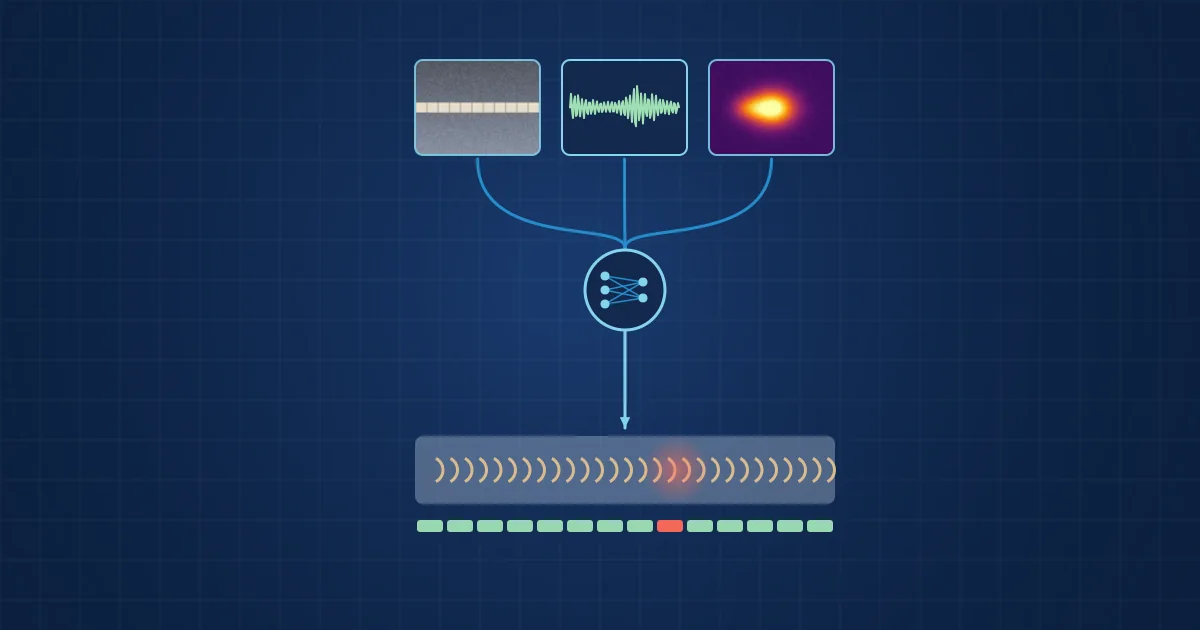
The case for multimodal inspection follows from the physics of the weld. A laser weld emits light, heat and sound, and leaves a seam surface with a specific geometry. Each of these carries a different part of the story. A camera sees the seam but not what happened underneath. Sound carries information about keyhole dynamics, as my colleague Saichand Gourishetti described in acoustic monitoring of laser welding. Combining modalities reduces the number of defects that fall into the blind spot of any single sensor. The defect catalogue for battery cell welding, from lack of fusion to piercing and intermetallics, is covered in laser welding of battery cells: defects and inspection.
The machine learning element is what makes small batches possible in principle. Instead of hand-tuning thresholds for each product, models learn what a good weld looks and sounds like from recorded, verified examples.
The pilot plant demonstration
The project page states that all project results were to be demonstrated in a pilot plant, and that the inline testing method with its assistance system could later be used in large-scale production as well. A pilot plant demonstration matters for two reasons, in this project as in any other.
First, it tests a measurement chain under production-like conditions, with fixtures, extraction and cycle times closer to a factory than a bench set-up in a quiet lab. Second, it is the place where sensing, models, process control and the operator interface have to work together, rather than as separate deliverables.
The assistance system: putting operators in the loop
The fourth goal, the digital assistance system, is easy to overlook and is in my view one of the more important ideas in the project. Inline inspection that only produces red and green lights does not help an operator decide what to change. An assistance system that shows which defect pattern is occurring, and which process adjustments have helped before, turns inspection data into a tool for the person at the machine.
The related goal of recording operators' experience systematically points the same way. Much of the knowledge about why a welding cell behaves as it does lives in the heads of experienced operators. Capturing it alongside sensor data makes the data easier to label and the models easier to trust. Our post on labelling multimodal industrial datasets discusses the practical side of that.
What carries forward
For NeuroControls, the most concrete outcome of e-LAS+ is the measurement chain. Together with the e-WAS feasibility study on spot welding from 2021, it forms the basis of our Process Monitoring Kit: the Edge AI Hub with an Acoustic Node and a Vision Node, and optionally a Vibration Node. The kit is built to order.
The Acoustic Node in that chain uses a Microtech Gefell MK 301 E measurement capsule, with a capture band from 2 to 100 kHz, production-proven from 2 to 20 kHz. When it is built as a hub node, its recordings get the hub's versioned manifest, per-segment SHA-256 hashes and append-only journal, so each weld record can be traced back to its source data.
Open questions for the field
Three years of research answer some questions and sharpen others. These are the ones I expect the industry to keep working on, independent of any single project:
- Transfer between joint types. How much new training data does a model need when the material pairing or geometry changes?
- Ground truth at scale. Destructive tests are the reference, but they are slow. How can labelling effort be reduced without weakening the reference? One research route is an independent reference measurement: Shevchik et al. (2020) used high-speed X-ray radiography as ground truth for acoustic emission and laser back-reflection signals in laser welding.
- Closing the loop. Inspection that feeds back into process adaptation needs clear rules for when the system may adjust parameters and when it must stop and ask.
- Evidence and traceability. As battery data becomes subject to regulation, per-weld inspection records will be asked to stand up as evidence. Their integrity has to be designed in.
Where NeuroControls fits
We are continuing the work started in e-LAS+ and e-WAS in feasibility studies, pilots and follow-up research. An overview of our funded projects, including e-LAS+, e-WAS and EdgeAI, is on the research projects page, and the demonstrators built in these projects are described under research demonstrators. The Process Monitoring Kit and the other kit configurations are listed on the kits page.
Frequently asked questions
What was the e-LAS+ project?
e-LAS+ was a German research project titled "Multimodal quality assurance for production of electricity storage in safety-critical systems". Its project period was May 2023 to April 2026, according to the Fraunhofer IDMT project page. Its partners were Fraunhofer IDMT, NeuroControls, SSI Software Service, SITEC and VRI, and it was funded by the Federal Ministry for Economic Affairs and Climate Action. It worked on machine-learning-based multimodal inline inspection of laser weld seams in battery cell production.
Who were the partners in e-LAS+?
The partners were Fraunhofer IDMT in Ilmenau, NeuroControls GmbH, SSI Software Service GmbH, SITEC Industrietechnologie GmbH and VRI GmbH. Fraunhofer IDMT focused on a multimodal inline measurement method with an emphasis on airborne sound analysis and on multivariate machine learning algorithms for quality assurance.
What problem did e-LAS+ address?
Finding optimal laser welding parameters for battery cells typically required an elaborate, iterative process with many destructive tests. That is costly, especially for small batch sizes. e-LAS+ aimed to replace part of this effort with inline inspection based on machine learning, predictive process adaptation and a digital assistance system for machine operators.
Where were the e-LAS+ results demonstrated?
According to the project description, all project results were to be demonstrated in a pilot plant. The developed inline testing method with its assistance system was also intended to be applicable later in large-scale production. Detailed technical results are for the consortium partners to publish.
How are e-LAS+ results used in NeuroControls products?
The measurement chain developed in e-LAS+, together with the earlier e-WAS spot welding feasibility study, is the basis of the NeuroControls Process Monitoring Kit. The kit combines the Edge AI Hub with an Acoustic Node and a Vision Node, optionally a Vibration Node, and is built to order.
Sources and further reading
- Fraunhofer IDMT: e-LAS+ project page
- Fraunhofer IDMT: Welding seam inspection by non-destructive testing
- Fraunhofer IDMT: Industrial sound analysis, research and practice
- Shevchik et al. (2020): Supervised deep learning for real-time quality monitoring of laser welding with X-ray radiographic guidance, Scientific Reports 10, 3389