
Short answer
Labelling multimodal industrial datasets works best when you design the label scheme before labelling, label each event in the modality where it is clearest, and propagate labels to the other streams using recorded time stamps and offset uncertainty. Use process records such as test results and maintenance logs as weak labels, double-label a sample to measure agreement, and document the dataset.
Key takeaways
- A label scheme with separate levels for state, fault class and severity, plus an explicit "uncertain" option, saves weeks of relabelling later.
- Label each event in the modality where a human sees it most clearly, then carry the label to other streams with a time window that reflects the recorded offset uncertainty.
- Process data such as end-of-line test results, maintenance work orders and operator notes can provide weak labels for large volumes of data at low cost.
- Even curated benchmark test sets contain errors: Northcutt and colleagues estimated an average of at least 3.3 % label errors across ten widely used datasets.
- Split training and test data by machine, batch or day rather than by random sample, and document how the dataset was built.
Labelling multimodal industrial datasets is where many sensing projects quietly lose months. The recording works, the sensors are fine, and then someone has to decide what every second of vibration, sound, video and thermal data actually shows. Done ad hoc, that job grows without end and produces labels nobody fully trusts.
This article sets out a workflow we find practical: design the scheme first, label where it is easiest, propagate carefully, borrow labels from the process, and measure quality instead of assuming it.
Why labelling multimodal industrial datasets is harder than labelling images
Image labelling has mature tools and a simple unit of work: one picture, one answer. Industrial multimodal data breaks that in several ways.
- Most data is unremarkable. A machine runs normally for weeks. Faults are rare, short and often unclear.
- Not every modality is human-readable. An operator can recognise a misplaced part on video. Very few people can label a raw 200 kSPS vibration trace by eye.
- Streams run at different rates and on different clocks. A label set on a video frame must be mapped onto vibration and thermal data recorded at other rates.
- Ground truth is often delayed. Whether a weld was good may only be known after a destructive test or an end-of-line check, hours later.
- The experts are busy. The people who know what a fault looks like are maintenance engineers and process specialists, not full-time annotators.
A workable process has to respect all five constraints.
Design the label scheme before anyone labels
The single most effective step is to agree the label scheme in writing before the first label is set. A good scheme has levels that match how models will be used later, which typically means a ladder from "is it normal?" to "what is it?" to "how bad is it?". Our article on anomaly detection, classification and severity grading describes that ladder from the model side.
| Label level | Question it answers | Typical values | Who can set it |
|---|---|---|---|
| State | What was the machine doing? | Running, idle, start-up, changeover | Automatically from control data |
| Normality | Is this normal? | Normal, abnormal, uncertain | Operator or engineer |
| Fault class | What is wrong? | Bearing outer race, looseness, spatter, porosity | Specialist, often after inspection |
| Severity | How bad is it? | Grades agreed with maintenance or quality | Specialist with reference examples |
| Sensor status | Can this data be trusted? | Valid, dropout, saturated, loose | Automatically from sensor health data |
Three rules make the scheme robust:
- Always include "uncertain". Forcing a labeller to choose between "good" and "bad" when they do not know creates confident wrong labels.
- Separate sensor problems from machine problems. A loose accelerometer is not a bearing fault, and mixing the two teaches models the wrong lesson.
- Decide event versus segment labels per class. A spatter event has a moment; a worn bearing has a period. Write down which classes are points in time and which are intervals.
Name fault classes in the vocabulary your maintenance and quality teams already use. For condition monitoring, ISO 13379-1:2025 sets out common concepts for diagnostics so that users and manufacturers describe machine states the same way, which makes it a sensible reference for class definitions.
Label in the modality that shows the fault best, then propagate
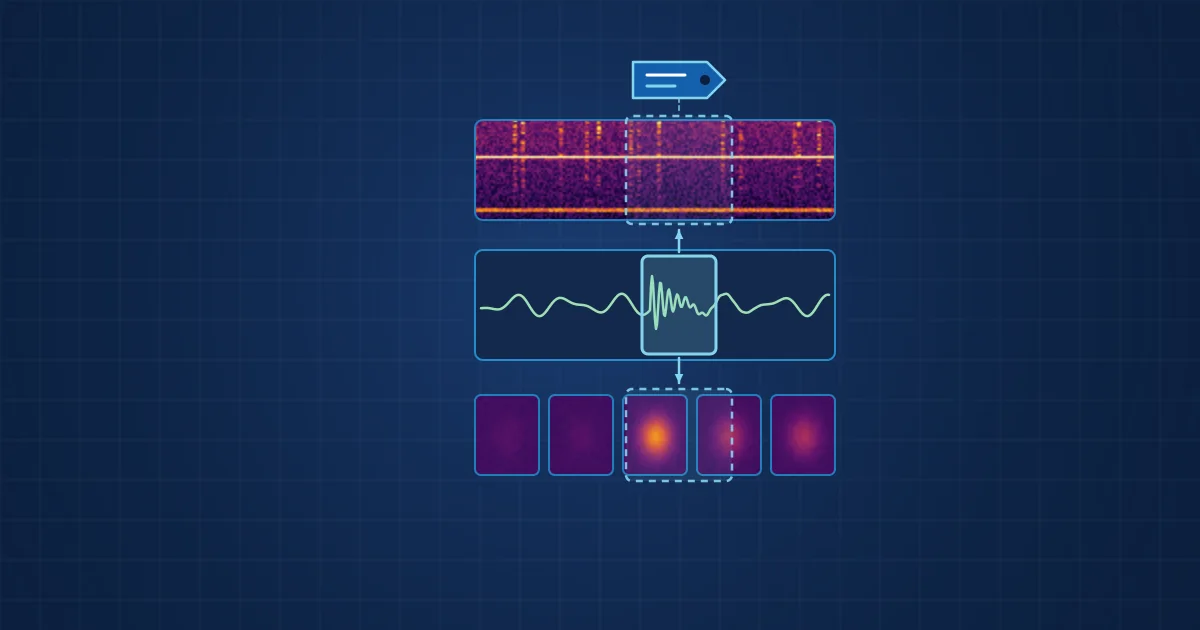
For each fault class, ask in which stream a human recognises it most easily. A part out of position is obvious on video. A cooling anomaly is obvious on thermal images. An impact may be clearest on the vibration envelope or the spectrogram of the sound. Label there.
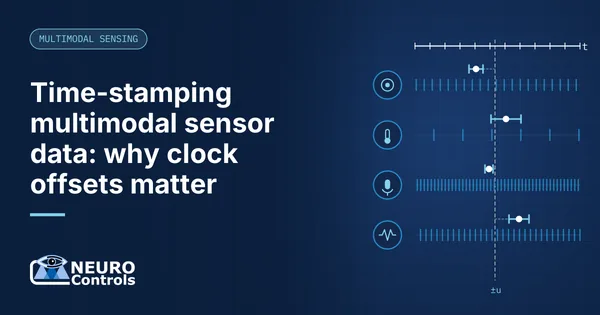
Then carry the label to the other streams using time stamps. This is where time-stamping discipline pays off. If each stream's offset to the reference clock and its uncertainty are recorded, the propagated label becomes a window: the labelled moment plus and minus the combined uncertainty, plus any physical delay between modalities, such as heat taking time to reach the surface. Our article on time-stamping multimodal sensor data explains how those offsets are recorded.
Two practical tips:
- Label windows generously, then trim. A label window that is too tight cuts off the start of the event in the slower or later stream. Models can be trained to find the event inside a slightly wider window.
- Show the streams together. A labelling view that displays video, thermal frames, spectrogram and vibration envelope on a common time axis lets labellers confirm events across modalities, which is faster and more reliable than labelling streams one at a time.
Use the process as a labeller
Many industrial labels already exist somewhere; they just are not attached to the sensor data. These are weak labels: labels that are cheap and plentiful but less precise in time or content than a human annotation.
- End-of-line and destructive test results label a part or weld as good or bad, even if they do not say when during the process the problem occurred.
- Maintenance work orders label a period before a repair as "fault developing" and a period after as "repaired".
- Control and MES data label machine states, product types and recipe changes automatically.
- Operator notes and shift logs mark unusual events, often with rough times.
Weak labels are ideal for the state and normality levels and for selecting which segments deserve expert attention. They are less suited to precise fault localisation. A common pattern is to use weak labels to pick a few hundred candidate segments, then have a specialist label those precisely.
Measure label quality instead of assuming it
Labels are measurements, and like any measurement they have errors. Even carefully curated public benchmarks contain them: Northcutt, Athalye and Mueller estimated an average of at least 3.3 % label errors across the test sets of ten commonly used datasets, and at least 6 % of the ImageNet validation set. Industrial data, labelled by busy experts under time pressure, is unlikely to do better.
Practical quality measures:
- Double-label a sample. Have two people label the same 5 to 10 % of segments independently and compare. Agreement statistics such as Cohen's kappa correct for agreement by chance; more useful still is reading the disagreements, which usually reveal unclear class definitions.
- Keep a review queue. Route "uncertain" labels and model-label disagreements to a specialist.
- Track label provenance. Record who set each label, when, in which modality, with which tool version and under which scheme version.
- Re-check after model training. Segments where a trained model strongly disagrees with the label are good candidates for review; some will turn out to be label errors.
Split and document the dataset
The way you split data into training and test sets matters as much as the labels. If segments from the same machine, batch or day appear in both, a model can learn to recognise the machine or the day rather than the fault. Split by machine, batch, specimen or time period, and keep a test set that nobody touches until the end. Our article on validating industrial AI models covers this shortcut-learning risk in detail.
Document the dataset as you build it. The Datasheets for Datasets proposal by Gebru and colleagues suggests recording a dataset's motivation, composition, collection process and recommended uses, modelled on the datasheets that accompany electronic components. For an industrial dataset, add sensor types and positions, mounting, sample rates, time-stamping method, label scheme version and known gaps.
Store labels in a plain, appendable format. JSON Lines, with one JSON value per line, works well for label records: each label is one line, files can be appended and diffed, and any tool can read them.
A labelling workflow that stays manageable
Putting it together, this procedure keeps labelling effort bounded:
- Agree the label scheme, including "uncertain" and sensor-status labels, and version it.
- Import process data (tests, work orders, states) as weak labels.
- Use weak labels and simple anomaly scores to select candidate segments for expert review.
- Label candidates in the clearest modality, in a view that shows all streams on a common time axis.
- Propagate labels to other streams with windows based on recorded offset uncertainty.
- Double-label a sample and resolve disagreements by refining class definitions.
- Split by machine, batch or time; freeze the test set.
- Document the dataset and keep label provenance with every record.
How much labelled data you need depends heavily on the task; for one modality, our piece on training data for acoustic quality inspection discusses the trade-offs.
How NeuroControls approaches labelling
Today, our engineers build labelled datasets together with customers and train custom models on them, from feature extraction and anomaly detection to fault and multi-fault classification and severity grading; the models and validation page describes the approach. Every stream is time-stamped on the hub, and each node's clock offset is written into every record with its uncertainty, which is what label propagation needs.
On our cognitive sensors, signal health and dropouts are flagged at the edge and gaps are noted in the record, so dropouts can be used as sensor-status labels. Recordings export to NWB, MKV/HEVC, JSONL and CSV through our recording software. A self-service framework with labelling, training and deployment screens is coming soon.
Frequently asked questions
How do you label sensor data that humans cannot interpret directly?
Label it indirectly. Find the modality in which people can recognise the event, such as video, thermal images or a spectrogram, and label there. Then propagate the label to raw signals like vibration using recorded time stamps and offset uncertainty. Process records such as test results and maintenance logs provide further labels for data that no human could read by eye.
What are weak labels in industrial machine learning?
Weak labels are labels obtained cheaply from existing sources rather than careful human annotation. Examples are end-of-line test results, maintenance work orders, machine states from control systems and operator notes. They are plentiful but imprecise in time or content. They work well for normal-versus-abnormal and state labels, and for selecting segments that a specialist should then label precisely.
How many label errors are normal in a dataset?
There is no fixed figure, but errors are always present. A NeurIPS 2021 study by Northcutt and colleagues estimated an average of at least 3.3 % label errors across the test sets of ten widely used benchmark datasets. Industrial labels, often set under time pressure and with delayed ground truth, should be checked through double labelling, review queues and model-label disagreement analysis.
Should I label each sensor stream separately?
Usually not. Labelling each stream separately multiplies effort and creates inconsistent labels for the same event. It is more efficient to label an event once, in the modality where it is clearest, using a view that shows all streams on a common time axis, then propagate the label to the other streams with a time window that reflects the recorded clock offset uncertainty.
How should a multimodal industrial dataset be split for training and testing?
Split by machine, batch, specimen or time period rather than randomly by segment. Random splits put near-identical data from the same machine and day into both sets, which lets a model score well by recognising the machine instead of the fault. Keep one test set untouched until final evaluation, and document the split in the dataset description.
Sources and further reading
- Northcutt, Athalye, Mueller: Pervasive Label Errors in Test Sets Destabilize Machine Learning Benchmarks (NeurIPS 2021)
- Gebru et al.: Datasheets for Datasets
- JSON Lines format specification
- ISO 13379-1:2025 Condition monitoring and diagnostics of machine systems, data interpretation and diagnostics techniques