
Short answer
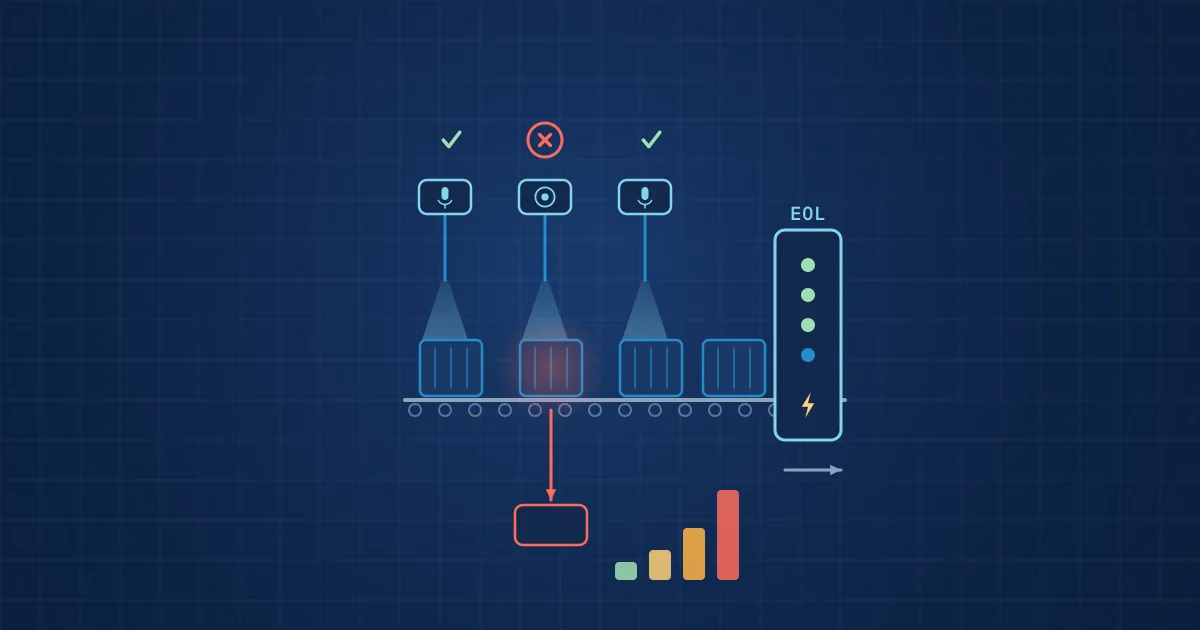
Inline inspection checks each process step, such as every cell connection weld, while the module is being built. End-of-line inspection tests the finished module: voltages, insulation, communication, leak tightness. End-of-line tests prove the module works when it leaves the line; inline inspection catches defects that still pass those tests, such as mechanically weak welds, and finds them while rework is still possible.
Key takeaways
- A typical battery module end-of-line test checks visual tolerances, communication and sensors, cell voltages and balancing, state of charge, high-voltage insulation and, where relevant, leak tightness.
- End-of-line electrical tests measure the module as a whole, so they cannot reliably detect single welds that conduct well today but are mechanically weak; where cells sit in parallel groups, even one open joint changes module values only slightly.
- Inline inspection finds defects at the station that caused them, which allows rework before the module is closed and links each defect to a specific joint and parameter set.
- A sound strategy uses inline inspection for process-specific defects and end-of-line tests for functional verification, with both results stored against the same module identifier.
Every battery module line has an end-of-line test. Fewer lines inspect every joint while it is made. The debate about inline vs end-of-line inspection usually starts after a field failure that the end-of-line test did not catch, or after a week of scrapped modules that could have been reworked if someone had noticed earlier.
This post defines both, shows what each one can and cannot see in module assembly, and gives a practical way to split the work.
Definitions: inline inspection and end-of-line testing
Inline inspection is an automated check carried out at or immediately after a production step, on every part, at line speed. In module assembly the most important inline checks sit at the cell contacting station, where cells are welded to busbars or connectors.
End-of-line (EOL) testing is the functional test of the finished module or pack before it is released. It verifies that the product meets its electrical and mechanical specification as a whole.
The two are not alternatives. They answer different questions. EOL asks: does this module work? Inline asks: was this step done right?
What a module end-of-line test covers
The module and pack assembly guide by PEM RWTH Aachen and VDMA lists the module test after the end plate is mounted. It includes:
- external irregularities against optical tolerances
- function of communication and sensors, as a software test
- cell voltages and cell voltage differences (balancing)
- state of charge of the module
- high-voltage strength, by resistance measurement
- if applicable, leak tightness of the cooling circuit and module, for example by test gas, overpressure or vacuum
For the pack test, the same guide notes that there is no uniform specification and that a criteria catalogue has to be defined for a comprehensive test. In other words, each manufacturer writes its own.
What inline inspection adds
The same guide describes the inline side at the cell contacting station: joints are checked for conductivity by resistance measurement, and with a high degree of automation the weld seams can be checked optically during welding. For the cell monitoring board, it describes signal checks plus sampled inspection of welds by X-ray or ultrasound.
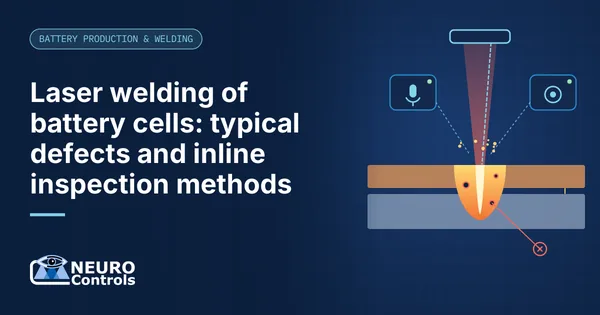
Inline inspection at the welding station can include:
- gap and position measurement before welding
- process signals during welding: photodiodes, cameras, optical coherence tomography, acoustics, electrode force and displacement
- seam surface inspection after welding
- per-joint resistance measurement
The individual methods are compared in our posts on laser welding defects and inspection and on monitoring resistance spot welds on battery tabs.
Side-by-side comparison
| Aspect | Inline inspection | End-of-line test |
|---|---|---|
| When | During or right after each step | After assembly is complete |
| Unit of judgement | Single joint or component | Whole module |
| Typical defects found | Gap, lack of fusion, piercing, pores, expulsion, misplacement | Wrong cell voltage, insulation failure, sensor or communication faults, leaks |
| Latent defects (weak but conductive joints) | Detectable with suitable process signals | Usually not detectable |
| Rework | Often possible before the module is closed | Often limited, scrap more likely |
| Root cause | Linked directly to station and parameters | Must be traced back |
| Coverage | Process-specific | Functional, product-wide |
| Data volume | High, per joint | Low, per module |
The defects that pass an end-of-line test
The critical category is the joint that conducts well enough today but will not last. EOL electrical tests measure the module as a whole and as it is now: voltages, insulation, resistance. Where cells and their joints sit in parallel groups, a single weak or even open joint changes module voltage and resistance only slightly: as an illustration, with 24 identical connections in parallel, losing one raises the group's connection resistance by only about 4 %. And a weld with a small bonded area, porosity or brittle intermetallics can carry current perfectly well on day one, so it may not change the module's electrical values at all.
Two published studies illustrate the problem. On 18650 cells spot welded to nickel-plated steel (Hilumin) connectors, Masomtob et al. found minimal differences in electrical resistance between welds and had to use shear strength to decide weld quality. For copper-to-aluminium laser welds on battery tabs, Kaufmann et al. found that resistance varied only slightly with process parameters (by less than 13 % across all parameter sets), although it did correlate with tensile strength. Detecting such small differences needs a precise measurement on each joint, which a module-level EOL test does not provide.
There is also a safety case. If a laser weld pierces the cell can, the cell may still pass voltage checks at EOL. A 2025 study by Basile et al. on busbar-to-terminal welds points out that an undetected through-penetration can puncture the cell, with possible electrolyte leakage and thermal runaway later. That defect has to be caught at the welding station.
The cost of finding defects late
Detection late in the line is expensive for three reasons. The module has accumulated value from every step since the defect occurred. A welded connection inside a closed module is hard or impossible to rework. And the root cause is harder to find, because the information about which parameter set, electrode or shift produced the defect has to be reconstructed.
Research on cell production shows the same logic. Xu et al. (2025) deployed machine-learning "virtual quality gates" on a pilot pouch cell line to predict end-of-line results at intermediate steps, so that low-performing cells could be rejected before later, costlier steps. They note that the full cycling-based assessment may take over a month. The principle carries over to modules: the earlier a reliable judgement is available, the cheaper the defect.
How to split inspection between inline and end-of-line
A practical procedure for a module line:
- List the failure modes of the module, from FMEA or field returns, and rank them by severity.
- For each failure mode, ask whether it changes a measurable property of the finished module. If yes, EOL can verify it. If no, it needs an inline check.
- Place inline checks at the station that creates the defect, not later. For cell connections that means the welding station.
- Validate every inline signal against destructive tests (cross-sections, peel or shear) on a labelled sample before trusting it.
- Keep EOL tests focused on function and safety: insulation, voltages, communication, leak tightness.
- Store inline and EOL results against the same module identifier, so that both can be queried together when a module comes back.
- Review regularly which inline findings would have been caught at EOL anyway, and which EOL failures had no inline precursor. Both lists tell you where coverage is missing.
The data question in step 6 is becoming more pressing with the EU battery passport. The passport itself does not require process data, as discussed in where weld quality data fits in the battery passport, but its unique identifier is the obvious key for linking inline and EOL records.
Why a single inline sensor is rarely enough
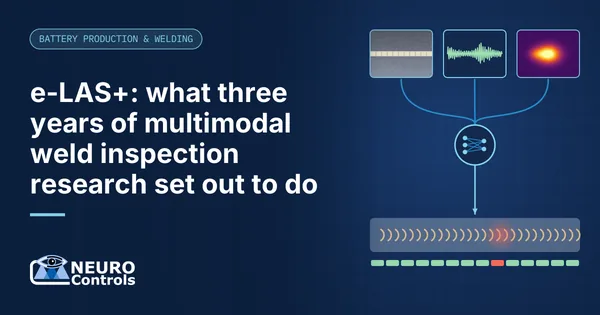
Inline inspection fails when it relies on one signal that sees one aspect of the process. A camera sees the seam surface but not the depth. A resistance check sees conductivity, which is only an indirect indicator of strength. Acoustic or vibro-acoustic signals carry information about keyhole stability or mechanical coupling, but need training data. The general argument is laid out in why single-sensor monitoring misses faults.
How NeuroControls approaches this
We focus on the inline side: sensing at the welding station, with one result per weld from a model our engineers train on your data, keyed to the module barcode. The machine's controller stays untouched. Our Process Monitoring Kit combines the Edge AI Hub with an Acoustic Node and a Vision Node, optionally with a Vibration Node, and is built on the measurement chain from our e-LAS+ and e-WAS research. Each sensor reports its signal health and dropouts with its data, so a dropout is visible in the record.
More detail is on our process and condition monitoring solutions page and the battery production overview. Kit configurations are listed on the kits page.
Frequently asked questions
What is the difference between inline and end-of-line inspection?
Inline inspection checks each production step on every part while the product is being built, for example every weld at the cell contacting station. End-of-line inspection tests the finished module or pack as a whole, for example voltages, insulation and communication. Inline asks whether a step was done right; end-of-line asks whether the product works.
What does a battery module end-of-line test include?
A typical module end-of-line test covers optical tolerances, function of communication and sensors, cell voltages and balancing, module state of charge, high-voltage insulation by resistance measurement and, where relevant, leak tightness of the cooling circuit and housing. Pack-level test catalogues are defined by each manufacturer, as there is no uniform specification.
Can an end-of-line test detect bad welds in a battery module?
It detects connection faults that change module voltages or resistance noticeably. Where cells and their joints sit in parallel groups, a single weak or even open joint changes module-level values only slightly, and a weld that conducts well but is mechanically weak, porous or brittle may not change them at all on day one. Those latent defects can fail later under vibration and thermal cycling, so they need inline inspection at the welding station.
Is inline inspection more expensive than end-of-line testing?
Inline inspection needs sensors at each relevant station and generates more data, so the equipment cost is higher. It saves money by finding defects before more value is added, by allowing rework before modules are closed, and by linking each defect directly to its cause. Which is cheaper overall depends on defect rates and the cost of field failures.
Should inline and end-of-line results be stored together?
Yes. Storing both against the same module identifier lets you trace a field return to the joint and parameters that produced it, and lets you check which inline findings EOL would have caught anyway. The EU battery passport's unique identifier is a convenient common key, even though the passport itself does not require process data.
Sources and further reading
- PEM RWTH Aachen and VDMA: Montageprozess eines Batteriemoduls und -packs (3rd edition, 2018)
- Masomtob et al. (2017): Parametric study of spot welding between Li-ion battery cells and sheet metal connectors, Engineering Journal 21(7)
- Kaufmann et al. (2023): Seam properties of overlap welding strategies from copper to aluminum using green laser radiation for battery tab connections, Materials 16(3) 1069
- Basile et al. (2025): Monitoring part-to-part gap and laser power effects in remote laser welding of 1050 aluminum busbar-to-terminal connections via optical microphone sensing
- Xu, Stier, Gronbach, Moeckel (2025): Deploying virtual quality gates in a pilot-scale lithium-ion battery assembly line, Batteries 11(8) 285