
Short answer
From 18 February 2027, every LMT battery, every industrial battery above 2 kWh and every electric vehicle battery placed on the EU market needs a battery passport under Article 77 of Regulation (EU) 2023/1542. Manufacturers must record the model data listed in Annex XIII (identity, composition, carbon footprint, performance, dismantling, test reports) plus individual battery data such as state of health, status and usage events, each with defined access rights.
Key takeaways
- The EU battery passport becomes mandatory on 18 February 2027 for LMT batteries, industrial batteries with a capacity greater than 2 kWh and electric vehicle batteries.
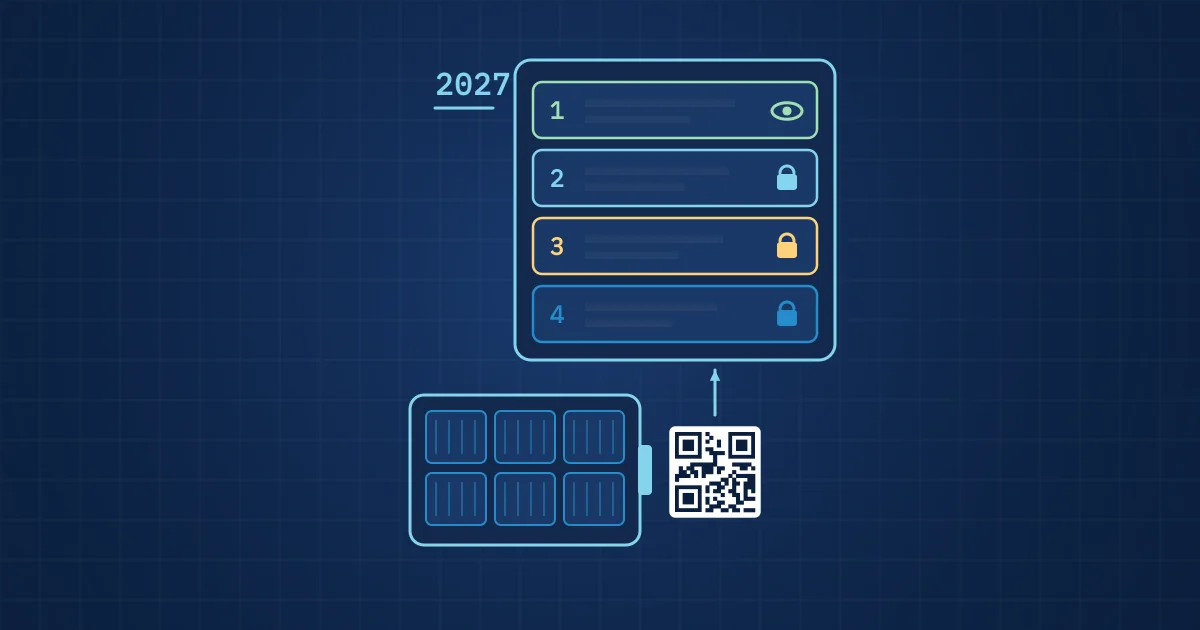
- Annex XIII sorts the content into four access tiers: public model data, model data for persons with a legitimate interest, test reports for authorities only, and individual battery data for persons with a legitimate interest.
- The passport is reached through a QR code linked to a unique identifier that must follow the ISO/IEC 15459 series, and the economic operator placing the battery on the market is responsible for keeping it accurate, complete and up to date.
- DIN DKE SPEC 99100, published in January 2025 and free to download, translates the legal requirements into concrete data attributes and is the most practical starting point for a data model.
- Production process data such as weld records are not listed in Annex XIII, but the passport's integrity requirements reward manufacturers whose line data is already traceable per battery.
The EU battery passport is an electronic record attached to an individual battery. It is required by Article 77 of Regulation (EU) 2023/1542, the EU Battery Regulation, and it applies from 18 February 2027. If you build LMT, industrial or traction batteries, the question is no longer whether you need a passport but which data you must record, at which granularity, and who is allowed to read it.
This guide works through the legal text clause by clause, then translates it into what a production and quality team actually has to set up. I have kept the regulation's own wording where precision matters. Interpretation is mine, not legal advice.
What is the EU battery passport?
A battery passport is a structured, machine-readable electronic record that holds information about a battery model and about one specific battery. Article 77(1) states that from 18 February 2027 each LMT battery, each industrial battery with a capacity greater than 2 kWh and each electric vehicle battery placed on the market or put into service "shall have an electronic record ('battery passport')".
Three features distinguish it from a datasheet. First, it mixes model-level information, which is the same for every unit of a type, with data specific to the individual battery, including data that results from its use. Second, it is layered: different readers see different fields. Third, it lives as long as the battery does. The passport only ceases to exist once the battery has been recycled (Article 77(8)).
The regulation also says how the data must be held. Article 77(5) requires information based on open standards, in an interoperable, machine-readable, structured and searchable format, transferable "without vendor lock-in". That rules out a PDF on a web server as a long-term answer.
Which batteries need a passport from 18 February 2027?
The scope follows the battery categories defined in Article 3 of the regulation. The weight thresholds matter, because they decide whether a traction battery for a two-wheeler counts as LMT or as an electric vehicle battery.
| Category (Article 3) | Definition in short | Passport from 18 Feb 2027 |
|---|---|---|
| LMT battery | Sealed, 25 kg or less, designed for traction of light wheeled vehicles such as e-bikes and e-scooters | Yes |
| Industrial battery | Designed for industrial uses, or any other battery over 5 kg that is not EV, LMT or SLI | Yes, if capacity is greater than 2 kWh |
| Electric vehicle battery | Traction battery for M, N or O category vehicles, or for L category vehicles above 25 kg | Yes |
| Stationary battery energy storage system | A sub-category of industrial battery that stores and delivers energy to the grid or end-users | Yes, as an industrial battery above 2 kWh |
| Portable and SLI batteries | Small sealed batteries and starter batteries | No passport, but a QR code |
Note the last row. Article 13(6) requires all batteries to carry a QR code from 18 February 2027. For the three passport categories, that QR code leads to the passport. For the others, it leads to the label and conformity information.
What manufacturers must record: Annex XIII in four tiers
Annex XIII is the core of the obligation. It lists the passport content and, for each block, who may access it. Article 77(2) maps the access rights: public, notified bodies and market surveillance authorities plus the Commission, and natural or legal persons with a legitimate interest.
Tier 1: public information on the battery model
Point 1 of Annex XIII lists what anyone with the QR code must be able to see. It includes:
- the general label information of Annex VI Part A: manufacturer, battery category, place and date of manufacture (month and year), weight, capacity, chemistry, hazardous substances, usable extinguishing agent and critical raw materials above 0.1 % w/w
- material composition, including chemistry, hazardous substances other than mercury, cadmium or lead, and critical raw materials
- the carbon footprint information referred to in Article 7(1) and (2)
- responsible sourcing information from the due diligence report, recycled content and the share of renewable content
- rated capacity in Ah, minimal, nominal and maximum voltage, original power capability in watts, expected lifetime in cycles with the reference test, and the capacity threshold for exhaustion (EV batteries only)
- the temperature range the battery can withstand when not in use, the commercial warranty period for calendar life, initial round trip efficiency and efficiency at 50 % of cycle life, internal cell and pack resistance, and the C-rate of the cycle-life test
- marking requirements, the EU declaration of conformity and waste prevention information
One field in this list will not be fillable on day one. Regulation (EU) 2025/1561 postponed the battery due diligence obligations of Article 48 from 18 August 2025 to 18 August 2027, so when the passport starts in February 2027 there is no due diligence report from which to take the responsible sourcing information. In its May 2026 guidance for the battery industry, the Commission said the due diligence report has to be included in the passport by August 2028 at the latest.
Tier 2: model information for persons with a legitimate interest
Point 2 covers data that repairers, remanufacturers, second-life operators and recyclers need, but competitors should not get for free. It includes detailed composition including cathode, anode and electrolyte materials, part numbers and sources for spare parts, safety measures, and dismantling information. The dismantling block is specific: exploded diagrams showing cell locations, disassembly sequences, the type and number of fastening techniques, tools required, warnings where parts can be damaged, and the number of cells and their layout.
Tier 3: test reports for authorities only
Point 3 adds the results of test reports proving compliance with the regulation and its delegated and implementing acts. Only notified bodies, market surveillance authorities and the Commission may see them.
Tier 4: individual battery data for persons with a legitimate interest
Point 4 is where the passport stops being a static document. For each individual battery it requires:
- the values of the performance and durability parameters of Article 10(1), when the battery is placed on the market and when its status changes
- state of health information pursuant to Article 14
- the battery status: original, repurposed, re-used, remanufactured or waste
- information resulting from use, including the number of charge and discharge cycles, negative events such as accidents, and periodically recorded operating conditions including temperature and state of charge
Who counts as a person with a legitimate interest is still open. Article 77(9) required the Commission to adopt implementing acts by 18 August 2026 specifying who these persons are, which information they may access and how far they may download, share, publish and re-use it. That deadline passed without an implementing act being adopted; the Commission's own timeline of May 2026 places the act on battery access rights in the fourth quarter of 2026. The passport obligation itself still applies from 18 February 2027.
Model data versus individual battery data: what changes on the line
Most of tiers 1 to 3 is model-level data. You produce it once per battery model (the carbon footprint declaration is drawn up per model per manufacturing plant, according to Article 7(1)) and update it when the model changes. That is document management, not production data.
Tier 4 and a few public fields are different. Place and date of manufacture appear on the label of every unit. The performance values at placing on the market belong to that specific battery. From the factory's point of view, this means the passport needs a reliable link between a serial number and the end-of-line measurements taken on that unit.
In practice, the hard part is rarely the passport platform. It is the data plumbing in the plant: which system knows the final capacity, the internal resistance and the manufacturing date of battery number 4711, and whether that system can hand them over in a structured format without someone copying values out of a spreadsheet. If your MES already stores per-unit results, you are in good shape. If test results live on individual test benches, start there.
Identifier, responsibility and the passport's lifetime
Unique identifier and QR code
Article 77(3) says the passport is accessed through the QR code referred to in Article 13(6), which links to a unique identifier attributed by the economic operator placing the battery on the market. Both the QR code and the identifier must comply with ISO/IEC 15459 parts 1 to 6 or their equivalent. The Commission has announced that these references will be updated by delegated act to the new European standards EN 18219 and EN 18220, and that the currently referenced standards remain usable as equivalents in the meantime. The ISO/IEC 15459 series defines unique identification for automatic identification and data capture; part 1, for example, covers individual transport units.
Article 13(7) requires the QR code to be printed or engraved visibly, legibly and indelibly on the battery. Where that is not possible because of the nature and size of the battery, it goes on the packaging and accompanying documents. Annex VI Part C asks for high contrast and a size readable with an ordinary handheld device.
Article 77(10), inserted by Article 78 of the Ecodesign Regulation (EU) 2024/1781, adds a registration step: the economic operator placing the battery on the market or putting it into service must upload the unique identifier to the Commission's digital product passport registry. That registry went live with a testing environment on 20 July 2026.
Two practical consequences follow. The identifier must be assigned before the battery leaves the line, ideally at the point where the pack or module first gets a physical identity, so that all later process and test data can attach to it. And the marking process becomes a quality characteristic in its own right: an unreadable code means an inaccessible passport.
Who is responsible, and for how long?
Article 77(4) puts the responsibility on the economic operator placing the battery on the market. It must ensure the information is "accurate, complete and up to date" and may authorise another operator in writing to act on its behalf. Service providers are allowed, but the duty stays with you.
The responsibility moves when the battery's life changes:
- after preparation for re-use, repurposing or remanufacturing, the operator who places the battery on the market again becomes responsible, and the battery gets a new passport linked to the original one (Article 77(7))
- when the battery becomes waste, responsibility passes to the producer, its producer responsibility organisation or the waste management operator
- after recycling, the passport ceases to exist
Article 78 then sets essential requirements for the technical design. Among them: the passport must be interoperable with other digital product passports, access must be free of charge, data is stored by the responsible operator or someone acting on its behalf, service providers may not sell or re-use the data, the passport must remain available if the responsible operator ceases to exist, and "data authentication, reliability and integrity shall be ensured". That last requirement will matter more than it looks, because it applies to every value you write.
Standards and guidance you can use today
The regulation tells you what to provide but not how to name, type and structure each field. Two pieces of work fill that gap.
The Battery Pass consortium, a German-funded project, published a content guidance in 2023 that groups the attributes into clusters such as general battery and manufacturer information, carbon footprint, supply chain due diligence, materials and composition, circularity and resource efficiency, and performance and durability. The consortium also maintains a data attribute longlist and an open data model on GitHub.
Building on that guidance, DIN and DKE published DIN DKE SPEC 99100 in January 2025. According to the VDE press release, it defines the data attributes to be included in the digital battery passport, covering both regulatory requirements and voluntary additions, and it is free to download from DIN Media. The Battery Pass content guidance itself now carries the note that it has been superseded by DIN DKE SPEC 99100, so use the SPEC as your reference.
A readiness checklist for battery manufacturers
The following procedure is the order in which I would tackle the passport in a module or pack plant. It assumes the battery model is already designed and the conformity work is under way.
- Confirm scope: list every battery model you place on the EU market and classify each by Article 3 category and capacity.
- Map Annex XIII to attributes: use DIN DKE SPEC 99100 to turn each legal point into named fields with units and data types.
- Assign ownership: for each field, name the source system (PLM, LCA tool, MES, test bench, BMS) and the person accountable for its accuracy.
- Fix the identifier: decide where in the line the unique identifier is created and marked, make sure every downstream station reads it, and plan the upload of each identifier to the Commission's passport registry required by Article 77(10).
- Close the per-unit gap: verify that end-of-line values (capacity, resistance, voltage limits) are stored per serial number, not just as pass or fail.
- Define access tiers: tag each field as public, legitimate interest, authorities only or individual-battery data, and check that your platform enforces this.
- Plan for change of status: decide how repurposing, remanufacturing and end-of-life updates will reach the passport, including the written authorisation of service providers.
- Prove integrity: make sure every value written can be traced back to its origin, with time stamp and version, so that "authentication, reliability and integrity" can be demonstrated in an audit.
What the passport does not ask for, and why that still matters
Annex XIII does not list manufacturing process data. There is no field for weld quality, no field for torque values on busbar screws, no field for the vision check that confirmed cell orientation. The regulation cares about the product's properties and its life, not how each joint was made.
That does not make process data irrelevant. When a battery comes back for remanufacturing or failure analysis, the first question is often whether a specific cell connection was sound when it left the factory. The passport's unique identifier gives you the key to answer it, provided your internal records are indexed by the same identifier. I go into this distinction in more detail in where weld quality data fits in the battery passport, and the inspection side is covered in laser welding of battery cells: typical defects and inline inspection methods.
The same logic applies to sensor data in general. If you are new to combining camera, thermal, acoustic and vibration signals on the line, what multimodal sensing means for industrial engineers is a good primer.
How NeuroControls approaches this
We do not build passport platforms. Our work sits one step earlier, at the machine: sensing systems that record what happened during a production step and attach it to the part. Our recording software keeps a versioned manifest, per-segment SHA-256 hashes and an append-only journal, so the origin of a stored value can be shown later. That is the kind of evidence Article 78's integrity requirement points towards, even where the data itself stays internal.
If you are planning inline inspection for cell connections or module assembly, our battery production page describes where multimodal sensing is used, and the data recording and export features explain how records are stored and exported. To discuss a specific line, get in touch with our engineers.
Frequently asked questions
When does the EU battery passport become mandatory?
The battery passport becomes mandatory on 18 February 2027 under Article 77(1) of Regulation (EU) 2023/1542. From that date each LMT battery, each industrial battery with a capacity greater than 2 kWh and each electric vehicle battery placed on the market or put into service in the EU must have an electronic battery passport, reachable through a QR code on the battery.
Which batteries need a battery passport?
Three categories need one: LMT batteries (sealed, up to 25 kg, for traction of light vehicles such as e-bikes), industrial batteries with a capacity greater than 2 kWh, including stationary storage systems, and electric vehicle batteries. Portable and SLI batteries do not need a passport, but from 18 February 2027 they still need a QR code giving access to label and conformity information.
What information must a battery passport contain?
Annex XIII lists four groups. Public model data covers identity, composition, carbon footprint, recycled content and performance values. Detailed composition and dismantling information is for persons with a legitimate interest. Test reports are visible only to authorities. Individual battery data, such as state of health, status and usage events, is for persons with a legitimate interest.
Who is responsible for the battery passport?
The economic operator that places the battery on the market is responsible for keeping the passport accurate, complete and up to date, and may authorise another operator in writing to act on its behalf. After repurposing or remanufacturing, responsibility passes to whoever places the battery on the market again, and that battery gets a new passport linked to the original.
Is there a standard for battery passport data attributes?
Yes. DIN DKE SPEC 99100, published by DIN and DKE in January 2025, defines the data attributes for the digital battery passport based on the EU Battery Regulation plus voluntary additions. It builds on the Battery Pass consortium's content guidance and is free to download from DIN Media. The Battery Pass consortium also publishes an open data model aligned with it.
Does the battery passport require weld or production process data?
No. Annex XIII contains no fields for manufacturing process data such as weld quality or assembly torque. It requires place and date of manufacture, performance values and later usage data. Many manufacturers still keep process records indexed by the passport identifier, because they help with failure analysis, warranty cases and remanufacturing decisions.
Sources and further reading
- Regulation (EU) 2023/1542 concerning batteries and waste batteries (EUR-Lex)
- VDE press release: DIN DKE SPEC 99100 on battery passport data attributes
- Battery Pass consortium: resources and publications
- Battery Pass: Battery Passport Content Guidance, executive summary
- Battery Pass Data Model (GitHub)
- ISO/IEC 15459-1:2014 Unique identification, part 1
- Regulation (EU) 2025/1561 amending Regulation (EU) 2023/1542 as regards battery due diligence obligations (EUR-Lex)
- Regulation (EU) 2024/1781 (Ecodesign for Sustainable Products Regulation), Article 78 inserting Article 77(10) (EUR-Lex)
- European Commission, DG GROW: The Digital Product Passport, implications and practical guidance for the battery industry (27 May 2026)
- EU Transition Pathways: The Digital Product Passport Registry is now live (July 2026)