
Short answer
ISO 17359 and ISO 13374 are complementary condition monitoring standards from ISO/TC 108/SC 5. ISO 17359:2018 gives the general procedure for setting up a monitoring programme, from cost-benefit analysis and criticality audit to monitoring method, alarm criteria and review. ISO 13374 defines how monitoring data is processed, communicated and presented, in six blocks from data acquisition to advisory generation.
Key takeaways
- ISO 17359:2018 is the third edition of the general guideline for condition monitoring and diagnostics of machines, last confirmed in 2023, and is stated to apply to all machines.
- ISO 17359 runs from cost-benefit analysis and equipment audit through reliability and criticality audit and monitoring method to data analysis, maintenance action and review.
- ISO 13374 has four parts: general guidelines (2003), data processing (2007), communication (2012) and presentation (2015).
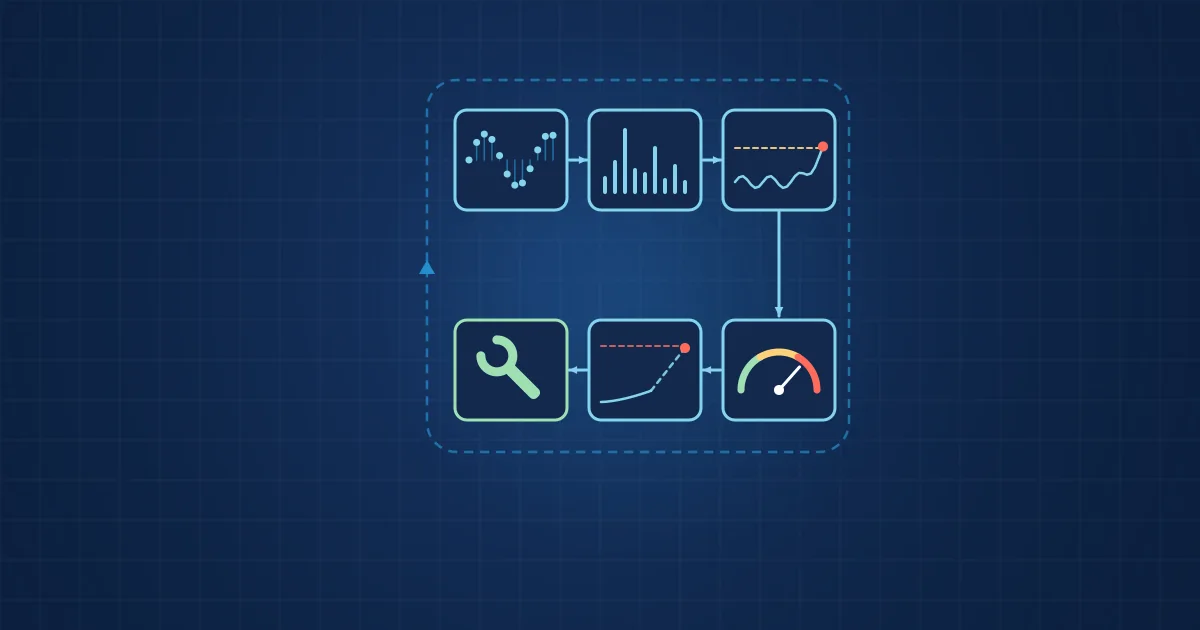
- ISO 13374-2 splits processing into six blocks: data acquisition, data manipulation, state detection, health assessment, prognostic assessment and advisory generation.
- The two standards answer different questions: ISO 17359 decides what to monitor and why, ISO 13374 how the resulting data flows through software.
ISO 17359 and ISO 13374 are the two condition monitoring standards that most other documents in the field refer back to, yet they are often cited without being read. One is a procedure for building a monitoring programme. The other is a reference architecture for the software that processes monitoring data. Neither tells you which accelerometer to buy or which threshold to set, and that is precisely why they remain useful as technology changes.
This article explains what each standard covers, how they fit together, and how we map them onto edge AI systems. Edition details were checked on iso.org in October 2026.
What is ISO 17359?
ISO 17359 is the international standard Condition monitoring and diagnostics of machines: General guidelines. The current version is ISO 17359:2018, the third edition, published in January 2018 and prepared by ISO/TC 108/SC 5. It was last reviewed and confirmed in 2023 and remains current. According to iso.org, it sets out general procedures for setting up a condition monitoring programme and "is applicable to all machines".
The introduction, visible in the ANSI preview, positions it as the parent document of a group of standards. It covers monitoring with parameters such as vibration, temperature and tribology, and directs monitoring towards detecting "symptoms of root cause failure modes". Individual techniques are only introduced briefly and are covered in detail by other standards.
The ISO 17359 procedure, step by step
The main clauses of ISO 17359 form a sequence. Reading the table of contents as a procedure, with our practical interpretation:
- Cost-benefit analysis (clause 5). Establish whether monitoring a machine is worth it. A cheap, redundant pump may be better run to failure than monitored.
- Equipment audit (clause 6). Identify the equipment and its function. Monitoring starts with knowing what each machine is for.
- Reliability and criticality audit (clause 7). Reliability block diagrams, equipment criticality, failure modes, effects and criticality analysis (FMECA), and alternative maintenance tasks. This is where you decide which failure modes deserve monitoring.
- Monitoring method (clause 8). Choose the measurement technique, required accuracy, feasibility, operating conditions during monitoring, monitoring interval, data acquisition rate, measurement locations, initial alert and alarm criteria, and baseline data.
- Data acquisition and analysis (clause 9). Measurement and trending, quality of measurements, comparison with alert and alarm criteria, diagnosis and prognosis, and how to improve confidence in them.
- Determine maintenance action (clause 10). Turn a diagnosis into an action.
- Review (clause 11). Check whether the programme achieves what it was set up for, and adjust.
- Training (clause 12). People need to understand the methods they rely on.
Four informative annexes support the procedure: examples of condition monitoring parameters, matching faults to measured parameters or techniques, typical information to record for machine types, and an overview of condition monitoring standards.
Two points are easy to miss. First, sensor and model choices come in clause 8, after the criticality audit, not before. Second, clause 9.2 on the quality of measurements makes sensor health part of the programme, a topic we covered in self-monitoring sensors.
What is ISO 13374?
ISO 13374 is the series Condition monitoring and diagnostics of machines: Data processing, communication and presentation. Its purpose, as the introduction to Part 1 puts it, is "to provide the basic requirements for open software specifications", so that monitoring data can be processed, communicated and displayed by different software packages without platform-specific or hardware-specific protocols. Part 1 includes an informative annex on the specifications of MIMOSA, the Machinery Information Management Open Systems Alliance.
The series has four parts. The status below is as listed on iso.org.
| Part | Title | Current edition | Last confirmed |
|---|---|---|---|
| ISO 13374-1:2003 | General guidelines | First edition, March 2003 | 2025 |
| ISO 13374-2:2007 | Data processing | First edition, July 2007 | 2021; 2026 systematic review closed in September, decision pending |
| ISO 13374-3:2012 | Communication | First edition, February 2012 | 2023 |
| ISO 13374-4:2015 | Presentation | First edition, 2015 | 2021; 2026 systematic review closed in September, decision pending |
Part 1 "establishes general guidelines for software specifications related to data processing, communication, and presentation". Part 2 sets requirements for a reference information model and a reference processing model. Part 3 defines communication requirements for that open architecture, with an informative annex based on IEC 62264-5. Part 4 covers how diagnostic and prognostic data, health information, advisories and recommendations are presented on displays and in reports.
The six processing blocks of ISO 13374
Part 2 is the most cited part, because of its processing model. Its table of contents lists six types of data-processing block, followed by clauses on external systems, archiving and presentation. The block names below follow that table of contents; the short descriptions are ours, and the examples are from vibration monitoring. Mouzoune (2012) gives similar short descriptions in an e-maintenance paper; note that he counts information presentation and external systems as two further blocks, giving eight.
| Block | Function | Example in vibration monitoring |
|---|---|---|
| Data acquisition (DA) | Produces digital records with values and metadata such as time stamps and quality | Sampled accelerometer signal with time stamp and sensor health |
| Data manipulation (DM) | Signal processing needed to make sensor values meaningful | Filtering, spectra, envelope analysis, feature extraction |
| State detection (SD) | Decides whether the asset is in a normal or abnormal state | Threshold on RMS, anomaly score against learned normal |
| Health assessment (HA) | Rates current health and diagnoses faults | Fault classification, severity grade |
| Prognostic assessment (PA) | Estimates remaining time until the next significant state change | Trend extrapolation of a severity indicator |
| Advisory generation (AG) | Recommends maintenance actions or changes to operation | "Plan bearing replacement at next stop" |
The blocks are functional, not physical. One device can host several blocks, and one block can be spread across devices. What matters is that the interfaces between blocks are defined, so that a state detector from one supplier can consume features from another.
How ISO 17359 and ISO 13374 fit together
The two standards answer different questions.
| Question | Answered by |
|---|---|
| Is monitoring this machine worth it? | ISO 17359, clause 5 |
| Which failure modes matter? | ISO 17359, clause 7 |
| Which technique, location, interval and rate? | ISO 17359, clause 8 |
| How is raw data turned into features? | ISO 13374-2, data manipulation |
| How is "abnormal" decided? | ISO 17359, clause 9, and ISO 13374-2, state detection |
| How are faults diagnosed and graded? | ISO 17359, clause 9.4, and ISO 13374-2, health assessment |
| How are results exchanged between systems? | ISO 13374-3 |
| How are results shown to people? | ISO 13374-4 |
| Does the programme work? | ISO 17359, clause 11 |
ISO 17359 sits above specific techniques. Vibration-specific evaluation criteria come from other documents, for example ISO 20816-3 for industrial machines above 15 kW, whose zones we explained in ISO 20816 vibration severity zones.
Applying the frameworks to edge AI systems
The ISO 13374 blocks map naturally onto modern edge systems, and the mapping is a useful design check.
- Data acquisition and data manipulation run on the sensor node or hub, close to the sensor, because that is where the data volume is. Feature extraction belongs here; see feature engineering for industrial signals.
- State detection and health assessment are where machine-learning models sit. Anomaly detection is a state detection block; fault classification and severity grading are health assessment. The ladder is described in anomaly detection, classification and severity grading.
- Prognostic assessment needs history and is often better placed where data from many periods is available.
- Advisory generation connects to maintenance planning and is usually a human decision supported by software.
The standard's emphasis on quality metadata in data acquisition is a good argument against systems that discard sensor health early. And its insistence on open interfaces is a good argument against systems that hide intermediate results. If you cannot export features and states, you cannot validate or replace a block.
A checklist for using the two standards
- Run the ISO 17359 criticality audit before choosing sensors or models.
- Document, for each monitored failure mode, the technique, location, interval and acquisition rate (clause 8).
- Record baseline data after installation and before setting alarm criteria.
- Map your software to the six ISO 13374-2 blocks and identify where each runs.
- Make sure measurement quality travels with the data from acquisition onwards.
- Define how results are exchanged with other systems and presented to operators.
- Schedule a review of the programme, with criteria agreed in advance.
How NeuroControls approaches this
Our systems are structured along the same lines. Nodes acquire and condition signals and compute signal statistics at the edge; the Edge AI Hub time-stamps every stream and records it on site with a versioned manifest; the operator dashboard on the hub presents status, alerts and events over the local network. Each sensor reports its own signal health and dropouts, so measurement quality is part of every record. The overall structure is on our architecture page.
Custom models trained by our engineers cover the state detection and health assessment blocks: anomaly detection, fault and multi-fault classification and severity grading. Exports in NWB, JSONL and CSV keep intermediate results open, and integration with Grafana, OpenSearch, Kafka or MES is available on request. Monitoring applications are described on our condition monitoring solutions page.
Frequently asked questions
What is ISO 17359?
ISO 17359 is the international standard Condition monitoring and diagnostics of machines: General guidelines. The current edition, ISO 17359:2018, is the third edition and was last confirmed in 2023. It describes a general procedure for setting up a condition monitoring programme, from cost-benefit analysis and criticality audit to monitoring method, data analysis, maintenance action and review, and applies to all machines.
What is ISO 13374?
ISO 13374 is a four-part series on data processing, communication and presentation for condition monitoring and diagnostics of machines. Part 1 gives general guidelines, Part 2 defines data processing requirements, Part 3 communication requirements and Part 4 presentation requirements. Its aim is open software specifications, so monitoring data can move between systems from different suppliers.
What are the six data processing blocks in ISO 13374?
ISO 13374-2 defines data acquisition, data manipulation, state detection, health assessment, prognostic assessment and advisory generation. Acquisition produces time-stamped records, manipulation turns them into meaningful quantities, state detection decides normal or abnormal, health assessment diagnoses and rates faults, prognostic assessment estimates remaining time, and advisory generation recommends actions.
What is the difference between ISO 17359 and ISO 13374?
ISO 17359 is about the monitoring programme: whether to monitor, which failure modes matter, which technique to use and how to act on results. ISO 13374 is about the software and data flow behind it: how data is processed, exchanged between systems and presented. A programme designed with ISO 17359 can be implemented with a processing architecture following ISO 13374.
Are ISO 17359 and ISO 13374 still current?
According to iso.org in October 2026, ISO 17359:2018 was confirmed in 2023 and remains current. ISO 13374-1:2003 was confirmed in 2025 and ISO 13374-3:2012 in 2023. ISO 13374-2:2007 and ISO 13374-4:2015 were last confirmed in 2021; their 2026 systematic review closed on 3 September 2026 and the decision is pending, so check iso.org for the latest status.
Sources and further reading
- ISO 17359:2018 Condition monitoring and diagnostics of machines, general guidelines
- ISO 17359:2018 preview, table of contents and introduction (ANSI webstore)
- ISO 13374-1:2003 General guidelines
- ISO 13374-2:2007 Data processing
- ISO 13374-3:2012 Communication
- ISO 13374-4:2015 Presentation
- ISO 13374-2:2007 preview, table of contents (ANSI webstore)
- Mouzoune: Towards an intelligence based conceptual framework for e-maintenance (arXiv, describes ISO 13374 with eight blocks)