
Short answer
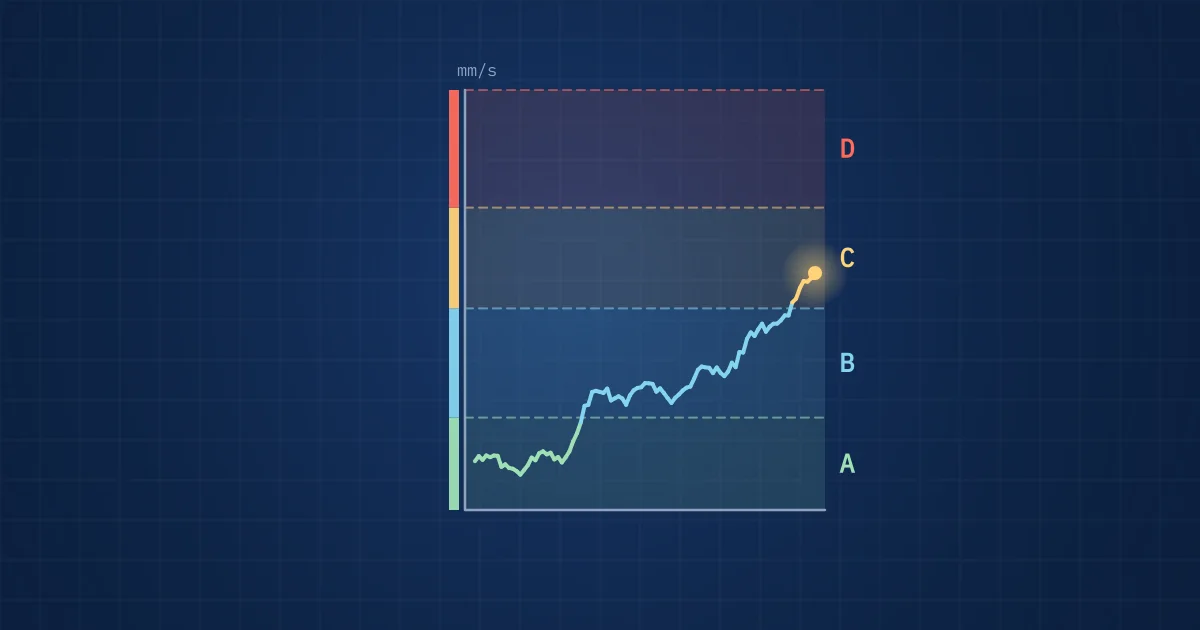
ISO 20816 vibration severity zones classify a machine's broadband vibration into four bands. Zone A is typical of newly commissioned machines, zone B is acceptable for unrestricted long-term operation, zone C is unsatisfactory for long-term continuous operation, and zone D is severe enough to cause damage. The boundaries depend on machine type, size and support, and they are guidance, not acceptance specifications.
Key takeaways
- ISO 20816 merges the older ISO 10816 (vibration on non-rotating parts such as bearing housings) and ISO 7919 (shaft vibration) series into one family of standards.
- Zones A to D describe vibration magnitude under steady operation; a second criterion looks at changes in magnitude, which often matters more for early warning.
- Zone boundaries for industrial machines above 15 kW sit in ISO 20816-3:2022 and depend on machine group and support flexibility, so a number without that context is meaningless.
- Alarms are normally set relative to the machine's own baseline, while trips relate to mechanical integrity and are usually set in zone C or D, normally no higher than 1.25 times the upper limit of zone C.
- A machine can sit comfortably in zone B while a bearing defect is developing, because broadband velocity is insensitive to early high-frequency damage.
ISO 20816 vibration severity zones are the most widely quoted yardstick in machine condition monitoring, and also one of the most misread. Engineers put a velocity reading next to a colour-coded chart, see green, and move on. That works for a quick sanity check. It does not work as a monitoring strategy.
This guide explains what the four zones mean, where the boundaries come from, how the standard expects you to set alarms and trips, and where a broadband severity number stops being useful. We do not reproduce the limit tables here: they are copyrighted, and you should work from a purchased copy of the part that covers your machine.
What ISO 20816 is and which parts matter
ISO 20816 is a series titled "Mechanical vibration: Measurement and evaluation of machine vibration". It replaces two older families. ISO 10816 covered vibration measured on non-rotating parts, typically bearing housings. ISO 7919 covered relative and absolute shaft vibration. ISO 20816 brings both under one roof.
Two parts matter for most industrial users:
- ISO 20816-1:2016, Part 1: General guidelines. It sets the measurement conditions, the two evaluation criteria and the guidance on operational limits. ISO lists it as current but to be revised. A second edition passed its final (FDIS) vote, which closed on 7 October 2026, and is now being published, so check which edition you are working from.
- ISO 20816-3:2022, Part 3: industrial machinery with a power rating above 15 kW and operating speeds between 120 r/min and 30 000 r/min. It replaced ISO 10816-3:2009 and ISO 7919-3:2009 with their amendments. This is the part most plant engineers mean when they say "ISO 20816".
Part 3 covers steam turbines and generators up to 40 MW, rotary compressors, industrial gas turbines up to 3 MW, turbofans, electric motors with flexible couplings, rolls and mills, conveyors, variable speed couplings, and blowers and fans (for fans, ISO notes that the criteria generally apply only above 300 kW or to fans that are not flexibly supported). ISO has also flagged Part 3 for revision. It excludes several machine types that have their own parts: large turbine sets at standard grid speeds, gas turbines above 3 MW, hydro sets, reciprocating machines, pumps (still ISO 10816-7), wind turbines and screw compressors.
So the first practical step is simple: confirm that your machine is actually in the scope of the part you are using. A gearbox or a screw compressor judged against Part 3 boundaries gives you a number with no meaning.
The four ISO 20816 vibration severity zones
The zone definitions in the 20816 series carry over from the ISO 10816 generation. The older ISO 10816-3 text (1998 edition), republished as the Indian standard IS 14817 (Part 3), defines them as follows (paraphrased with short quotes):
| Zone | Meaning in the standard | Typical practical response |
|---|---|---|
| A | Vibration of "newly commissioned machines would normally fall within this zone" | Reference state; record it as part of the baseline |
| B | Normally "acceptable for unrestricted long-term operation" | Normal monitoring interval |
| C | Normally "unsatisfactory for long-term continuous operation" | Plan an investigation and a repair window; the machine may run for a limited period |
| D | Normally "of sufficient severity to cause damage to the machine" | Reduce load or stop; do not keep running on the hope that it settles |
Three words in those definitions carry most of the weight: "normally", "long-term" and "continuous". The zones encode decades of field experience with similar machines. They do not say that a machine in zone C will fail, or that a machine in zone B is healthy. They say where most machines of that type sit when they are in a given condition.
The standard also states that the zone boundaries are not acceptance specifications. Acceptance values for a new machine are a matter of agreement between manufacturer and customer, usually well inside zone A or on the A/B boundary.
What the zone boundaries depend on
A single "ISO limit" does not exist. In Part 3, the boundary values depend on several things you must pin down before you compare a reading:
Machine group
Part 3 classifies machines by type, rated power or shaft height. A 20 kW fan motor and a 10 MW compressor train do not share boundaries.
Support flexibility
Part 3 distinguishes rigid and flexible supports. The classification depends on the relationship between the machine's running speed and the natural frequencies of the machine-on-support system, not on whether the foundation looks solid. Get this wrong and you move the boundaries by a whole step.
Measured quantity and frequency range
For bearing housings, the criteria apply to broadband root mean square (rms) vibration velocity. In the ISO 10816-3 generation the range was 10 Hz to 1000 Hz, with the lower limit dropping to 2 Hz for machines below 600 r/min, and displacement was also considered where low-frequency content is expected. Part 3 keeps an annex with cautionary notes on velocity criteria at low rotational speeds, because velocity under-represents large slow displacements.
Measurement location and operating condition
Readings are taken on bearing housings or pedestals, in defined directions, at rated speed under steady operating conditions. Shaft vibration, measured as relative displacement with proximity probes, has its own criteria in the same part.
If you report an ISO 20816 zone, report all of these with it. "4.1 mm/s, zone B" means nothing to the next engineer unless they know which group, which support class, which point and which load.
Criterion II: change matters as much as level
ISO 20816-1 sets two evaluation criteria. Criterion I is the vibration magnitude itself, which is where the zones live. Criterion II is the change in vibration magnitude from a reference value, measured at the same point under roughly the same operating conditions.
The older ISO 10816-3 treated a change of more than 25 % of the upper value of zone B as significant, especially if it is sudden, and as a trigger for diagnostic investigation. The principle is the same in the 20816 series: a machine that jumps from low in zone A to the top of zone B has changed state, even though it never left "acceptable".
In practice, criterion II is where monitoring earns its keep. Most machines spend their working lives in zone B. What separates a healthy machine from one that is starting to fail is usually the trend, not the absolute level.
Setting alarms and trips the way the standard intends
ISO 20816-1 gives guidance on two kinds of operational limit. Alarms warn that vibration has reached a level, or changed by an amount, that deserves attention. Trips are the level at which continued operation may cause damage and the machine should be shut down.
The ISO 10816-3 generation gave clear rules of thumb, which remain a sensible starting point:
- Set the alarm above the machine's established baseline by 25 % of the upper limit of zone B. It should not normally exceed 1.25 times the upper limit of zone B.
- Set the trip within zone C or D, based on mechanical integrity rather than the baseline. It should not normally exceed 1.25 times the upper limit of zone C.
An illustrative example, with symbols rather than numbers from the standard: if your machine's baseline is a velocity V0 and the B/C boundary for its group and support class is VBC, the alarm sits at V0 plus 0.25 × VBC, capped at 1.25 × VBC. A machine that normally runs quietly therefore gets a tighter alarm than one that has always run near the B/C boundary.
That is the key point most dashboards miss. Alarms in this framework are machine-specific. A fleet-wide fixed alarm at the B/C boundary ignores the baseline and throws away criterion II.
A procedure for applying the zones on site
- Confirm the machine is in scope of ISO 20816-3, or find the part that does cover it.
- Classify the machine group and the support flexibility, and write both down.
- Define measurement points and directions, and fix them physically so later readings are comparable.
- Record a baseline at rated speed and steady load, including the operating condition (speed, load, temperature).
- Compare the baseline with the zone boundaries for that group and support class.
- Set alarms relative to the baseline and trips relative to mechanical integrity, as described above.
- Trend the readings and review any change that exceeds your criterion II threshold, even within zone B.
What the zones cannot tell you
Broadband velocity in the 10 Hz to 1 kHz range is a good measure of overall mechanical energy at running speed and its low harmonics. Unbalance, misalignment, looseness and soft foot all raise it. That is why it works as a severity yardstick.
It is a poor detector of early rolling element bearing damage. A spall on an outer race produces short impacts that excite structural resonances well above 1 kHz. Those impacts barely move a broadband velocity value until the damage is advanced. By the time the bearing pushes the machine into zone C, you are often weeks or days from failure, not months.
For bearings, you need the methods covered in our guide to bearing fault frequencies: envelope analysis around a resonance, defect frequencies such as BPFO and BPFI, and time-domain statistics such as kurtosis and crest factor. The same applies to gear mesh problems, cavitation in pumps and electrical faults that show up at line-frequency harmonics. If you need a refresher on how a time signal becomes a spectrum, start with vibration analysis basics.
There is a second limit. A zone reading says nothing about whether the sensor is telling the truth. A loose magnet mount, a cracked cable or a saturated amplifier can push a reading into zone C or hide a real rise. Before acting on a zone change, check the signal itself.
How NeuroControls approaches this
We treat the ISO 20816 broadband value as one feature among many, not as the verdict. Our Vibration Node records the raw acceleration signal with an Analog Devices ADXL1002 (±50 g) through an 18-bit ADAQ4003 at 200 kSPS, so the same recording can give an ISO-style broadband velocity, an envelope spectrum and impact statistics. The machine monitoring solution shows how those streams are evaluated at the machine.
Custom models trained by our engineers on the customer's data move from anomaly detection to fault classification and severity grading, as described in our model ladder. The ISO zone gives that grading a familiar anchor for maintenance staff. Our cognitive sensors flag signal health and dropouts with every segment, so a clipped or interrupted signal is visible before anyone reads a zone change into it. For the wider framework around these measurements, see our article on ISO 17359 and ISO 13374.
Frequently asked questions
What is the difference between ISO 10816 and ISO 20816?
ISO 20816 is the successor series. It combines ISO 10816, which evaluated vibration measured on non-rotating parts such as bearing housings, with ISO 7919, which evaluated shaft vibration. ISO 20816-3:2022, for example, replaced both ISO 10816-3:2009 and ISO 7919-3:2009. The zone concept of A, B, C and D carried over, so existing practice mostly transfers, but you should check boundaries and scope against the new part.
Is zone C in ISO 20816 an automatic shutdown?
No. Zone C means vibration is normally considered unsatisfactory for long-term continuous operation. The machine may run for a limited period while you investigate and plan a repair. Zone D is the region normally considered severe enough to cause damage. Trip settings usually sit within zone C or D and are based on mechanical integrity, not on the zone label alone.
Which ISO 20816 part applies to electric motors and fans?
For industrial machines above 15 kW running between 120 and 30 000 r/min, ISO 20816-3:2022 applies. It covers electric motors with flexible couplings, fans and blowers, compressors, rolls, mills and conveyors, among others. Pumps are still evaluated under ISO 10816-7, and reciprocating machines and wind turbines have their own parts. Check the scope clause before applying any boundary values.
How should I set vibration alarm levels using ISO 20816?
Set alarms relative to each machine's own baseline. The established rule from the ISO 10816-3 generation is the baseline plus 25 % of the upper limit of zone B, normally not exceeding 1.25 times that limit. This makes alarms tighter for quiet machines. A single fleet-wide alarm at the B/C boundary ignores the baseline and misses meaningful changes inside zone B.
Can ISO 20816 detect bearing faults?
Only late. The zones use broadband rms velocity, typically between 10 Hz and 1 kHz, which responds well to unbalance, misalignment and looseness. Early rolling element bearing damage produces short high-frequency impacts that barely change this value. Envelope analysis, defect frequencies and impact statistics such as kurtosis detect bearing damage much earlier than a severity zone change.
Sources and further reading
- ISO 20816-1:2016 Mechanical vibration, Part 1: General guidelines
- ISO 20816-1 second edition project page (FDIS vote closed 7 October 2026, under publication)
- ISO 20816-3:2022 Mechanical vibration, Part 3: Industrial machinery above 15 kW
- UNI ISO 20816-3 preview (scope, structure and replaced documents)
- IS 14817 (Part 3):2004, identical to ISO 10816-3:1998 (zone definitions, alarms and trips)