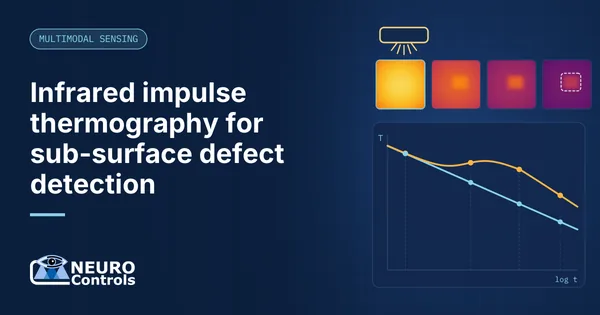
Infrared impulse thermography for sub-surface defect detection
Heat a surface for an instant, watch it cool, and hidden voids and delaminations appear. How impulse thermography works, its limits, and the MYW.AI 4 QM research context.
 Clemens Saur
Blog topic
Vision, thermal, depth, sound and vibration: how combining sensing modalities reveals what one sensor misses.
8 articles
Heat a surface for an instant, watch it cool, and hidden voids and delaminations appear. How impulse thermography works, its limits, and the MYW.AI 4 QM research context.
Clemens SaurForty terms that come up when mechanical engineers, electronics designers and data scientists build multimodal sensing systems together, each defined in one to three sentences.
 Saichand Gourishetti
A practical workflow for labelling vibration, sound, video and thermal data together: label schemes, label propagation with time uncertainty, weak labels and quality checks.
Saichand GourishettiA channel-by-channel checklist for specifying vibration, acoustic, vision, thermal and depth sensors on a multimodal test rig, including the time and data questions people forget.
Clemens SaurEvery sensor has its own oscillator, and they all disagree. How clock offset and drift arise, how to measure them and what a recording should store so data can be aligned later.
Saichand GourishettiFive structural reasons a single sensor misses machine faults or raises false alarms, an illustrative pump example and a checklist for deciding when to add a second modality.
Clemens SaurA modality-by-modality look at cameras, thermal cores, time-of-flight, microphones and accelerometers: what each one sees, what it misses and what fools it.
Clemens SaurMultimodal sensing measures one machine through several physical channels at once. What it is, which modalities matter, how the data is fused and how to start.
Clemens SaurNext step
Write to us and we pass your question to the author.