
Short answer
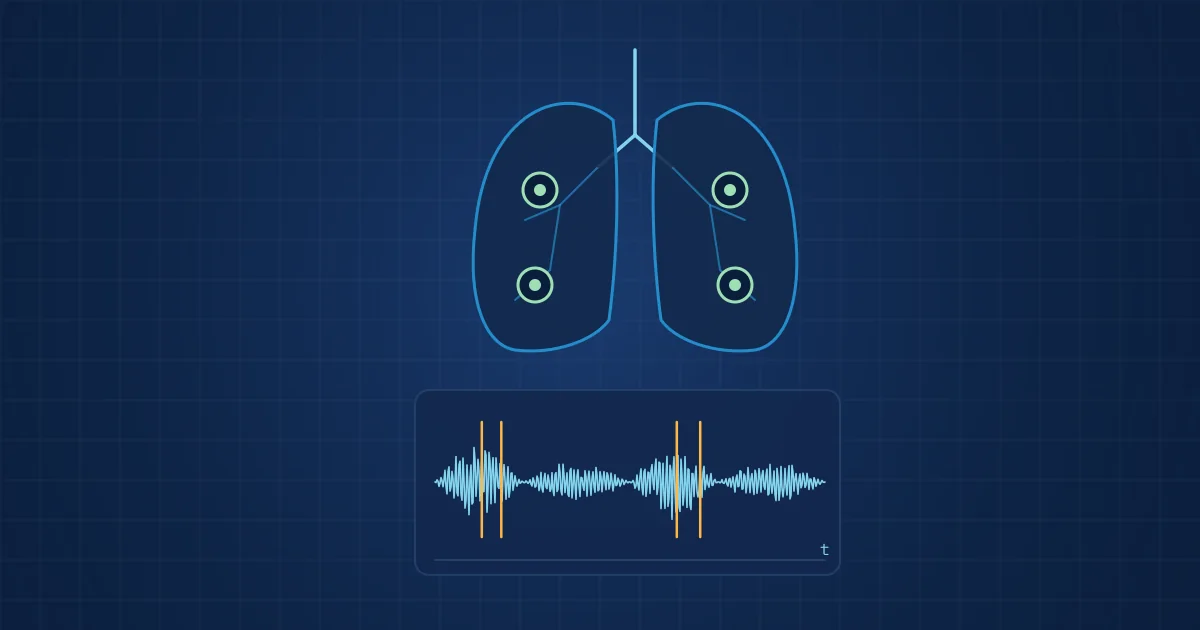
Vibro-acoustic sensing in medical research records the sound and vibration that the body produces, for example breath sounds at the chest wall, with microphones or contact sensors. The engineering problems mirror industrial monitoring: coupling between sensor and surface, background noise, small and inconsistently labelled datasets, and validation. A research prototype without a medical intended purpose is not a medical device; given a medical intended purpose it can qualify as one, and the EU Medical Device Regulation then governs its clinical investigation and placing on the market.
Key takeaways
- Wheezes and rhonchi are reported in the literature between about 100 Hz and 1 kHz, and crackles last only around 5 to 15 ms, which sets demanding requirements for sensor coupling and timing.
- A 2017 systematic review of 77 studies found that automated respiratory sound analysis had no standard validation method, so published results could not be compared directly.
- Coupling, motion artefacts and ambient noise affect a sensor on a chest wall in the same way they affect a sensor on a pump housing.
- Under MDCG 2019-11 guidance, software intended for diagnosis or monitoring of individual patients can qualify as a medical device; research use must be kept clearly separate.
Vibro-acoustic sensing in medical research looks, at first glance, like a long way from bearings and weld seams. It is closer than it appears. A sensor on a chest wall faces the same physics as a sensor on a machine housing: a weak signal, an imperfect mechanical coupling, background noise from everything else, and a classification problem built on too little labelled data.
NeuroControls worked on TeMeLu, a research project on a vibro-acoustic lung monitor, in the context of the EU-funded INNO4COV-19 programme. This post describes what that kind of work demands from the sensing chain and the data, and what transfers back to industrial monitoring. It makes no medical claims. TeMeLu was research, not a product, and nothing here describes a diagnostic device.
The research context: INNO4COV-19
INNO4COV-19 was a Horizon 2020 innovation action, Boosting Innovation for COVID-19 Diagnostic, Prevention and Surveillance, which ran from 1 October 2020 to 30 November 2022 under the coordination of the International Iberian Nanotechnology Laboratory in Braga. It set up an open-access innovation hub for companies and laboratories, and provided funding to third parties.
A CORDIS results article on the project lists four sub-platforms, one of them dedicated to low-cost sensors, wearables and telemedicine, and reports support for 30 new products or solutions. A vibro-acoustic lung monitor belongs naturally in that sensing space, and TeMeLu was an engineering research contribution, not a clinical study.
What a lung monitor actually has to hear
Breath sounds are a well-studied signal, and the literature gives useful engineering numbers. The systematic review by Pramono, Bowyer and Rodriguez-Villegas, Automatic adventitious respiratory sound analysis (PLoS ONE, 2017), summarises the acoustic characteristics reported across studies:
| Sound type (as described in the literature) | Reported frequency characteristics | Reported duration |
|---|---|---|
| Normal vesicular breath sound | Energy drops after around 100 to 200 Hz | Continuous with breathing |
| Wheeze | Dominant frequency of at least 400 Hz | Minimum around 80 to 100 ms |
| Rhonchus | Dominant frequency of at most 200 Hz | Minimum around 80 to 100 ms |
| Fine crackle | Around 650 Hz | Around 5 ms |
| Coarse crackle | Around 350 Hz | Around 15 ms |
For an engineer, the table translates into requirements. The band of interest is modest by industrial standards, but the events are short and weak. A 5 ms transient spread over a few hundred hertz is easily lost to a poor coupling, a filter with too much group delay, or a compression codec designed for speech.
Lesson one: coupling decides everything
On a machine, an accelerometer bolted with a stud has a well-defined mechanical connection. A sensor on skin does not. Contact pressure, the soft tissue underneath, hair, movement and the angle of the sensor all change the transfer function from source to sensor. Two recordings of the same breath at slightly different pressure can differ more than two different breaths.
The review notes that most studies used microphones or electronic stethoscopes, with 31 studies using microphones and 21 electronic stethoscopes, and one using an accelerometer. Each couples differently, and results obtained with one rarely carry over unchanged to another.
The industrial lesson is the same one we draw in acoustic vs vibration monitoring: the sensor's datasheet is only half the story. Mounting defines the measurement. A system that cannot tell whether its sensor is properly coupled will mistake a mounting change for a change in the source.
Lesson two: noise and artefacts are the real signal-processing task
Bodies move. People talk, cough and shift position. Hospital rooms have ventilation, alarms and conversation. The review notes that the intensity of normal respiratory sounds can itself mask adventitious sounds. In practice, much of the work in a vibro-acoustic monitor goes into deciding which segments are usable at all.
That is a familiar task. On a machine, operating-state changes, neighbouring equipment and sensor faults play the same role as speech and movement. The engineering answer is similar too: detect and flag unusable segments explicitly, report signal quality alongside every result, and never let a model silently score data that the sensor itself considers suspect. Our post on self-monitoring sensors explains the principle and what our systems flag today.
Lesson three: labels are opinions until proven otherwise
Respiratory sound datasets are labelled by people listening, and listeners disagree. The review reports small datasets in some studies, for example 17 recordings in one case, and states that a standard validation method had not been established, so the performance of different works could not be compared directly.
Industrial labelling has the same weakness. A technician's "slightly rough bearing" is not a calibrated measurement. The lessons we take:
- Record who labelled what, and with which information available.
- Keep the raw data and the label separate, so labels can be revised.
- Measure agreement between labellers before trusting a model's agreement with them.
- Split training and test data by subject or by machine, never by segment from the same recording.
The last point prevents a model from recognising the person or the machine rather than the condition, a form of shortcut learning we describe in validating industrial AI models. Our post on labelling multimodal industrial datasets covers the practical side.
Lesson four: know where research ends and regulation begins
In Europe, medical devices are governed by Regulation (EU) 2017/745, the Medical Device Regulation (MDR). Whether software is a medical device depends on its intended purpose. The Medical Device Coordination Group's guidance MDCG 2019-11 Rev.1 (June 2025) sets out the qualification steps: software that acts on data beyond storage, communication or simple search, for the benefit of individual patients, with a medical purpose such as diagnosis, prevention, monitoring, prediction or treatment, can be medical device software. The guidance also states that claims of a medical purpose must be supported by appropriate clinical evidence.
For a research team, that has practical consequences:
- Define the intended purpose of any prototype in writing, and keep it to research.
- Avoid diagnostic language in documentation, presentations and user interfaces.
- Separate research data handling, including consent and ethics approval, from any later product development.
- Treat a move towards clinical use as a new project with its own regulatory pathway, not as a software update.
This is not a legal opinion, and any team considering clinical use needs regulatory advice. The point for engineers is simpler: the same signal chain can be a research instrument or a regulated device, and the difference is set by what you claim it does.
What transfers back to industry
Working on a physiological signal makes several habits very concrete, and all of them apply to industrial systems:
- Treat sensor coupling as a measured quantity, not an installation assumption.
- Report signal health with every result, and refuse to score unusable segments.
- Design datasets and splits so that models learn the condition, not the subject or the machine.
- Write down what a system is for, and what it is not for, before the first demonstration.
How NeuroControls approaches this
Our measurement chains for acoustics and vibration come from industrial work: the Acoustic Node with a Microtech Gefell MK 301 E measurement capsule and the Vibration Node with an 18-bit, 200 kSPS front end. The same chains can serve research teams that need well-documented, time-stamped multimodal recordings, with each sensor reporting its own signal health; the Acoustic Node is also available as a standalone logger. The research projects page lists TeMeLu alongside our other projects.
For laboratories and medical technology research, the laboratories page and the medical technology page describe how we support measurement campaigns. We do not offer diagnostic products.
Frequently asked questions
What is vibro-acoustic sensing in medical research?
Vibro-acoustic sensing records sound and mechanical vibration produced by the body, such as breath sounds at the chest wall or the trachea, using microphones, electronic stethoscopes or contact sensors. Researchers analyse these signals to study physiological processes and to develop algorithms. In research, it is a measurement technique; any clinical use requires a defined intended purpose and regulatory assessment.
What frequency range do lung sounds cover?
According to a 2017 systematic review in PLoS ONE, normal vesicular breath sounds lose energy above about 100 to 200 Hz, wheezes have a dominant frequency of at least 400 Hz, rhonchi at most 200 Hz, and crackles sit around 350 to 650 Hz with durations of about 5 to 15 ms. The same review reports that normal tracheal sounds can reach up to 5,000 Hz, with an energy drop usually from 800 Hz.
Why is automated respiratory sound analysis hard to validate?
Datasets are often small, recorded with different sensors and protocols, and labelled by listeners who do not always agree. A 2017 review of 77 studies found that no standard validation method had been established and that results could not be compared directly because each study used different input data. Shared datasets and subject-wise test splits help.
When does sensing software become a medical device in the EU?
Under Regulation (EU) 2017/745 and the MDCG 2019-11 guidance, software can qualify as a medical device when its intended purpose, as stated by the manufacturer, is medical, such as diagnosis, monitoring or prediction for individual patients. Research prototypes should have a documented non-clinical purpose. Anyone planning clinical use should seek regulatory advice early.
What can industrial condition monitoring learn from medical sensing?
Mainly discipline about coupling, noise and labels. A sensor on skin shows how strongly mounting changes a measurement, how much effort goes into rejecting unusable segments, and how easily a model learns the subject instead of the condition. The same issues affect sensors on machines, and the same remedies of signal-health reporting and careful dataset splits apply.
Sources and further reading
- CORDIS: INNO4COV-19 - Boosting Innovation for COVID-19 Diagnostic, Prevention and Surveillance (grant 101016203)
- CORDIS: Boosting innovation for future pandemics (INNO4COV-19 results)
- Pramono, Bowyer, Rodriguez-Villegas: Automatic adventitious respiratory sound analysis: A systematic review, PLoS ONE 2017, doi 10.1371/journal.pone.0177926
- MDCG 2019-11 Rev.1: Guidance on Qualification and Classification of Software in Regulation (EU) 2017/745 and (EU) 2017/746
- EUR-Lex: Regulation (EU) 2017/745 on medical devices