
Short answer
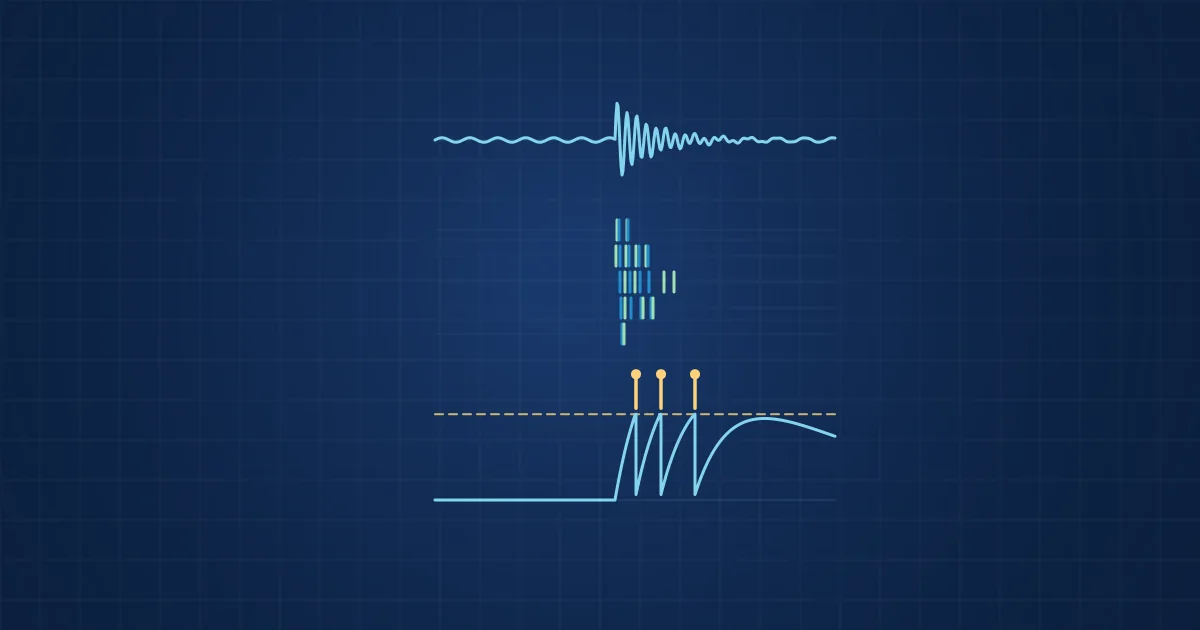
Neuromorphic computing for condition monitoring means processing sensor signals with event-driven hardware and spiking neural networks that only compute when the input changes. Vibration or sound is converted into spikes, a small network detects deviations, and the chip idles between events. Commercial neuromorphic processors now run audio and radar tasks below one milliwatt, which makes them candidates for battery-free sensors, though a well-designed microcontroller pipeline can still compete.
Key takeaways
- A spiking neural network communicates with discrete events over time rather than continuous values, so computation and energy scale with signal activity rather than with the sampling clock.
- Research has demonstrated unsupervised vibration anomaly detection on bearing data with a spiking network built from a cochlea-like filterbank and a delta modulator.
- Neuromorphic microcontrollers announced in 2025 quote sub-milliwatt operation, for example 400 µW for audio scene classification.
- A conventional microcontroller with carefully chosen time-domain features can reach below 10 µJ per inference, so neuromorphic hardware must be judged at system level, not by headline claims.
- The main barriers today are tooling, training methods and the lack of established design practice for industrial signals.
Neuromorphic computing for condition monitoring is attractive for a simple reason. Most of the time, a healthy machine produces a boring signal. A conventional processor still samples, buffers and computes at full rate. An event-driven processor, in principle, does almost nothing until something changes.
On a mains-powered hub that difference hardly matters. On a sensor running from harvested vibration, it can decide whether the design works at all. This article explains what neuromorphic computing is, what research on vibration has shown, which hardware exists, and how to compare it honestly with a conventional microcontroller.
What neuromorphic computing is
Neuromorphic computing is a family of hardware and algorithms inspired by how biological nervous systems process information. Three ideas recur:
- Spikes instead of numbers. Neurons communicate with discrete events in time. Information sits in when and how often spikes occur.
- Event-driven operation. Circuits are active only when spikes arrive. With little input activity, energy use falls.
- Memory next to compute. Synaptic weights are stored close to the neurons that use them, which reduces data movement, one of the main energy costs in conventional processors.
A spiking neural network (SNN) is the model that runs on such hardware. Its neurons integrate incoming spikes over time and fire when an internal state crosses a threshold. That built-in sense of time is useful for signals such as vibration and sound, where timing carries the information.
In their 2022 perspective in Nature Computational Science, Schuman and colleagues point out that much of the work in the field had focused on hardware, and that algorithms and applications are where the main opportunities and obstacles now lie. For condition monitoring, that is still a fair summary.
Why condition monitoring suits event-driven processing
Condition monitoring signals have three properties that match the neuromorphic model.
First, they are sparse in the interesting sense. A bearing defect shows up as short impacts; a wheel flat as one impact per revolution; a leak as a change in the ultrasonic noise floor. Between those events, the signal is either stationary or irrelevant.
Second, the task is often change detection. Before you can classify a fault, you need to know that the machine's behaviour has moved away from its normal state. That is an anomaly detection problem, and it maps well onto networks that adapt to a baseline and react to deviations.
Third, the power budget is tiny where it matters most. Battery-free sensors on rail vehicles or remote machines may have hundreds of microwatts on average, as our article on energy harvesting sensors shows.
From vibration signal to spikes
An SNN does not take raw samples. The signal must first be encoded into spikes, and this step decides much of the system's performance and power.
A good example is the work of Dennler, Haessig, Cartiglia and Indiveri (2021). Their pipeline has three stages:
- A Gammatone filterbank, modelled on the cochlea, splits accelerometer data into 16 frequency channels.
- An asynchronous delta modulator converts each channel into spikes whenever the signal changes by a set step.
- A three-layer balanced spiking network learns the normal spike rates during an initial healthy window and fires when rates deviate.
The thresholds adapt with a controller that the authors describe as inspired by homeostatic plasticity, so the network settles on the machine's normal state without labels. On an induced bearing fault dataset they report a perfect confusion matrix with detection about 0.17 s after the transition. On a run-to-failure dataset, detection times were comparable to established methods: earlier than the one-class least squares support vector machine (LSSVM) baseline for two of the four bearings and later than it for the other two. They ran the network on a DYNAP-SE neuromorphic chip as a proof of concept, but reported no power measurements.
Other groups have taken different routes. Joseph and Pakrashi (2022) built a spiking network that extracts cepstral coefficients from vibration signals for structural health monitoring and ran it on Intel's Loihi neuromorphic hardware, benchmarked on a single-degree-of-freedom system with changing stiffness.
Both studies are honest about their scope: laboratory datasets, proof-of-concept hardware and no field deployment. That is roughly where neuromorphic condition monitoring stands.
The hardware that exists today
Neuromorphic hardware falls into two groups.
Research platforms such as Intel's Loihi 2 are built for exploring algorithms at scale. Intel states that Loihi 2 outperforms its predecessor by up to ten times and ships with Lava, an open-source software framework for neuromorphic computing. These chips are excellent for research and not designed to sit on a bearing housing.
Neuromorphic microcontrollers target the sensor edge. In May 2025, Innatera announced Pulsar, which combines a spiking neural network engine with a RISC-V CPU and accelerators for convolutional networks and FFTs. The company quotes sub-milliwatt operation, with 600 µW for radar-based presence detection and 400 µW for audio scene classification. Those figures are for consumer and building applications, not industrial vibration, but they show the power class.
Neuromorphic versus a well-tuned microcontroller
Headline claims of hundreds of times lower energy compare neuromorphic chips with conventional AI processors running conventional networks. For condition monitoring, that is often the wrong baseline. The fair comparison is against the best conventional design for the same task.
Our own VCD4.3 freight-wagon sensor is a useful reference point. As we described on the EdgeAI project blog, we replaced an FFT pipeline of about 50 µJ per inference on an STM32L4-class microcontroller with a time-domain classifier using crest factor, kurtosis, envelope characteristics and inter-pulse timing. It needs fewer than 2,000 operations and less than 10 µJ per inference. In our first EdgeAI article we called it a neuromorphic time-domain classifier, because its features are inspired by how biological neural systems process sensory information; it is a feature-based classifier running on a standard STM32 microcontroller without a specialised accelerator, which is why it serves here as the conventional baseline. The full story is in inside VCD4.3.
| Approach | Where the energy goes | Strengths | Weaknesses |
|---|---|---|---|
| Conventional MCU with FFT | Long buffers, many multiply-accumulates | Mature tools, interpretable spectra | Expensive per inference, poor at grading impact severity |
| Conventional MCU with time-domain features | Short windows, few operations | Mature tools, very low energy, interpretable | Feature design needs expert knowledge of the fault |
| Neural network on an NPU | Dense matrix operations at fixed rate | Strong accuracy on rich data, good tooling | Power class suits hubs, not harvesters |
| Spiking network on neuromorphic hardware | Spike events, scaled to signal activity | Potentially lowest idle and average power, adapts online | Immature tooling, encoding design is hard, few industrial results |
The table points to a practical conclusion. Neuromorphic hardware wins when the signal is quiet most of the time and the task is detecting change. When the sensor must grade a known fault at a fixed rate, a microcontroller with good features is hard to beat today. The method side of that choice is covered in our guide to feature engineering for industrial signals.
How to evaluate a neuromorphic option
If you are considering neuromorphic processing for a monitoring task, use a checklist like this:
- Compare at system level. Include the sensor front end, the analogue filters or spike encoder, wake-up costs and data hand-off, not only the core's energy per operation.
- Measure on your signal. Energy in an event-driven system depends on signal activity. A rough gearbox produces far more spikes than a smooth fan.
- Check the encoding. Ask how the signal is converted into spikes and what information is lost. Delta modulation, filterbanks and level crossing each behave differently on impacts.
- Check training and adaptation. Is the network trained offline and frozen, or does it adapt online? Online adaptation helps with drift but complicates validation.
- Check the toolchain. Can your team train, quantise, deploy and debug without the vendor's application engineers?
- Plan validation. The same rules apply as for any industrial model: realistic data, independent test conditions and attention to shortcuts.
How NeuroControls approaches this
We have worked with neuromorphic methods in research. In the MYW.AI 4 QM project we combined infrared impulse thermography with neuromorphic pattern matching to find sub-surface defects in medical ultrasound probes, a topic we cover in infrared impulse thermography. Our neuromorphic technology page summarises that work, and the event camera in our built-to-order Event Node is the sensor-side counterpart of the same idea: pixels that report changes rather than frames.
In products, we choose the processing method per task. Custom models are trained by our engineers on customer data as a service and delivered as ONNX; on-device inference was first proven on our Vibration Node CPU, and NPU inference is coming soon, as described in edge AI hardware for sensing. On energy-autonomous sensors such as our vibration sensor developed as demonstrator VCD4.3 in the EU EdgeAI project, now built to order as a special sensor, we currently use carefully engineered time-domain features on a low-power microcontroller. We treat spiking networks as a promising option for the quietest, most power-starved monitoring tasks, to be adopted where measurements on real signals show a clear system-level gain.
Frequently asked questions
What is neuromorphic computing in simple terms?
Neuromorphic computing is hardware and software modelled on how nervous systems process information. Instead of processing numbers at a fixed clock rate, it uses spiking neurons that communicate with discrete events and only compute when input arrives. Memory sits close to compute. The result can be very low energy use for signals that change rarely, such as sensor data from a healthy machine.
Can spiking neural networks detect machine faults?
Research shows they can detect anomalies in vibration data. One study converted bearing vibration into spikes with a cochlea-like filterbank and a delta modulator, then used a balanced spiking network to detect deviations without labels, reporting detection within about 0.17 seconds on an induced fault dataset. Field deployments in industrial condition monitoring are still rare, and power figures for such systems are seldom reported.
How much power does a neuromorphic processor use?
Neuromorphic microcontrollers for the sensor edge quote sub-milliwatt operation. Innatera, for example, announced its Pulsar chip in May 2025 with 600 µW for radar presence detection and 400 µW for audio scene classification. Actual consumption depends on the signal: event-driven systems use more energy when the input is busy, so measure on your own data.
Is neuromorphic hardware better than a microcontroller for condition monitoring?
Not automatically. A conventional microcontroller running well-chosen time-domain features can be extremely efficient: our VCD4.3 classifier needs under 10 µJ per inference. Neuromorphic hardware has the edge when the signal is quiet most of the time and the task is detecting change. Compare complete systems, including encoding and data hand-off, on your real signals.
What are the main obstacles to neuromorphic condition monitoring?
Tooling, training methods and experience. Converting vibration or sound into spikes without losing the fault information is a design problem of its own. Training spiking networks is less mature than training conventional networks, and few industrial datasets and deployments exist to learn from. Validation practice also needs care when networks adapt online.
Sources and further reading
- Schuman et al., Opportunities for neuromorphic computing algorithms and applications, Nature Computational Science 2 (2022), doi:10.1038/s43588-021-00184-y
- Dennler, Haessig, Cartiglia and Indiveri, Online detection of vibration anomalies using balanced spiking neural networks (2021)
- Joseph and Pakrashi, Spiking neural networks for structural health monitoring, Sensors 22(23) 9245 (2022), doi:10.3390/s22239245
- Intel Loihi 2 technology brief
- HPCwire: Innatera unveils Pulsar neuromorphic microcontroller for the sensor edge (22 May 2025)
- EdgeAI project blog: No battery, no problem, how edge AI is making freight rail condition monitoring finally viable (May 2026)
- EdgeAI project blog: Inside the VCD4.3 energy-autonomous sensor