
Short answer
NeuroControls exhibits at electronica 2026 at Messe München from 10 to 13 November 2026, in Hall B4 at stand 169/4. Visitors can see the multimodal sensing platform live at our stand, with every stream time-stamped on the hub. Meetings with our engineers can be booked in advance through the contact page.
Key takeaways
- electronica 2026 takes place from 10 to 13 November 2026 in Munich, open 09:00 to 18:00 from Tuesday to Thursday and 09:00 to 15:00 on Friday.
- NeuroControls is in Hall B4 at stand 169/4, showing a live demo of its multimodal sensing platform.
- The platform combines an Edge AI Hub on a Qualcomm QCS6490 board with cameras and a thermal core on the hub, and sensor nodes for vision, depth, sound and vibration, each flagging its signal health.
- Engineers working on battery production, machine monitoring, rail or research test rigs can book a meeting slot with our team in advance.
electronica 2026 opens in Munich in four weeks, and NeuroControls will be there with a live demo of our multimodal sensing platform. You will find us in Hall B4, stand 169/4, from 10 to 13 November.
This post covers the practical details, the platform behind the demo, which topics we are glad to go deep on, and how to make the most of a visit to a sensing stand at a large trade fair.
electronica 2026 at a glance
According to the electronica website, electronica 2026 takes place from 10 to 13 November 2026 in Munich, with the All Electric Society as its guiding theme, covering automation with AI, electromobility and smart energy. The previous edition in 2024 had more than 3,480 exhibitors and over 80,000 visitors. The electronica Automotive Conference takes place the day before the fair, on 9 November.
| Detail | Information |
|---|---|
| Event | electronica 2026 |
| Venue | Messe München, Am Messesee 2, 81829 München |
| Dates | Tuesday 10 to Friday 13 November 2026 |
| Opening hours | Tuesday to Thursday 09:00 to 18:00, Friday 09:00 to 15:00 |
| NeuroControls stand | Hall B4, stand 169/4 |
| What we show | Live demo of the multimodal sensing platform |
The opening hours page also notes that a visitor ticket does not allow re-entry once you leave the grounds, which is worth knowing if you plan meetings outside the fair.
The platform behind the demo
The centre of the stand is a live demo of our multimodal platform. Multimodal sensing means observing a machine or process with several physical sensing principles at once, such as images, heat, distance, sound and vibration, and evaluating them together. Our introduction to what multimodal sensing is explains why that matters more than adding one more camera.
The platform has three layers; the exact demo set on the stand is still being finalised.
The Edge AI Hub
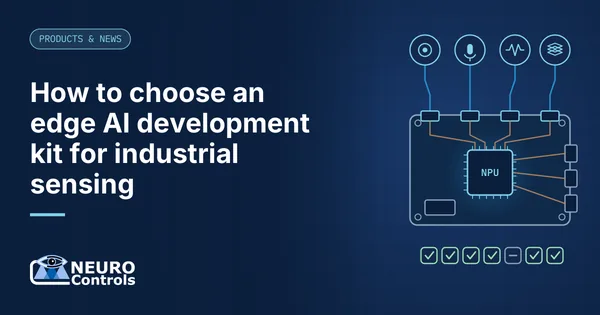
The hub is built on a RUBIK Pi 3 board with a Qualcomm QCS6490 processor and NPU, plus NVMe storage. In its Multi-Camera configuration, which is available now, it carries three OmniVision OV9281 global-shutter cameras, a FLIR Lepton 3.5 radiometric thermal camera with 160 x 120 pixels, a USB microphone at 48 kHz for event recording, and 512 GB of NVMe storage. According to Qualcomm's product brief, the QCS6490 combines an octa-core Kryo 670 CPU of up to 2.7 GHz with a sixth-generation AI Engine rated at up to 12 dense TOPS, built in a 6 nm process. Custom models are trained for you by our engineers; on-device inference as ONNX on the QCS6490's CPU was first proven on our Vibration Node, and NPU deployment is coming soon. The Lepton 3.5 is radiometric, which means it delivers calibrated, non-contact temperature data in every pixel, not just a thermal picture.
A second configuration, Triple Eye, combines an ST VL53L9CX direct time-of-flight depth sensor with a global-shutter camera and a Lepton 3.5, and is built to order. More on what this class of hardware can do is in edge AI hardware for sensing: what a QCS6490-class hub can do.
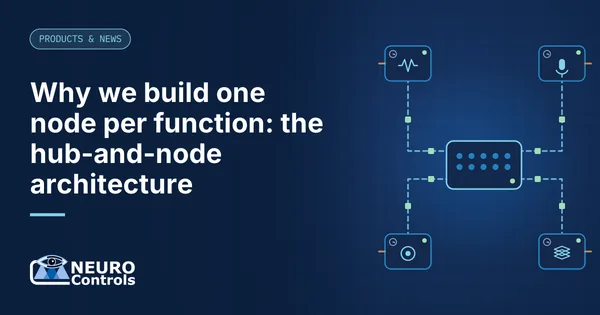
Sensor nodes, one per function
Around the hub sit nodes, each dedicated to one sensing function: vision, vibration, acoustics, depth, event cameras and wireless sensing. The Vibration Node, for example, uses an ADI ADXL1002 accelerometer with an 18-bit ADAQ4003 converter at 200 kSPS. The Acoustic Node uses a Microtech Gefell MK 301 E measurement capsule with a capture band from 2 to 100 kHz. Why we split functions this way is explained in why we build one node per function.
Recording, dashboard and models
The operator dashboard runs on the hub and is reached over the local network. It shows live status, previews, alerts, events and a vibration view. Every stream is time-stamped on the hub, and recordings carry a versioned manifest with per-segment SHA-256 hashes. Each sensor flags its signal health and dropouts with the data, a principle described in self-monitoring sensors.
Topics we are glad to go deep on
A live demo opens the conversation. The more useful part is usually the discussion about your own machine or process. These are the areas where our engineers can go into detail at the stand:
- Battery production. Inline weld inspection for cell connections, building on our research in e-LAS+ and e-WAS, and our work in DIGIBATT360, where we contribute cognitive sensing and returned-goods analysis and where the per-weld verdict is designed to go into the module's battery passport. Background: e-LAS+ results and DIGIBATT360.
- Machine health. Combining vibration, acoustic and thermal signals on motors, pumps, gearboxes and spindles, with models that go from anomaly detection to fault classification and severity grading.
- Rail and autonomous sensing. The VCD4.3 freight wagon sensor from the EdgeAI project, which is powered by the vibration it monitors and read out over passive RFID. More in inside VCD4.3.
- Research and test rigs. Multimodal recording for labs that need open export formats such as NWB, MKV/HEVC, JSONL and CSV.
- Custom models. How our engineers train models on your data, how on-device inference as ONNX was first proven on our Vibration Node, and what is coming next: a self-service framework for labelling, training and deployment, and NPU inference.
How to get the most out of a sensing demo at a trade fair
Trade fair demos are designed to look good. A few questions help you find out whether a sensing system will work on your shop floor, wherever you ask them:
- What happens when a sensor fails? Ask how the system tells a sensor fault from a machine fault. A loose cable should not look like a bearing defect.
- How are streams aligned in time? Ask how time stamps are created, whether clock offsets between sensors are known, and whether that uncertainty is recorded. Our post on time-stamping multimodal sensor data gives the background.
- Where is the data evaluated? At the machine, on a server or in the cloud? What happens to recording when the network goes down?
- What does the model actually output? A binary alarm, a class, a severity grade? How was it validated, and on whose data?
- Can you get the raw data out? In which formats, and without a licence for the vendor's analysis software?
- What does integration cost? Which interfaces exist today, and which are "on request"?
We are happy to answer all six about our own platform. For integrations, the honest answer is that Grafana, OpenSearch, Kafka and MES connections are available on request and scoped per project.
Book a meeting with our engineers
Stands at large fairs get busy, and a live demo draws people in. If you want time with a specific engineer, for example to discuss a weld inspection application or a vibration monitoring retrofit, book a slot in advance.
Use our contact page and mention electronica 2026, the day you plan to visit and the application you want to discuss. If you can, bring a short description of your machine or process, the failure modes that matter, and any data you already record. That makes the conversation at the stand much more productive.
Where NeuroControls fits
NeuroControls is an industrial sensing and edge AI company based in Munich, founded in 2017. Our positioning is simple: see, hear and feel your machine, and decide at the edge. Trade fairs are one part of how we meet engineers; conferences are another. NeuroControls has presented at the Future Battery Forum in Berlin and at the HiPEAC 2024 workshop "Driving Next-Gen Edge AI Technologies" in Munich, and I presented mobile agent condition monitoring at the European Conference on EDGE AI Technologies and Applications (EEAI 2025) in Naples, in session C01, "Multi-Agent Solutions at the Edge".
If you cannot make it to Munich in November, the multimodal sensing solutions page and the hub product page show the platform, and our events page lists where else we present.
Frequently asked questions
When and where is electronica 2026?
electronica 2026 takes place from 10 to 13 November 2026 at the trade fair centre Messe München, Am Messesee 2, in Munich. The fair is open from 09:00 to 18:00 on Tuesday to Thursday and from 09:00 to 15:00 on Friday. The electronica Automotive Conference takes place the day before, on 9 November.
Where is NeuroControls at electronica 2026?
NeuroControls is in Hall B4 at stand 169/4. The stand features a live demo of the NeuroControls multimodal sensing platform. Engineers are available for technical discussions throughout the fair.
How can I book a meeting with NeuroControls at electronica?
Use the contact form on the NeuroControls website and mention electronica 2026, your preferred day and the application you want to discuss. Booking in advance is recommended for detailed technical conversations, for example about inline weld inspection, machine health monitoring or research test rigs, because the stand can be busy at peak times.
What is shown in the NeuroControls live demo?
The demo shows the multimodal sensing platform working live, with every stream time-stamped on the hub and shown on the dashboard. Ask our engineers how signal health and dropouts are flagged at the edge.
Which NeuroControls products are available now?
The Edge AI Hub in its Multi-Camera configuration and the Starter Kit are available, as are the Vision Node with OV9281 camera, the Vibration Node and the Depth Node; the Acoustic Node is available as a standalone logger and built to order as a hub node. The Triple Eye Hub, the Event Node, the Wireless Node and the other kits are built to order. Prices are given on request through a quote.